Karl Edwards presents Working Matters

Tag: leadership

  • Listen In -> Employees… What Are They Good For? #4: The Problem of Poor Employee Performance

    I’d venture that for 90% of employee performance problems, supervisors focus their solution efforts on the problem employee.

    Helping the employee change. Demanding that the employee change. Talking to the employee. Writing up the employee. Training the employee. Disciplining the employee.
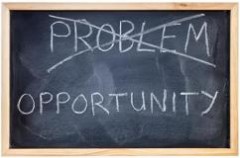
    What if, though, the employee was not the problem?

    What if problems elsewhere in the company were creating a situation in which no employee would look good?

    What if their negative attitude was a self-protective response to your harsh, arbitrary and/or imperious leadership style?

    What if their uncooperativeness was a response to the competitive bonus program in your compensation structure?

    In this week’s podcast discussion, Claudia and I take a closer look at the problem of poor employee performance.

    When acceptable performance becomes a problem, are we jumping too quickly to blame and punishment?

    Could there be aspects of your corporate structure, culture, or your own leadership methods that might be setting the stage for poor performance?

    Listen in.
    Just now joining the conversation? Catch up on the entire series here.
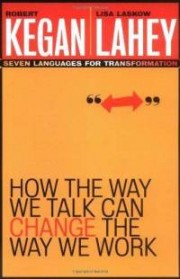
  • Karl’s Library: How The Way We Talk Can Change the Way We Work by Kegan and Lahey

    Set aside what you’re currently reading about leadership.

    If you want to transform your impact as a leader, you need to pick up a copy of How the Way We Talk Can Change the Way We Work by Robert Kegan and Lisa Laskow Lahey.

    Have you ever considered than an annoying employee complaint might also be a valuable personal value needing expression?

    Have you ever withheld an idea for improvement so your supervisor wouldn’t feel criticized?

    Kegan and Lahey provide an entirely new perspective on leadership by paying attention to how we talk to each other.

    They point to seven changes we can make in how we communicate that will reframe how we approach problems and result in lasting change.

    Seven Languages for Transformation

    1. From the language of complaint to the language of commitment
    2. From the language of blame to the language of personal responsibility
    3. From the language of New Year’s resolutions to the language of competing commitments
    4. From the language of big assumptions that hold us to the language of assumptions we hold
    5. From the language of prizes and praising to the language of ongoing regard
    6. From the language of rules and policies to the language of public agreement
    7. From the language of constructive criticism to the language of desconstructive criticism

    The shift we need to make as leaders is internal. When we see the conversation differently ourselves we will be able to have a different sort of conversation with others.

    You can continue to blame the rest of the team for their shortcomings. You may even be accurate in your assessment. But you will not see change.

    When you’re ready to try something new, try taking a look at how “the way you talk affects the way the team works.”

    You can get a copy of the book here.

    Karl’s Library is a weekly column highlighting my favorites from my professional development library. “Always learning” is one of the pillars of my personal mission statement. Explore past columns here.


    If you’re a Kindle fan like I am, it is available for the Kindle.

    Don’t have a Kindle? Get one! You’ll love it.

  • Listen In -> Employees… What Are They Good For? #1: Expense or Asset?

    You’ve met them both.

    One is the leader who views their employees as an expense to be minimized.

    The other is the leader who views their employees as an asset into whom to invest.

    The one is most often at odds with their team. Cracking the whip to make sure no one is slacking off. Squeezing out every last drop of effort, delaying promotions, denying vacations, and doing their best to protect the company from the unfortunate necessity of needing more hands and feet to get the job done.

    The other leader is grateful to surround him or herself with a complementary set of skills, experiences, working styles and passions.

    This leader is most often working in concert with their team. Building on strengths, strengthening weaknesses, expressing confidence, extending trust, and celebrating aggressive goals achieved.

    Working with people, of course, has both its ups and downs. What is significant though is the beginning lens through which you choose to views these problems and opportunities.

    Are your employees are an expense to minimize or an asset to maximize?

    The lens you choose will have a radical impact on how you deal with four common employee problems.

    Employees… What Are They Good For?
    Week 1: Expense or Asset?
    Week 2: The Problem of Finding Good Employees
    Week 3: The Problem of Retaining Good Employees
    Week 4: The Problem of Poor Employee Performance
    Week 5: The Problem of Stagnant Employee Progress

    What lens do you use when addressing employee problems? 

    Listen in.

    Each week the conversation will continue. Catch up on the entire series here.
  • Intractable Problem? Where To Look First

    Problems by definition are messy, complex affairs not lending themselves to simple solutions.

    Time has gone by. Unhealthy patterns have developed. Perceptions have hardened. Inefficient practices have become policy. Power struggles have morphed into a hierarchical bureaucracy.

    The process of problem solving… that is, the unraveling, the sorting out, the rethinking, the insightful critiques, the fresh alternatives, and the bold decisions needed can neither be delayed nor rushed.

    One thing, though, is simple. Where to start. While there is no telling where the process will end up, we know right away where to begin. (more…)

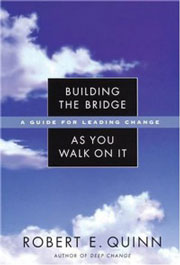
  • Karl’s Library: Building The Bridge As You Walk On It by Robert Quinn

    The perfect metaphor for describing the task of leadership today.

    With constant and rapid change being a decision-making reality, leaders no longer have the luxury of planning for futures that are either predictable or stable for any period of time.

    Robert Quinn was one of the first to address this issue in Building The Bridge As You Walk On It.

    Both visionary and practical Quinn helps us see how we can actively participate in building the future even as it emerges in many ways beyond our control.

    Eight practices characterize the leader who functions in what Quinn indentifies as the “Fundamental State of Leadership”:

    1. Reflective Action
    2. Authentic Engagement
    3. Appreciative Inquiry
    4. Grounded Vision
    5. Adaptive Confidence
    6. Detached Interdependence
    7. Responsible Freedom
    8. Tough Love 

    Each noun and its complementary adjective in the list are carefully chosen and combined.

    I use this book in my “No Excuses WORKout” coaching cohorts, and cannot say enough good things about it.

    Order your copy today.

    Karl’s Library is a weekly column highlighting my favorites from my professional development library. “Always learning” is one of the pillars of my personal mission statement. Explore past columns here.


    If you’re a Kindle fan like I am, it is available for the Kindle.

    Don’t have a Kindle? Get one! You’ll love it.

  • Listen In -> Posture of Strategic Readiness with Van Wray #1: The Adjusting Process

    From the way many leaders approach strategic planning, you’d think they owned crystal balls.

    They seem to have confidence that the future is going to be exactly as they expect and make huge decisions and long-term commitments accordingly.

    Not so! argues our special guest, Van Wray of Amperant Advisors who joins us for a new podcast discussion series entitled “Posture of Strategic Readiness.”

    Wray asserts that strategic planning needs a serious rethink, and, over the next five weeks, will be resourcing us with the tools to do just that.

    The metaphor of physical posture is striking and powerful.

    I think of the tennis player poised on the balls of their feet ready both to execute their own strategy as well as react to whatever comes at them.

    If what comes at them is not what they expected, then they are ready to adjust… immediately (because they are prepared), instinctively (because they are trained), and, yes, strategically (because they never relinquish leadership of the game).

    In this week’s discussion Van and I confront the reality that the future is not nearly as clear cut as we’d like to think. The many unknowns that lie ahead, though, need not worry or stop us from making aggressive plans.

    We simply need to make a different sort of plans. Plans that have enough room in them to welcome the future. Plans that have enough flexibility in them to adjust along the way.

    You are going to want to meet Van Wray. He is an insightful, practical, and encouraging leader, coach, and ally.

    Join us over the next five weeks for what will be a transforming discussion.

    Posture of Strategic Readiness
    Week #1: The Adjusting Process
    Week #2: The Stop and No Lists
    Week #3: The Sumo Wrestling Goals
    Week #4: The Built-In Slack
    Week #5: The Anticipated Decisions 

    Listen in.

  • Listen In -> Bold Resolutions for the New Year #2: Think Outside the Box

    Far too many of us are waiting for the economy improve before we make important decisions and commitments of our own.

    I suggest this is the case because most of us are waiting until we know it is safe to go back to doing things the way we did before our economy’s near collapse and this extended recession.

    I am almost certain that the only viable way forward will not be found in going backwards. In fact, business may never be successfully done again the way it was before 2008.

    To move forward aggressively and responsibly, though, we need to get our thinking out of the rigid box that limits us to the values, methods and means of the past.

    We need new perspectives, new frames of reference, and new approaches.

    In this week’s show, Claudia and I discuss making one of our “Bold Resolutions” for the new year to think outside the box.

    Not crazy, impulsive, rash thinking. But creative, non-linear, and proactive thinking.

    Listen in.

    Just now joining the conversation? Catch up on the entire series here.
  • Business Book Awards from 800-CEO-Read

    My reading list just gets longer and longer.

    800-CEO-Read announced their 2011 awards for best business books.

    You can read the entire book summaries on their blog post here.

    The winners are:

    General Business


    Leadership


    Marketing and Sales

    Entrepreneurship


    Personal Development


    Finance & Economics

    Innovation & Creativity


    Management

    Head over to 800-CEO-Read’s website and check out the many resources they make available.

    Enjoy!

  • Clippings from Don: Dumping the Dreaded Performance Review

    Everybody hates performance reviews. As much is not news to anyone.

    More interesting is the lack of creativity in designing meaningful and effective alternatives. 

    In this morning’s Wall Street Journal, Rachel Emma Silverman takes a look at the fading allure of this rigid, intimidating and counter-productive time-waster.

    Teams need to be able to communicate about their work. Everyone needs to be able to give constructive and timely feedback to those with whom they work.

    The problem with most performance evaluation processes is that they function exclusively as a top-down tool for ineffective leaders to communicate the negative feedback they didn’t have the courage or grace to communicate throughout the year.

    Two major problems result. The climate of judgment and intimidation makes even the most competent employee reticent to be honest about their (more…)

  • Favorite Authors: Peter Block

    This week’s author favorite is Peter Block.

    Much of his attraction to me is our shared confidence in the intrinsic value and, I would even say, genius of every individual person.

    What any given person has to offer comes from the depths of who they are, not from what has been added to them from outside sources such as schools and seminars and workshops.

    While people can be trained in skills, informed of required procedures, and be given aggressive goals to achieve, nothing can replace tapping into and empowering their core passions, values and dreams.

    When he writes of professional development, he writes of getting to know yourself and building from the inside out.

    When he writes of leadership, he writes of empowering those who work for you.

    We are reading one of his books, The Answer to How Is Yes: Acting on What Matters, chapter by chapter in our Thought Leaders Unpacked™ series.

    You can find Peter Block on the web at: http://www.peterblock.com/

    Must Read Books

    The Answer to How Is Yes: Acting on What Matters

    Stewardship: Choosing Service Over Self Interest

    Community: The Structure of Belonging

    Flawless Consulting: A Guide to Getting Your Expertise Used

    Pick anyone of these gems to start with. But, please don’t put off getting to know Peter Block.

    Favorite Authors are those unique writers whom I believe are worth reading everything they have written. Explore all my favorites here.