Karl Edwards presents Working Matters

Tag: leadership

  • Clippings from Don: Who Needs a Desk When You Have a Lap?

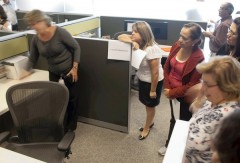
    Office workspace is shrinking. So observes Roger Vincent in Wednesday’s Los Angeles Times.

    Vincent does his best to observe an insightful emerging trend, but I can’t help suspect a desperate cost-cutting ploy.

    With the rapid embrace of mobile technology and the integrated lifestyles of the young emerging professional, the need for dedicated office real estate for each individual’s private usage may not be a valid starting assumption for planning purposes.
    On the other hand, we must recognize that there exist leaders who consider employees an unfortunate and painfully necessary expense; and who upon any excuse whatsoever will eliminate, minimize and/or squeeze any outlay related to them.

    One set of leaders observes the changing nature of work, communications, lifestyles, and office space and sees an opportunity to redesign workspace to make the office an even more useful, productive and appropriate source of resources.

    The other set of leaders hears of these developments and discovers a source of excuses to use in their quest to squeeze as much as possible from every employee for as little as possible, whether or not it results in actual benefits to the bottom line.

    Which type of leader are you? In one case, you stand to increase employee loyalty and company results designing office space around actual usage. In the other case you risk alienating the very people you need to succeed in your desperation to save a buck or two cutting wherever and whenever possible.

    Read Vincent’s full article here.

    Voracious reader friend Don Silver always has an eye out for what interests me. Clippings from Don is a column where I pass on some of these articles, stories and resources to you.
  • Listen In -> Lies and Myths We Believe About Work #5: Making Waves is Making Trouble

    Fear is a tricky foe.

    Fear often fools us into keeping to ourselves valuable information that might help the team as a whole because it is difficult information for some.

    In order to protect ourselves from the fall-out that any difficult information would ignite, we withhold the information altogether. The result is that the team does not benefit from our contribution, insight, and/or perspective.

    Pointing out what is not working well is more commonly known as “making waves.” It gets this derogatory name in order to intimidate us away from getting involved.

    Insecure leaders views all forms of feedback (however constructive) as negative judgment on their competence. If they can create an even more negative perception of those who offer alternatives (make waves) then many of us will withhold our feedback. We don’t want to be perceived negatively, after all!

    In this week’s show, Claudia and I discuss this twisted and counter-productive logic, better known as, “making waves.”

    Listen in.

    Just now joining the conversation? Catch up on the entire series here.
  • Question of the Week #23

    What is involved in helping your team adjust to the loss or addition of a key member?

    The Question of the Week is offered to increase awareness of one’s personal leadership practices and encourage experimentation with creative alternatives.
  • Listen In -> Lies and Myths We Believe About Work #3: You Have to Prove Yourself First

    This week’s lie would have us believe that we should prove our ability even though no opportunity has been afforded us to do so.

    How’s that for being caught between a rock and a hard place?!

    They’ll consider us for a supervisor role once we’ve proved that we can supervise. We can manage the budget once we can show a budget we’ve successfully managed.

    Join Claudia and I as we look into yet another career-wasting trap: “You have to prove yourself first.”

    Earning someone’s trust or building someone else’s confidence in your capabilities can be a no-win predicament. While you can work hard, learn quickly, and offer excellence, you can never control what makes another person willing to trust.

    Some people simply do not trust easily. Some people never trust anyone other than themselves. If you have one of these people as your boss, you could be spinning your wheels trying to prove yourself.

    They benefit from the extra efforts you invest, while you continue to wonder how high you need to jump.

    Stop wondering and join the conversation here on Working Matters.

    Listen in.

    Just now joining the conversation? Catch up on the entire series here.
  • Listen In -> Lies and Myths We Believe About Work #2: You Don’t Have What It Takes

    Are you giving away your best professional years trying to meet a standard that doesn’t exist?

    One of the both cruelest and emptiest barbs insecure people in power like to ambush people they do not understand with is, “You don’t have what it takes.”

    In this week’s podcast discussion, Claudia look at this unhelpful, diminishing, spirit-crushing accusation.

    What’s most interesting about this vague accusation is that it has no criteria by which we can demonstrate otherwise. There is no way to measure up. There is no “what it takes” being discussed.

    Whatever it is, though, you don’t seem to have it. This would be laughable if it were so hurtful.

    Do you find yourself giving vague accusations such as this one more power over you than they deserve?

    Listen in.

    Just now joining the conversation? Catch up on the entire series here.
  • Sustainable Excellence at Milken Institute Forum

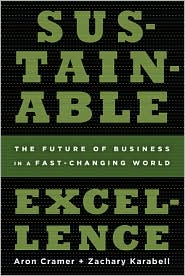
    The Milken Institute Forum last night was excellent. Aron Cramer and Zachary Karabell were there discussing their new book, Sustainable Excellence: The Future of Business in a Fast-Changing World.

    Theirs was not a morality play. That is, they did not discuss sustainability as a moral precept on behalf the planet’s survival, humanity’s future and the kumbaya warmth of being good and doing better. So many activists rely on a liberal pseudo-religious elitism that manipulates conformity to one’s agenda based on threatening to label people something they would find horrible like, “ignorant,” “narrow-minded,” or “greedy.”

    Cramer and Karabell discussed sustainability from a business perspective.

    It makes business sense to integrate issues of sustainability into the heart of one’s business strategy. Good stewardship of one’s business goes hand in hand with good stewardship of our resources.

    While both authors were morally committed to sustainability, they did a good job of describing their research into a phenomenon of the last several years wherein leadership, creativity, and innovation in sustainability is coming from the business world, not the non-profit activist organizations or governments. They also described how they believe business is best positioned to both design and act upon meaningful change in an effective and timely manner.

    I look forward to this read. I have long believed that only the business context has the necessary combination of systemic financial motivations, human and capital resources, and decision-making flexibility to provide the sort of creative leadership necessary to give shape and form to the emerging future.

    Where and to whom do you look for meaningful change?

    On your side,

    – Karl Edwards

  • Question of the Week #21

    How would it affect your leadership style if you considered yourself accountable to your staff instead of your supervisors?

    The Question of the Week is offered to increase awareness of one’s personal leadership practices and encourage experimentation with creative alternatives.
  • Thought Leaders Unpacked -> The Soul of a Leader #9: Finding Spiritual Guidance

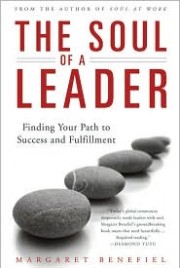
    thought-leadersIt’s always difficult to conclude a series. Especially a series as rich as this one. Margaret Benefiel has given us a great gift with her book, The Soul of a Leader.

    She concludes by addressing one of the primary dysfunctions of leadership in America. I call it the myth of the strong, competent, and isolated leader.

    Unlike athletes, for example, leaders seem to believe that their work must be done alone in order to qualify as legitimate leadership. An athlete surrounds her or himself with coaches, doctors, advice, and support of all sorts. Athletes know they cannot learn, succeed or even survive on their own.

    Leaders, on the other hand, seem possessed by a demon that is ever threatening to expose them for the frauds they are afraid they might be. Consequently they direct all their energies to proving that they are completely competent, sufficiently strong and absolutely independent in their role.

    When Benefiel asserts that spiritual guidance is a crucial form of support for leaders in today’s business world I have to cheer.

    We need another set of eyes and ears in our life. We cannot remain focused, keep things in perspective, plan for the future, address emergencies, build enterprising teams, and sustain the energy, enthusiasm and spirit required to lead an business on an on-going basis. And that’s only a partial list of a leader’s role!

    The key in considering spiritual direction is believing that having someone else watching and listening with you will be of value. The spiritual dimension of life in (more…)

  • Thought Leaders Unpacked -> The Soul of a Leader #8: Persevering to the End

    thought-leadersWhen consistently engaging in practices of human wholeness and integrity something “subtle” takes place. Transformation.

    This has been my favorite and most challenging chapter of this book. I am still wrestling with the notion that the “dark night of the soul” has an impact on one’s business life as well as one’s spirituality.

    Of course, you say. Of course, I say!

    A big mistake of modernity has been to compartmentalize spirituality away from other categories of work, life and relationships.

    Of course one’s journey of personal maturity includes and impacts all areas of life. Even work. Especially work.

    Benefiel courageously takes on perseverance in light of those tumultuous, disorienting seasons of life when the assumptions that have guided us to date collide with a deeper, richer, larger reality.

    A medieval scholar, St. John of the Cross, is most famous for observing and describing how the spiritual journey includes seasons of such enormous disorientation that all ways seem dark, lonely, and impassable.

    But we live busy lives of work, family, community involvement, political activism, etc. How do we accommodate an extended season of difficult (more…)

  • Thought Leaders Unpacked -> The Soul of a Leader #6: Battling for the Soul

    thought-leaders“When things aren’t going well, the temptation to allow the soul to erode is strong.” (p. 101) Aptly put.

    Considering that all businesses rely on people to get their work done, it always amazes me that so many leaders do not do everything in their power to make sure their teams are playing at the top of their professional games. In fact, many do not even factor the human component into their thinking and planning.

    Soul erosion.

    I have long taught that there are three “hard facts” about working with people that any leader must come to terms with if they want their teams to succeed. One is that people need to contribute and make a difference. Second, people need to grow and develop. And third, people need to connect and belong.

    Ignore any one of these three “hard facts” and you are merely erecting your own obstacles.

    Margaret Benefiel is calling for this sort of honest assessment of one’s commitment to people. It’s not lip service. It’s looking at one’s practices, policies and behaviors, and assessing the effect they have on those in your professional care. If the effect is negative, harmful, or even dismissive, then you are—like it or not—fostering “soul erosion.”

    Fact. People add value when they get to show up as people. Diminish the human (more…)