Karl Edwards presents Working Matters

Tag: teams

  • Listen In -> Employees… What Are They Good For? #2: The Problem of Finding Good Employees

    We’ve all received them. The polite email thanking us for our job application, but with regrets declining the opportunity to meet us in person.

    The computer, it seems, decided that since the job requisition form specified a minimum of five years of experience and we only had four years of experience, that there would be no reason to explore our qualifications further. 

    Can such talent search methods be serving us well? Could it be that our standardized job descriptions, computerized key word searches, and the use of unformatted text-only resumes are eliminating valuable candidates before we even have a chance to meet them?

    In this week’s podcast discussion, Claudia and I look at the problem of finding good employees.

    The challenge in a tough economy—when we’re receiving possibly hundreds of applications for any given opening—is how to make sure we’re meeting the unique, real-life people who would be the best fit for our team.

    The options at either end of the spectrum aren’t practical. We cannot personally interview every single applicant.  The computerized culling cannot take into account important intangibles like industriousness, team spirit, creativity, working styles, or communication abilities.

    How do we make sure we’re meeting and hiring the best people available?

    Listen in.
    Just now joining the conversation? Catch up on the entire series here.
  • Listen In -> Employees… What Are They Good For? #1: Expense or Asset?

    You’ve met them both.

    One is the leader who views their employees as an expense to be minimized.

    The other is the leader who views their employees as an asset into whom to invest.

    The one is most often at odds with their team. Cracking the whip to make sure no one is slacking off. Squeezing out every last drop of effort, delaying promotions, denying vacations, and doing their best to protect the company from the unfortunate necessity of needing more hands and feet to get the job done.

    The other leader is grateful to surround him or herself with a complementary set of skills, experiences, working styles and passions.

    This leader is most often working in concert with their team. Building on strengths, strengthening weaknesses, expressing confidence, extending trust, and celebrating aggressive goals achieved.

    Working with people, of course, has both its ups and downs. What is significant though is the beginning lens through which you choose to views these problems and opportunities.

    Are your employees are an expense to minimize or an asset to maximize?

    The lens you choose will have a radical impact on how you deal with four common employee problems.

    Employees… What Are They Good For?
    Week 1: Expense or Asset?
    Week 2: The Problem of Finding Good Employees
    Week 3: The Problem of Retaining Good Employees
    Week 4: The Problem of Poor Employee Performance
    Week 5: The Problem of Stagnant Employee Progress

    What lens do you use when addressing employee problems? 

    Listen in.

    Each week the conversation will continue. Catch up on the entire series here.
  • Karl’s Library: Vital Friends by Tom Rath

    The myth of the independent, diversely-competent, always-together person must be hunted down wherever it still reigns and destroyed once and for all.

    It’s destroying more people and all workplace cultures where its lies are still blindly obeyed.

    Human beings don’t do life alone.

    Human being can’t do life alone.

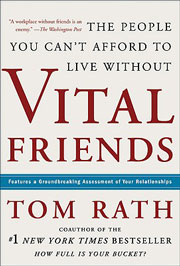
    Fortunately, Tom Rath has taken a look at friendship and work in Vital Friends: The People You Can’t Afford To Live Without.

    Would you believe, “that people who have a ‘best friend’ at work are seven times as likely to be engaged in their job?!”

    Take note of the eight vital roles Rath asserts we need surrounding us:

    1. Builder
    2. Champion
    3. Collaborator
    4. Companion
    5. Connector
    6. Energizer
    7. Mind Opener
    8. Navigator 

    You don’t have to be a “warm and fuzzy” type to appreciate the value of most of these roles.

    This book is an invitation to connect with others in ways you may not yet have considered.

    This book may even be a helpful wake-up call to those of us who tend to isolate and go it alone.

    Order your copy today.

    Karl’s Library is a weekly column highlighting my favorites from my professional development library. “Always learning” is one of the pillars of my personal mission statement. Explore past columns here.


    If you’re a Kindle fan like I am, it is available for the Kindle.

    Don’t have a Kindle? Get one! You’ll love it.

  • Listen In -> Bold Resolutions for the New Year #3: Build a Team, Not Fill a Job

    One of the great self-defeating strategies of team building is the practice of culling resumes with numeric and search engine based criteria.

    Thousands of talented, appropriate and possibly “best fit” candidates are never met, because their resumes were thrown in the trash based on missing “key words”, arbitrary experience requirements, and other impersonal and unhuman criteria.

    In this week’s show, Claudia discuss the need to build teams rather than fill job openings.

    The annual “All-Star” games in many team sports made up of the best players from all the teams, do not result in the two best teams.

    The order is important. We need thriving teams in order to function at the level necessary to create a way out of our economic doldrums.

    A job opening is merely the existing set of tasks that the former employee did. It does not consider what might be possible given what the new hire brings to the table.

    The question is, will you ever know? You may have just thrown the most promising resume in the trash because it showed six years of experience instead of seven.

    Listen in.

    Just now joining the conversation? Catch up on the entire series here.
  • Listen In -> The Hard Facts of Working with People #4: People Need to Connect and Belong

    While some people prefer to work alone than in a group, all people need to be a part of a working community of other people.

    The rare bird who is a true loner would most likely not work for a company, opting instead for some sort of independent structure.

    This week’s show is about the hard fact that people need to connect and belong.

    We need to belong to a community with a mission that is larger than ourselves. We need to be an integral part of making that mission succeed. (Remember the hard fact about making a difference?)

    There is simply no escaping the reality that this process includes working with others. But working with others runs deeper than the functional necessity of most tasks requiring more than one person to complete them.

    Working together involves a process of connecting and belonging that is core to being human.

    Keep roles and responsibilities anonymous and impersonal at your own risk. Want to know why?

    Listen in.

    Just now joining the conversation? Catch up on the entire series here.
  • Listen In -> The Hard Facts of Working with People #1: Replaying a Timely and Helpful Series

    “If I had a nickel for every time someone referred to working with people as “the soft side of business” I’d be a millionaire.”

    What I said several years ago when this podcast first aired still holds today.

    It is precisely because of this disastrous fallacy about working with people that we are replaying this important series during our vacation season at Bold Enterprises.

    Far from being the soft side of business, working with people is filled with hard realities that, unless faced, will undermine even the best laid plans.

    Just because the human element is difficult to quantify and doesn’t show up neat and tidy in the financial reports, doesn’t mean that it isn’t one of the central keys to success in your workplace.

    You invest in state of the art technology. You conduct thorough and ambitious strategic planning. You invest in the best in marketing and sales. You keep a lid on unnecessary costs.

    But too many of us are dismissing, ignoring or overlooking the highest impact investment of all… our people.

    The Hard Facts of Working with People
    Week #1: Facing the Facts about a Timely and Practical Reality
    Week #2: People Need to Contribute and Make a Difference
    Week #3: People Need to Learn and Develop
    Week #4: People Need to Connect and Belong

    Listen in.

    Just now joining the conversation? Catch up on the entire series here.
  • Karl Shares Six Words… #11


    Skeptical about the training retreat bribe.


    Karl Edwards

  • Question of the Week #23

    What is involved in helping your team adjust to the loss or addition of a key member?

    The Question of the Week is offered to increase awareness of one’s personal leadership practices and encourage experimentation with creative alternatives.
  • Thought Leaders Unpacked -> What the Dog Saw #18: The New-Boy Network

    thought-leadersFirst impressions stick. While strangely enduring, these impressions are not necessarily accurate.

    In this week’s chapter of What the Dog Saw, Gladwell explores how much weight we give our first impressions and the misleading conclusions we too readily draw.

    What-the-Dog-Saw

    The result being, “we replace the obviously arbitrary with the not so obviously arbitrary.” This one quote is worth the price of the entire book.

    I have long advised that the traditional interview process of hiring is fraught with pitfalls given the brief and artificial nature of the structure.

    All involved are putting on their best social personas in order to make a positive impression. Interviewers usually omit disclosing anything negative about the working culture of the organization. Applicants are careful to use the wordings and examples that they have been told the employer wants to hear.

    Now on top of these practical limitations, Gladwell reveals how often most people don’t let any of this information inform their initial gut impressions anyway. We replace one set of fallacious information with another.

    Our lengthy interview processes don’t feel arbitrary, but if they aren’t providing valid or meaningful information that is resulting in any better hiring results, why should we bother?

    Is it all a waste? Should we conduct all our hiring at social mixers and simply select the people we enjoy the most?

    As Gladwell concludes, maybe all that is necessary to secure your next job, get your next promotion, or possibly even win your next date is to, “speak clearly and smile.”

    What do you think? What was your main take-away from this chapter?

    Each week I post my reflections from one chapter of What the Dog Saw by Malcolm Gladwell. If you are just joining the discussion now, welcome! Catch up on the entire series here.
  • Question of the Week #13

    What is the difference between having a distinct working style and not being a team player?

    The Question of the Week is offered to increase awareness of one’s personal leadership practices and encourage experimentation with creative alternatives.