Karl Edwards presents Working Matters

Tag: leadership

  • Thought Leaders Unpacked -> What the Dog Saw #17: The Talent Myth

    thought-leadersPretty sobering to read that the company which believed in and practiced talent-based hiring and promoting was Enron.

    Assessing performance instead of potential. But performance cannot be measured when promotions are taking place within the span of an evaluation cycle.
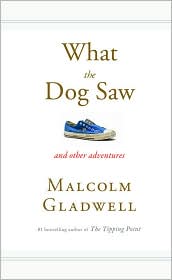
    What-the-Dog-Saw

    We tend to describe ourselves by the categories used by those with power. But those categories do not always (if even very often) either help us describe or understand reality accurately.

    Gladwell suggests that the system is the star in companies that consistently thrive.

    Different systems serve different strategic needs better. Whether highly centralized or decentralized, there is no one-size-fits-all “best” management system.

    What intrigues me most is our enduring desire to find the “magic” answer. Which is the “correct” or “best” management system? What leadership style is most effective? Tell me, expert, tell me. Don’t make me think. Don’t make me choose. Give me another book. Find me a more authoritative guru.

    This chapter makes me feel a bit proud that we at Bold Enterprises help leaders discover and develop their own individual “leadership poise.” The stance from which and out of which you observe, reflect, act and adjust on an on-going, non-formulaic basis.

    Instead of searching for “the right answer” we become proficient at raising the right questions. The way forward through uncharted territory (the future) is not going to be found on any map. Becoming better map readers is not the skills leaders need in these times of rapid change.

    How does one become a better explorer in a culture of competence, perfection and short-term measurements?

    What do you think? What was your main take-away from this chapter?
    Each week I post my reflections from one chapter of What the Dog Saw by Malcolm Gladwell. If you are just joining the discussion now, welcome! Catch up on the entire series here.
  • The Way We’re Working Isn’t Working

    American managers are in denial about the fact that their teams are comprised of human beings.

    Content with a data-defying strategy of squeezing as much work as possible out of their teams for as little compensation as possible, these self-congratulating fools close their eyes to the facts and resort to childish name-calling (e.g. “soft”) to anyone who dares suggest that human physiology and psychology are important factors in workplace productivity.

    What if there were facts, though, about how people work that could multiply your productivity with only incremental additional costs?

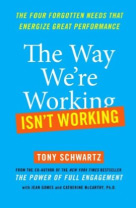
    I’m excited to come across a kindred spirit in Tony Schwartz in his new book, The Way We’re Working Isn’t Working.

    I’ve long advocated that people are an amazing, if complex, asset into which we should invest not a faceless, annoying expense that we should minimize.

    Schwartz provides invaluable insights into how the human beings function and provides the practical means to transform these insights into a more energetic, renewing, and yes, productive workplace.

    Specifically he looks at human physiology, emotions, our minds, and our spirituality. Far from hyping the latest feel-good fad, Schwartz methodically supports his case with data. If you look at the facts, certain things are true about what makes people thrive, commit, care, and work hard. On the downside, certain factors cause people to wear down, avoid risk, blame others and otherwise distance themselves from their work.

    Far from being “soft,” it is those leaders who have the courage, honesty and wisdom to face what I describe as “the hard facts about working with people” who have the mettle it takes to face the complex issues facing business going forward.

    Gone are the days where people can be reduced to inter-changeable commodities to be discarded at the first sign of trouble.

    Tony Schwartz is a must-read resource for any leader hoping to work effectively with people going forward.

    On your side,

    – Karl Edwards

  • Question of the Week #17

    How do you affirm and encourage risk-taking without reducing your demand for results?

    The Question of the Week is offered to increase awareness of one’s personal leadership practices and encourage experimentation with creative alternatives.
  • Listen In -> Visionary Leadership with Marion Skeete #5: Cultivating a Language for Change

    How does a leader speak boldly without robbing others of their voices?

    Who gets a voice in the conversation of work, leadership, collaboration and the goals of the organization?

    We conclude our series with Marion Skeete of LegacyMakers International with a discussion about how difficult it is for most leaders to surrender their excitement about their own personal ideas in order to pay attention to and incorporate the ideas of the rest of the team.

    How does the leader stand with integrity in the tension between owning their responsibility to show up, engage and lead on the one hand, and showing deep respect for the participation, contribution, and dreams of the wider community on the other?

    Could the leader’s empowerment to lead be woven into how well they empower the community to embrace the stewardship of their own lives?

    How do you view the role of the leader?

    Listen in.

    Just now joining the conversation? Catch up on the entire series here.
  • Question of the Week #16

    How will postponing the decision you are trying to make really improve the decision you end up making?

    The Question of the Week is offered to increase awareness of one’s personal leadership practices and encourage experimentation with creative alternatives.
  • Listen In -> Visionary Leadership with Marion Skeete #4: Respecting and Involving People

    Is the leader so ordained because she is better, smarter, more knowledgeable, better in any way than everyone else on the team or in the community?

    Does following a leader involve turning off our brains and compliantly doing what we are told?

    Is the leader the author of a vision that emerges from his or her own imagination? Or is the leader the servant of a vision that emerges from the unfolding story of the community?

    In week 4 of our series on Visionary Leadership with Marion Skeete our discussion turns to the voices that are and are not included in the conversation about where we are going and how we do things.

    Could it be arrogant and inappropriate for the leader to assume that anyone who cannot get on board with the leader’s vision is better off not being in the community or organization at all?

    If you feel like you’re on the outside of your organization looking in, then this show is for you.

    Listen in.

    Just now joining the conversation? Catch up on the entire series here.
  • Listen In -> Visionary Leadership with Marion Skeete #3: Inspiring and Catalyzing Change

    Are you as tired as I am of hearing leaders complain about resistance to change?!

    The leader is always right and the people are always wrong. It’s the leader’s job to effect change by bringing the people running gratefully out of their “wrong” and into the leader’s “right.”

    Anyone who voices any practical or conceptual problem with the leader’s vision is labeled, “resistant to change.” It’s as if the story was about the leader!

    Enter Marion Skeete of LegacyMakers International for week three of our discussion on Visionary Leadership.

    What if the story, in fact, belonged to the community?

    What if the unfolding future was comprised of the real life unfolding stories of the individuals, families, teams and organizations that leaders serve?

    What if the only conversations about the future that might really result in change were those conversations that included the people who were themselves maturing into those changes?

    Vision would not be something dreamed up by the leader in isolation and announced one day, but something already transpiring that the leader observes and articulates in such a way that helps the community interact, engage, and embrace.

    What if catalyzing change involved nurturing an already existing ember, rather than pouring fuel on a damp wood and striking a match?

    Listen in.

    Just now joining the conversation? Catch up on the entire series here.
  • The Visionary Leader: Captain or Mid-Wife?

    I find myself rethinking vision and leadership.

    Who do you know who seems to see what no one else sees? Not because no one else has eyes, but because no one else is looking.

    Visionary leadership is not about seeing something entirely new as much as it is about seeing what is already there unfolding in a way no one else yet expects. Just as our brains filter out most of the visual data in our field of vision so that we can pay attention to what is most important, so in our busy and complex lives many of us may not be able to see what is unfolding right in front of us.

    The visionary leader is more rarely the source of brand new ideas. She or he is rather the highly aware and deeply reflective one for whom all persons, events, stories, dynamics, and trends are precious and meaning-laden data.

    What distinguishes the visionary is the capacity to interpret this flood of information from a variety of vantage points. It is as if he or she is rearranging the tiles in a mosaic so that entirely different pictures emerge than the otherwise obvious one that everyone up until that point had been convinced was the only one.

    What we encounter in many hierarchical organizations are positional leaders who aspire to be perceived as visionaries. (A common cultural bias.) They consequently “do vision” out of their hierarchical frame of reference, which is to act as the primary idea generator, strategy definer, and program creator.

    The significance of distinguishing the personal skill from the organizational position lies in the very real possibility that the visionary leaders in your organization may not be the positional leaders. They may not even be on your radar screen. But they are there. Observant, reflective and influential.

    Think about it. Think through the people on your team. Think through people in other departments. What if someone in the accounting department could see in the numbers new possibilities for how you went about your work which you couldn’t see from your vantage point in operations? What if your receptionist understood your clients’ needs better from his or her perspective of helping than your marketing team could from their perspective of selling?

    And who has eyes and ears integrated enough with their heart and mind to watch these dynamics on a number of fronts and across a spectrum of personalities, roles, functions and processes? What kind of person does it take to see what ideas, directions and connections might be unfolding in enough time to participate in their emergence?

    Maybe “mid-wife” would serve as a better metaphor for visionary leader than “captain.” I wonder.

    What do you think?

    I think the emerging mosaic deepens and sharpens a bit more.

    This article flows out of recent conversations with Marion Skeete of LegacyMakers International. (These recordings are available on our web site and on iTunes.)
    As conversation always enriches and challenges, I find myself here needing to pause, reflect and adjust my conceptions of visionary leadership in light of my discussions with Marion.

    On your side

    – Karl Edwards

  • Listen In -> Visionary Leadership with Marion Skeete #2: Thinking Outside the Box

    How does a visionary leader communicate the “new thing” she or he sees when no one else sees it yet?

    And what if this new thing is something this leader is merely observing emerge from within the community she or he leads?

    In other words, how does one think outside of the box when much of the thinking is being done by others?

    In this week’s show, Marion Skeete of LegacyMakers International and I discuss how visionary leaders help “the story” of the community unfold and emerge.

    The story does not merely start over every time a power and control-based leader gets a new idea and starts shouting orders.

    Hence the importance of the empowering, listening visionary leader who can articulate where the story of the community needs to go next in terms of where the story of the community has been so far.

    Newness out of the old. A future integrated with the past. A maturing, developing, unfolding process of change.

    Listen in.

    Just now joining the conversation? Catch up on the entire series here.
  • Question of the Week #15

    How well does your team know what your priorities for them are?

    The Question of the Week is offered to increase awareness of one’s personal leadership practices and encourage experimentation with creative alternatives.