
Karl Edwards presents Working Matters

Tag: focus

  • Thought Leaders Unpacked -> Clutch #5: Fear and Desire

    thought-leadersThis chapter was a heart stopper for me. Fear and desire. Two ends of a spectrum that I have spent a lifetime trying to find the middle point. A mythical point that may not exist.

    Sullivan asserts that those with an articulate awareness of both what they want on the one hand and what they don’t want on the other possess a twin motivation that is more than the sum of the parts.
    I for my part instead of holding those twin motivations in steady tension with each other have probably been avoiding them.

    Standing in the middle is different than holding both extremes in tension. In the middle I have neither much I am working to avoid or much I am working to achieve. At the extremes I am working very hard to avoid certain fearful possibilities and to achieve certain very attractive dreams.

    My personal challenge out of this chapter is to adjust my strategy away from striving for the mythical middle point and toward the clear identification of where those powerful twin motivators of fear and desire find their expression in my story.

    Such reflection is going to require both courage and reflection. Self-awareness is a skill most of us spend a lifetime avoiding. And yet, even as I have advocated over the years for the unsurpassable value of self-awareness as a life and leadership core competency, I can feel the stakes go up when it comes to identifying what I fear and what I desire.

    Fear and desire can paralyze as easily as they can motivate. The status quo can feel safer than actively working against a negative line of outcomes or possibly failing at one’s efforts to achieve the positive line of outcomes.

    Can you articulate what you want? What you fear? Can you articulate them in such a way that they both become positive motivators for you to work toward?

    What was your main take-away from this chapter?

    On your side,

    – Karl Edwards

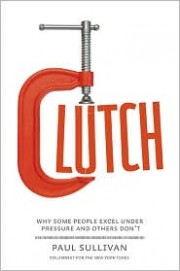
    Each week I post my reflections from one chapter of Clutch: Why Some People Excel Under Pressure and Others Don’t by Paul Sullivan. My reflections are my own and are intended to generate conversation, catalyze additional thinking and encourage mutual learning.
    If you are just joining the discussion now, welcome! Catch up on the entire series here.
  • Thought Leaders Unpacked -> Clutch #4: Being Present

    thought-leaders“Being present” is a term of great personal interest.

    Of all my professional traits and skills, the one I would describe as both my greatest strength and my favorite is my capacity to “be present.”

    For purposes of our discussion of Sullivan’s Clutch we need to be careful, because he uses the word slightly differently than you are used to hearing from me.

    Sullivan uses the theatre and stage acting to illustrate the characteristics of “being present.” When you are “on” you need to fully embody the character you portray. When you are “off” you are able to switch back and be yourself.

    Being present means the experience of each is an all-or-nothing affair. You are not thinking about acting, how you want to come across, your facial expressions, or the intensity of your voice. You simply become the character.

    It’s the self-consciousness that undermines the ability to be fully present in the role. It’s the extra thinking about what others are thinking, whether or not you’re effective, and what adjustments you might need to make that pulls you out of the role and sabotages your full engagement.

    As we translate the acting illustration into our own pressure-filled, time sensitive, clutch moments that require our being fully present, the key question (more…)

  • Thought Leaders Unpacked -> Clutch #3: Adapting

    thought-leaders“Fight the fight, don’t fight the plan.”

    Even while the subject of this chapter is “adapting,” it is interesting to me that we return to “focus” as the underlying capability that makes even adapting possible.

    Focusing on the outcome allows the decision-maker to adjust plans along the way without getting bogged down by a fallacious loyalty to the original plans.

    In other words, the issue is not implementing the plans as currently laid out, but achieving the outcome those plans were intended to achieve.

    As I have written elsewhere, the leader needs both proactive decision-making skills and reactive skills. The poised tennis player is as ready for whatever might come at them as they are prepared to execute their own game plan.

    In “clutch” situations (where ordinary skills need to be applied in extraordinary circumstances), pressure, immediacy, danger, the unexpected, and complexity conspire to muddle and/or overwhelm our senses.

    If we are not prepared or willing to pay attention to those complicating, unfolding realities, then our ability to make appropriate and relevant decisions will suffer.

    If we have the luxury of time, then we can take a step back and evaluate the data and adjust accordingly. If time is not available, we need to be able to make (more…)

  • Thought Leaders Unpacked -> Clutch #2: Discipline

    thought-leaders“Discipline is almost always a battle against yourself.”

    If there were one character quality or virtue that I both recognize my own need to develop and feel motivated to develop, it would be discipline.

    Paul Sullivan illustrates the power of discipline for withstanding, keeping a level head, and sticking to one’s game plan in the midst of enormous pressure. Having the ability to perform under pressure is, of course, the premise of his book.

    His stories are strong and persuasive.

    Having conceded that, what I think is called for at this point from us reading is an honest personal assessment about how close (or, more likely, far away) from these examples we are in our own mastery of a character quality such as discipline.

    It can be easy (I know it is for me) to want to identify with the “hero” of the story. In principle, I heartily agree with all that was said and done by these masterful practitioners. You’re nodding too, I can tell.

    The issue, though, on the path toward mastering discipline is how to learn the skill and developing it to the depth of a reliable character quality.

    Here we probe beyond the scope of our text.

    What exactly are we trying to develop when we speak of discipline? What is involved in becoming more disciplined?

    The results are enormously attractive and the outcomes are hugely impactful.

    But we are reading of people who have spent a career, if not a lifetime, building, honing, and refining their capacities to exercise discipline. These are not quick (more…)

  • Thought Leaders Unpacked -> Clutch #1: Focus (Part 1)

    thought-leadersAs I speculated in my post of October 28th, I have now indeed selected Clutch: Why Some People Excel Under Pressure and Others Don’t by Paul Sullivan to read for our next Thought Leaders Unpacked™ series.

    I have selected it for my own sake more than anything else. While I believe it holds great value for all of us who consider ourselves lifelong learners, I am looking forward to taking the spotlight of Sullivan’s insights and shining it on myself.

    I’m not so concerned that I might not show up well against the characteristics of “clutch” performers as I am with my ability to be honest about where I need to learn and improve.

    Chapter #1: Focus

    As we dive into the first chapter on Focus, I am initially struck by Sullivan’s method of using a single story to explain what all his research on focus reveals. I suppose I expected multiple stories making the multiple points. Once I settled in with his style, I became absorbed with his content.

    My first take-away came from distinguishing between focus and concentration. I would describe concentration as paying attention to one thing at the exclusion of everything else. She was concentrating so hard on her spreadsheet that she didn’t hear her phone ringing.

    Focus, on the other hand, I would describe as paying attention to one thing and seeing everything else in its light. She would not approve the corporate retreat (more…)

  • Loving Monday: Not the “Yes” But the “No”

    loving_mondayWe come into work with a multitude of projects, deadlines, people and tasks competing for our attention. In order to say, “Yes” to the one thing we are going to tackle next, we need to be able to say, “No” to everything else.



    Therein lies the trouble for most of us.

    Not the “Yes,” but the “No.”

    The difficulty arises because all the “No’s” will eventually need to become “Yes’s.”

    It would be easy to say “No” to bad things, wasteful things, useless things, ineffective things, destructive things. The challenge, though, is that in order to focus on one good thing, we need to say “No” to many other good things. Things to which we eventually will need to say “Yes.”

    Once we succeed in selecting the priority that will receive our undivided attention, the battle does not stop there. We find our minds continually justifying our decision to the voices of the “rejected” (i.e. postponed) options.

    All this thinking and rethinking is enough to drive a person crazy.

    I am one of those people who tends to rethink and over-think decisions that I’ve made. Interestingly enough, all the extra processing is not doing me any good. Instead of resulting in better decisions or timely adjustments in my decisions, the extra thinking is merely a stress-inducing and time-consuming distraction.

    Focus is the skill by which we not only learn to concentrate on one thing, but learn to tune out everything else.

    The ability to set other important matters aside in order to give one’s full attention to the matter at hand is no mean achievement and does not come naturally to most of us.

    Helpful to me has been to remind myself that I am saying “No” to so many things in order to get to them sooner. But I will never get to them if I am battling myself all the time. Therefore I clear my desk of everything else in order to have a better chance of eventually addressing everything else.

    We need to stop battling ourselves. We need to learn how to focus and push.

    Try clearing your desk of everything except the one item on which you’ve decided to focus. Use the uncluttered space as a training tool to help you concentrate. One thing on your mind… one thing on the desk.

    When finished pull out the next thing.

    Watch as all those “No’s” transform into “Yes’s… one by one.

    How do you deal with the competing voices calling for your attention? Leave a comment. Give me a call.

    I’m on your side,

    – Karl Edwards

    Loving Monday is a weekly column designed to encourage us to step into our weeks with an intention to show up authentically, engage fully, and choose to make it a good week for ourselves. Explore past columns here.
  • Clutch: Why Some People Excel Under Pressure and Others Don’t

    I heard Paul Sullivan speak yesterday at the Milken Institute in Santa Monica. The subject, of course was his book, Clutch: Why Some People Excel Under Pressure and Others Don’t.

    While much of the audience wanted to cling to a romantic definition of “clutch” that was significantly different than Sullivan’s, I thought he did a great job of carving out a specific angle that both set the stage for his research into extraordinary performers as well as make “clutch” performance attainable for anyone.

    Specifically, he is examining how some people can continue to do what they are capable of doing on an ordinary basis under pressure. The key being, “do what they are capable of doing on an ordinary basis.” This is not a book on heroics, luck or extraordinary achievements.

    I’ve already purchased my copy and am considering using Clutch for my next “Thought Leaders Unpacked” series so that we can think through Sullivans observations together.

    He works his way through five characteristics of “clutch” performers.

    1. Focus
    2. Discipline
    3. Adaptability
    4. Being Present
    5. Fear and Desire

    He also offers three reason why others do not perform well under pressure.

    1. Failure to take responsibility
    2. Overthinking decisions
    3. Overconfidence

    Keep your eyes and ears open for my decision about the next book we study together in “Thought Leaders Unpacked.” Clutch looks like an interesting, practical, and encouraging option.

    If you are in Los Angeles and not attending the Milken Institute’s free forums, you are missing out on a great resource. They invite extremely interesting people to introduce their latest books in the context of an open forum. There is time for Q & A and always a book signing.
    Thought Leaders Unpacked” is a regular column on this blog where we read a key book together, and I post my reflections on one chapter each week. My reflections are my own and are intended to generate conversation, catalyze additional thinking and encourage mutual learning.
  • Keeping It Real: Attending to Details

    I am not a detail person. Fact.

    Sometimes, though, I need to attend to details. Patiently and painstakingly work my way through every last jot and tittle. Systematically, thoroughly, exhaustively, completely, accurately, timely… you get the idea.

    I’m exhausted just thinking about it.

    Details, for us concept-people, represent a challenge of focus, discipline and perseverance.

    Focus. The sort of attentiveness required to spot and recognize necessary distinctions among the blur and whirl of facts, events and personalities is a capacity we can only dream of. (And we usually call those dreams, “nightmares.”)

    It’s like that children’s game, “Which of these pictures is different than the rest?” Detail-oriented people spot the distinction instantly, while the rest of us look and look and look. Not until we compare each and every feature of each drawing do we discover the difference.

    Discipline. The sort of patience required to look at something from every imaginable angle, follow through on every clue, look under every stone, is both a skill and a character quality that takes years for the uninitiated of us to develop.

    Like a chess game where one is thinking about all the possible future moves. (more…)

  • Loving Monday: Recovering From a Busy Weekend

    loving_mondayNormally we associate the weekend with rest. This time “off” work is our opportunity to refresh, recharge, rejuvenate, and restore our energies and spirits.

    Some weekends, though, are so busy that—even if most of our activities were great things—rest was not one of them.

    Which brings us to the interesting situation of finding ourselves needing a break on Monday morning instead of ready to dive back into work.

    I suppose we could push on through as if it were any other Monday morning. Or we could broadcast the news of our exhausted state to everyone as a way of lowering their expectations.

    I’m guessing that neither ignoring the reality of our weariness nor expecting others to compensate for us will work very effectively for us.

    What if we chose tasks and chores that don’t take a lot of brain power or inter-personal energy as a means for both working with the reality of your tiredness and ramping back up to full engagement?

    Organize your desk, sort through old email, finish your expense report, catch up on paperwork, or take care of a couple of chores. This way you’re not wasting time trying to focus on efforts for which you haven’t yet recovered your ability to focus. (Ever read the same paragraph repeatedly without any comprehension? –Waste of time!)

    It’s a matter of being able to recognize and assess your frame of mind, energy levels, and responsibilities, and then choosing the activities that are most constructive in light of those assessed realities.

    It’s Monday. We can begin by second-guessing our busy weekends, or we can move forward in light of them.

    I’m exhausted. I think I’ll take care of some filing.

    Loving Monday is a weekly column designed to encourage us to step into our weeks with an intention to show up authentically, engage fully, and choose to make it a good week for ourselves. Explore past columns here.
  • Loving Monday: Wind Down, Wind Up

    loving_mondaySummer comes to its official end with the commencement of the new school year.

    The season of swim lessons, out of town guests, and vacations (even if you didn’t take one) fades as a new cycle of plans, projects and intensity comes into focus.

    This cycle is a good thing. It doesn’t work to be intense all of the time. Energies need to be renewed, refreshed and restored. The relaxed space makes room for new ideas to germinate and hidden stale patterns to become visible.

    Alas, though, it is time to wind down from this season of rest and overlapping vacation schedules.

    Using the calendar to guide our own rhythms of planning, intensity and reflection can be of enormous help. Instead of re-creating the wheel every year, the calendar provides a pre-made structure around which to work. It provides an almost go-with-the-flow component the hard work of strategy, planning and focused effort.

    With school back in session, it is time to wind up. Gather the troops, set priorities, agree on deadlines and standards, and push forward with everything you all have in the way of passion and skill.

    It’s Monday. It’s the Fall season. It’s time to wind down from one season and wind up for the next.

    Loving Monday is a weekly column designed to encourage us to step into our weeks with an intention to show up authentically, engage fully, and choose to make it a good week for ourselves. Explore past columns here.