Karl Edwards presents Working Matters

Tag: responsibility

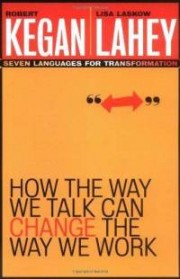
  • Karl’s Library: How The Way We Talk Can Change the Way We Work by Kegan and Lahey

    Set aside what you’re currently reading about leadership.

    If you want to transform your impact as a leader, you need to pick up a copy of How the Way We Talk Can Change the Way We Work by Robert Kegan and Lisa Laskow Lahey.

    Have you ever considered than an annoying employee complaint might also be a valuable personal value needing expression?

    Have you ever withheld an idea for improvement so your supervisor wouldn’t feel criticized?

    Kegan and Lahey provide an entirely new perspective on leadership by paying attention to how we talk to each other.

    They point to seven changes we can make in how we communicate that will reframe how we approach problems and result in lasting change.

    Seven Languages for Transformation

    1. From the language of complaint to the language of commitment
    2. From the language of blame to the language of personal responsibility
    3. From the language of New Year’s resolutions to the language of competing commitments
    4. From the language of big assumptions that hold us to the language of assumptions we hold
    5. From the language of prizes and praising to the language of ongoing regard
    6. From the language of rules and policies to the language of public agreement
    7. From the language of constructive criticism to the language of desconstructive criticism

    The shift we need to make as leaders is internal. When we see the conversation differently ourselves we will be able to have a different sort of conversation with others.

    You can continue to blame the rest of the team for their shortcomings. You may even be accurate in your assessment. But you will not see change.

    When you’re ready to try something new, try taking a look at how “the way you talk affects the way the team works.”

    You can get a copy of the book here.

    Karl’s Library is a weekly column highlighting my favorites from my professional development library. “Always learning” is one of the pillars of my personal mission statement. Explore past columns here.

     

    If you’re a Kindle fan like I am, it is available for the Kindle.

    Don’t have a Kindle? Get one! You’ll love it.

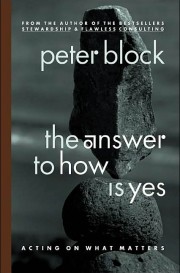
  • Thought Leaders Unpacked -> The Answer to How is Yes #3: Defenses Against Acting

    thought-leadersFreedom is a funny thing. While a vocational aspiration for many of us, the implication that when free we bear full responsibility for our lives is often too much to bear.

    Hence chapter three. Chapter three is where we get the opportunity to check our spoken aspirations against our actual behavior.

    I often have myself convinced that I want one thing, and then find that I am acting in such a way that sabotages or contradicts my own desires.

    Block does a nice job of pulling out several of these behaviors that work against our dreams.

    When swimming around in my own head, it is easy for me to convince myself about the sincerity and passion of my desires.

    When confronted with a behavior, like seeking the approval of those in power or collecting “enough” data to make an informed decision, I have a tool for reconnecting myself to reality.

    I have a tool to help me shift my focus away from those things that are outside of my control back to my own choices which are in my control.

    I have a tool help me notice when I am giving away my power or shifting responsibility off of myself. I don’t need to beat myself up for doing so, as much I need to celebrate catching myself in the act, so to speak, earlier than later.

    The good news of chapter three is that I don’t have to stay blind to the subtle means I employ to avoid what I want. The sooner I can spot a fear, an escape, a defense, an excuse, or a weakness, the sooner I can address it.

    The sooner I address my “defenses against action” the sooner I’m back to taking action and on the way to being, living and making the unique contribution that I have to offer the world.

    Which of Block’s defenses against action do you relate most closely with? How can you reframe an excuse you’ve been making to avoid responsibility into an opportunity to embrace responsibility?

    What was your main take-away from this chapter?

    Each week I post my reflections from one chapter of The Answer to How is Yes by Peter Block. My reflections are my own and are intended to generate conversation, catalyze additional thinking and encourage mutual learning.
    If you are just joining the discussion now, welcome! Catch up on the entire series here.
  • Clippings from Don: The Many Powers of Maybe

    Elizabeth Bernstein in Tuesday’s Wall Street Journal offers a pithy and insightful look at the growing practice of answering “yes-or-no” questions with a “maybe.”

    I‘ve long interpreted “maybe” as a polite “no.” My experience in my circles has been there are only two answers people give, “yes” and “maybe.” But evidently there are as many definitions and uses of the word as there are socially indirect communicators.

    After offering a variety of reasons why a person might respond to a question with an answer that is not an answer at all, Bernstein does a nice job of alerting us to awkward, insensitive and unhelpful impact our “maybe” has on the questioner.

    While interesting to read the reasons (excuses?) people opt for the non-response of “maybe,”  the insight is small consolation. That’s like asking an abused spouse to be more understanding of why her or his spouse is so violent.

    The person needing the counseling is the perpetrator not the victim.

    This is where Bernstein’s insights about the negative impact of a “maybe” response are worth their weight in gold to the discerning reader. If a few more of us find more direct ways to communicate our situations, then the word, “maybe” wouldn’t have to do so much more work than it really can.

    Take a look at the article here. How often do you find yourself using “maybe” as a response? How do you feel when you receive “maybe” as a response to your invitations?

    On your side,

    – Karl Edwards

    Voracious reader friend Don Silver always has an eye out for what interests me. Clippings from Don is a column where I pass on some of these articles, stories and resources to you.
  • Quote to Consider: Before Pointing the Finger

    quote-to-consider“It seems to me probably that any one who has a series of intolerable positions to put up with must have been responsible for them to some extent… they have contributed to it by impatience or intolerance, or brusqueness, or some provocation.”

    Robert Hugh Benson

  • Quote to Consider: Destiny is a Choice

    quote-to-consider“The tissue of life to be we weave with colors all our own, And in the field of destiny we reap as we have sown.”

    John Greenleaf Whittier

  • Choosing to Show Up… Showing Up Engaged

    bored-at-workNo matter how powerless you feel at work. No matter how little power you actually wield. You always have control over how you show up.

    You can wield this “power” in a childish manner. Resentfully drag your feet and do the bare minimum at the last minute and only when asked for the umpteenth time. In other words, barely show up at all. As powerful as it feels to “stick it to the man” in this way, you end up diminished as a result as well. In other words, you’re only hurting yourself.

    Do yourself a favor and choose to show up engaged no matter what’s going on at work. Even for the most ungrateful supervisor, show up engaged. Even for the most uncooperative team members, show up engaged. Even for the most toxic of work cultures, show up engaged.

    You don’t have to keep working here—in fact, you should probably be looking for a change if you’re in an unhealthy situation—but while you are here, (more…)

  • Loving Monday: Verdict on a Rainy Day

    loving_mondayI hate the rain.

    Grey skies and rain-drenched highways evoke a spectrum of responses as we roll out of bed to begin another week of work.

    For some, including me, dreariness and traffic jams fill the imagination before we even get out the door.

    For others, thankfulness for the nourishing and cleansing water covering our desert metropolis fills our hearts, and we smile.

    It’s a matter of perspective. Same circumstance. Radically different experiences of it.

    Particularly powerful, though, is to realize that you get to choose what perspective you adopt each morning.

    Given that it’s Monday morning, and we’re trying to get our weeks off to a good start, I’d venture that anything we can do to read refreshment and gratitude into the precipitation would help set the brighter, more constructive tone we want for the busy week ahead.

    How aware are you of the perspective with which you interpret circumstances? Do you even realize that you are making a choice when you interpret circumstance as positive, negative or somewhere in between?

    Try an experiment with me. Next time something out of the ordinary happens: like a change in weather, a deadline change, an irritable client, an absent co-worker. Try noting your initial reaction. Then write down three other possible interpretations of the same set of circumstances.

    Now take another look at your original reaction. The choice is yours, and you are, in fact, making a choice. Will you stay with your original interpretation of the circumstance or will you choose to adjust it?

    The choice is yours. You have more power in how you experience of what happens around you than you think.

    I‘m still not particularly fond of rain, but I choose to be grateful for its gift of life and appreciate the clean skies that will result. My week is off to a much better start.

    What about yours?

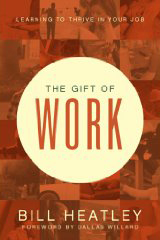
  • The Gift of Work -> Chapter 2: Kingdom Living

    thought-leadersTraining for kings.

    From the outside in… practicing habits of healthy living until proficient. From the inside out… becoming increasingly open to the involvement of God in the training process.

    Such are the spiritual disciplines: twin and simultaneous trajectories toward becoming the kind of person you were meant to be.

    gift-of-work1Reflecting on the workplace, it is my stewardship of the life God has given me that determines the character of my presence and contribution there. Hence the power of Heatley’s now obvious, but usually overlooked, linkage between our stewardship within God’s kingdom with the role of kings.

    How I show up matters.

    Whether or not I choose to engage fully—authentically, energetically and creatively—matters.

    The choices I make at work improve, restore, and (more…)

  • The Gift of Work -> Chapter 1: Changing Our Minds About Work

    thought-leadersI’m going to jump right into the issues raised by Bill Heatley’s The Gift of Work: Spiritual Disciplines for the Workplace without much content summary. So grab your copy and join the fun!

    gift-of-work1

    Faulty Frames of Reference

    Powerful from the get go is his challenge to our basic frame of reference about work as “a daily humiliation.” (p. 24) Such starting assumptions: work is but a necessary evil to pay the bills, TGIF, and working for “the man”—among others—is where we get our equation backwards. It’s as if we suspend our lives while at work in order to make the money we need to finance the lives we want to live while at home. We have to get ourselves dirty in the workplace (read “the world”) in order to serve God and others everywhere else.

    Instead of investing, engaging, reflecting and improving, we end up keeping work at arm’s length.

    A huge hurdle to becoming open to alternate frames of reference is learning how to identify our own starting assumptions. It can be like asking a blind person why they tripped on the cracked sidewalk. How can I figure out what I’m not seeing if I’m not seeing?

    More Ordinary Than You’d Think

    I love the way Heatley, almost matter-of-factly, asserts that work is (more…)

  • What’s In A Perception?

    Perception MattersSo what’s the big deal with how others perceive me?

    I can’t control what another person thinks. I can’t force them to change their mind about me if they have settled on some incorrect perception.

    The big deal is that those other people are making decisions that affect you. To the extent that their perception about who you are and what you bring to the professional table is incorrect, so will their decisions be.

    Decisions like whether to hire you, promote you, invest in your training, or in the worst case, lay you off in a recessionary season.

    While you cannot make someone see what they will not or cannot see, you can exert influence.

    Our conversation topic this month is how our resume can be a powerful perception influencer. That is, if we accept responsibility for choosing how we present our professional interests and work history.

    Begin by listing three responsibilities you would love to have in a job, even if you don’t have any work experience in them.

    Now turn each of them into a job title, however silly it might sound. For example, if I want to be in charge of the development of a new product and lead the process from beginning to end, I might call myself a “Project Manager” or a “Lead Designer” or a “Brilliant Idea Implementor.”

    The idea is to create for yourself some job-related vocabulary that would be helpful for describing yourself in terms of what you want to do next.

    Try it. Share one or all three of your desired responsibilities and corresponding job titles in a comment here.

    On your side,

    – Karl Edwards


    Don’t forget to sign up for our Resume Workshop: A Fresh Approach to Career Advancement coming up in Los Angeles on February 7th! Or contact us for information on inviting us to your community.