Karl Edwards presents Working Matters

Tag: technology

  • Listen In -> Clutter: Friend or Foe? #3: All Those Tech Tools

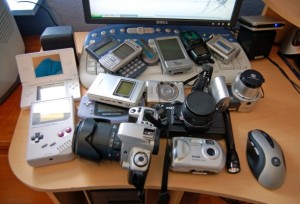
    Where is that conversation thread? On my phone, my tablet, my laptop, or my desktop computer?

    We are surrounded by dramatically new, increasingly fantastic, ever-changing tools. When do the new options propel us forward and when do they confuse, distract or paralyze us?

    In this week’s podcast discussion, web developer Jorge Rosas and I take a look at the myriad new technology tools which are available to us.

    Each new tool has the potential to create as many problems as it solves.

    Some of us thrive with new tools and some of us get overwhelmed.

    It wasn’t that long ago that a telephone had a single, very focused capability while a desktop computer had a different capability and purpose.

    Now they are almost completely interchangeable. We can surf the web on our phones and talk to family in Asia on our computers.

    For some the new tools have dramatically increased our effectiveness. For others the new tools have only increased the confusion and mess.

    How many contact lists do you keep for phone numbers, email addresses, messaging user names, and residence addresses?

    What are you carrying today? Your phone? Your tablet? Your laptop? All three? 

    Listen in.

    Just now joining the conversation? Catch up on the entire series here.
  • Listen In -> Clutter: Friend or Foe? #1: Dispelling Myths About Clutter

    Would you believe I lost my notes for this blog post in all the clutter on my desk?

    I hope not. While I definitely fall into the seriously cluttered category, such poetic irony is not my lot this morning. But it did make for a fun lead-in sentence.

    Welcome to a fresh discussion on clutter.

    Instead of simply declaring war on clutter as the arch enemy of all that is good and effective in the workplace, our special guest, Jorge Rosas, web developer and producer of this podcast, and I will think out loud over the next five weeks about how to figure out what level of clutter works best for you.

    The possibilities for creating clutter seem to be growing logarithmically, and in order to stay effective we need to adjust quickly.

    Not only do we have messy desks, we have messy computer desk tops. We have technology clutter. We have communication clutter. We have relationship clutter.

    The disorienting piles in every category seem to grow out of control before we’ve even learned how to use them.

    You’re going to enjoy this series. Clutter need not be our enemy. Nor is it a benign growth.

    It’s an open question: is clutter your friend or your foe?

    Clutter: Friend or Foe?
    Week #1: Dispelling Myths About Clutter
    Week #2: All Those Social Networks
    Week #3: All Those Tech Tools
    Week #4: All Those Communication Options
    Week #5: All That Stuff On Your Desktop 

    Listen in.

    Just now joining the conversation? Catch up on the entire series here.
  • Listen In -> Playing Favorites #3: Favoring Certain Technologies

    Every technology has its loyal fans. I’ve never worked on any computer but a Mac.

    I believe my bias is based in fact. I want my employees doing their jobs not learning how to use their tools.

    But what if I were spending a premium on computers because they were cool?

    Some of us feel locked into our technology choices because of the magnitude of the initial investment. We let better solutions and technologies that come along pass us by because we can’t deal with the awkward reality that the world changed before we got our money’s worth.

    In this week’s show, Claudia and I explore how we play favorites when it comes to the technologies we choose.

    When does our loyalty to a brand exceed its merits in comparison to another?

    Are we making the best leadership decisions on these huge investments if we’re playing favorites without even knowing it?

    Listen in.

    Just now joining the conversation? Catch up on the entire series here.
  • Listen In -> Technology… When Less is More #5: Collaborating Effectively

    Work, organization and communication all come together when we collaborate with others.

    Do our technology tools facilitate our efforts or complicate them? Propel us forward or hold us back? Enhance our effectiveness or stymie it?

    It’s easy to get the thinking process backwards when it comes to what technology will help us best collaborate with others.

    In this week’s discussion, Jorge and I turn the thinking around and and suggest that different expected outcomes require different methods of collaboration.

    It therefore becomes counter-productive to begin with choosing a technology solution.

    Confusing? Listen in.

    Joining this series mid-stream? Catch up on the entire series here.
  • Listen In -> Technology… When Less is More #4: Communicating With Purpose

    Do you find yourself sending an email, leaving a voicemail and texting your message just to make sure you get through?

    With such a wide repertoire of communication options available today, we should be communicating more effectively, not less.

    And yet.

    How do you choose which communication method or technology to use for your various purposes?

    In this week’s show, Jorge and I discuss whether we’ve got the cart in front of the horse when we assume the best way to communicate is always by using the latest technology.

    Listen in.

    Joining this series mid-stream? Catch up on the entire series here.
  • Listen In -> Technology… When Less is More #3: Getting Organized

    Are you buried underneath your own organizational system?

    Do your categories, folders, tags, and lists confuse more than direct? When do all your organizational tools merely become your next mess?

    Organizational software can become the next mess to tend. As if you didn’t have enough to do already.

    When is it more work than help to add another tool to the tool chest?

    The answer is different for each of us depending on our working styles, relative affinity for technology, and our specific practical needs.

    Join Jorge Rosas and I as we discuss how to think about the interface between technology and getting organized.

    Listen in.

    Joining this series mid-stream? Catch up on the entire series here.
  • Listen In -> Technology… When Less is More #2: Getting Work Done

    More features does not mean getting more done.

    Do you spend more time writing your report or formatting it? More time using your software or learning how to use it?

    The point is, you’re trying to get work done. You’re looking for tools that will help to that end.

    Having all the features may or may not help get you there. And should those layers and layers of features, in fact, get in the way, then they have become your sabotaging enemy instead of your facilitating friend!

    How do we think about what tools we need to best get our work done?

    Listen in.

    Joining this series mid-stream? Catch up on the entire series here.
  • Listen In -> Technology… When Less is More #1: Slave To Your Tools?

    Do you work for your tools or do they work for you?

    Imagine a hammer and a saw telling a carpenter how to build a house. Silly image?

    Not if the tools involved are your workplace technology.

    More often than not, our computers, our telephones, our word processors and databases are dictating the terms by which we can access their benefits.

    We become unwitting partners in this unfortunate role reversal by shopping for the latest, fastest, most versatile, most interconnected devices available. As if having the most features meant having the best tool.

    Not so.

    Join me and our special guest, Jorge Rosas, in a new series on Technology… When Less is More. Jorge is a passionate early adopter of all things tech, programmer, webmaster, musician, and producer of the Working Matters podcast.

    We dare to suggest that you are the carpenter, and it is the house that you want to build that determines what tools will best serve you and not the other way around.

    Technology… When Less is More
    Week #1: Slave to Your Tools?
    Week #2: Getting Work Done
    Week #3: Getting Organized
    Week #4: Communicating with Purpose
    Week #5: Collaborating Effectively

    Listen in.

  • Out-of-Contact Doesn’t Have To Mean Out-of-Touch

    If your working rhythm thrives on extended periods of concentration and focus, you need to turn off the phone, close your email browser, quit all your messaging programs and close the door. No question about it. No question, that is, from your perspective.

    Continuing our discussion of this week’s podcast interview with software developer Jorge Rosas, from the perspective of others (clients, team members, supervisors) a complete communication cut-off can be quite disconcerting, if not problem-causing.

    What we want is for others to feel that we are accessible without having instant accessibility be the only form contact can take.

    All communication technologies include a means to notify others of how and when you will respond to their contact. I have found that as long as others hear:

    1. That their message is important to you, and
    2. A time frame for when you will get back to them, they will be satisfied.

    Now your communication “absence” serves both your working needs and others’ contact needs.

    Please don’t sacrifice your own effectiveness in order to stay in touch with others. Those are not mutually exclusive outcomes.

    How do you get things done while remaining accessible 24/7?

  • To Upgrade or Not To Upgrade? Is That Really the Question?

    It’s tempting to reduce software or hardware upgrade decisions to simple purchase choices. Can we afford the sticker price?

    Talking with software developer Jorge Rosas in this week’s podcast, there are two problems with this strategy. 1.) There are also indirect costs, such as helping users get up-to-speed and adjusting business processes impacted by the upgrade. These are more difficult to calculate, but need to be considered. 2.) There are also indirect benefits, such as staying connected with support services to help solve problems and mitigate disasters.

    More helpful might be to ask whether the upgrade will result in an “arithmetic benefit” or an “exponential benefit.” Arithmetic benefits include such things as: speed increases, feature enhancements, and quality improvements. Exponential benefits involve changes that permit you to eliminate entire business processes, reorganize for slimmer staffing, stop using paper or making certain telephone calls altogether.

    As a rule of thumb, I wait for something to provide an exponential benefit before investing in extensive change.

    How do you evaluate upgrade decisions?