 “Many people have the ambition to succeed; they may even have a special aptitude for their job. And yet they do not move ahead. Why? Perhaps they think that since they can master the job, there is no need to master themselves.”
John Stevenson
“Many people have the ambition to succeed; they may even have a special aptitude for their job. And yet they do not move ahead. Why? Perhaps they think that since they can master the job, there is no need to master themselves.”
John Stevenson
 “Discipline is almost always a battle against yourself.”
If there were one character quality or virtue that I both recognize my own need to develop and feel motivated to develop, it would be discipline.
Paul Sullivan illustrates the power of discipline for withstanding, keeping a level head, and sticking to one’s game plan in the midst of enormous pressure. Having the ability to perform under pressure is, of course, the premise of his book.
His stories are strong and persuasive.
Having conceded that, what I think is called for at this point from us reading is an honest personal assessment about how close (or, more likely, far away) from these examples we are in our own mastery of a character quality such as discipline.
It can be easy (I know it is for me) to want to identify with the “hero” of the story. In principle, I heartily agree with all that was said and done by these masterful practitioners. You’re nodding too, I can tell.
The issue, though, on the path toward mastering discipline is how to learn the skill and developing it to the depth of a reliable character quality.
Here we probe beyond the scope of our text.
What exactly are we trying to develop when we speak of discipline? What is involved in becoming more disciplined?
The results are enormously attractive and the outcomes are hugely impactful.
But we are reading of people who have spent a career, if not a lifetime, building, honing, and refining their capacities to exercise discipline. These are not quick (more…)
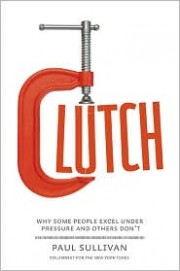
As I speculated in my post of October 28th, I have now indeed selected Clutch: Why Some People Excel Under Pressure and Others Don’t by Paul Sullivan to read for our next Thought Leaders Unpacked™ series.
I have selected it for my own sake more than anything else. While I believe it holds great value for all of us who consider ourselves lifelong learners, I am looking forward to taking the spotlight of Sullivan’s insights and shining it on myself.
I’m not so concerned that I might not show up well against the characteristics of “clutch” performers as I am with my ability to be honest about where I need to learn and improve.
Chapter #1: Focus
As we dive into the first chapter on Focus, I am initially struck by Sullivan’s method of using a single story to explain what all his research on focus reveals. I suppose I expected multiple stories making the multiple points. Once I settled in with his style, I became absorbed with his content.
My first take-away came from distinguishing between focus and concentration. I would describe concentration as paying attention to one thing at the exclusion of everything else. She was concentrating so hard on her spreadsheet that she didn’t hear her phone ringing.
Focus, on the other hand, I would describe as paying attention to one thing and seeing everything else in its light. She would not approve the corporate retreat (more…)
I heard Paul Sullivan speak yesterday at the Milken Institute in Santa Monica. The subject, of course was his book, Clutch: Why Some People Excel Under Pressure and Others Don’t.
While much of the audience wanted to cling to a romantic definition of “clutch” that was significantly different than Sullivan’s, I thought he did a great job of carving out a specific angle that both set the stage for his research into extraordinary performers as well as make “clutch” performance attainable for anyone.
Specifically, he is examining how some people can continue to do what they are capable of doing on an ordinary basis under pressure. The key being, “do what they are capable of doing on an ordinary basis.” This is not a book on heroics, luck or extraordinary achievements.
I’ve already purchased my copy and am considering using Clutch for my next “Thought Leaders Unpacked” series so that we can think through Sullivans observations together.
He works his way through five characteristics of “clutch” performers.
He also offers three reason why others do not perform well under pressure.
Keep your eyes and ears open for my decision about the next book we study together in “Thought Leaders Unpacked.” Clutch looks like an interesting, practical, and encouraging option.
 I am not a detail person. Fact.
Sometimes, though, I need to attend to details. Patiently and painstakingly work my way through every last jot and tittle. Systematically, thoroughly, exhaustively, completely, accurately, timely… you get the idea.
I’m exhausted just thinking about it.
 Details, for us concept-people, represent a challenge of focus, discipline and perseverance.
Focus. The sort of attentiveness required to spot and recognize necessary distinctions among the blur and whirl of facts, events and personalities is a capacity we can only dream of. (And we usually call those dreams, “nightmares.”)
It’s like that children’s game, “Which of these pictures is different than the rest?” Detail-oriented people spot the distinction instantly, while the rest of us look and look and look. Not until we compare each and every feature of each drawing do we discover the difference.
Discipline. The sort of patience required to look at something from every imaginable angle, follow through on every clue, look under every stone, is both a skill and a character quality that takes years for the uninitiated of us to develop.
Like a chess game where one is thinking about all the possible future moves. (more…)

My buddy reminds me to write a little bit each day. Even if only for five minutes.
The finish line is reached by taking every step, not by trying to sprout wings.
– Karl Edwards