Karl Edwards presents Working Matters

Blog

  • Listen In -> Tangible Accountability #4: Motivators That Build In Lifelong Learning

    Tangible accountability transforms failures into learning opportunities.

    Now that you have structures that build in results and relationships that build in support, you are aware of missed deadlines, errors in judgment, miscalculated budgets, etc. right when they happen.

    For accountability to serve a positive purpose (ensure that your stated intentions are accomplished), these problems need to become possibilities. Instead of failures being the end of the story, they need to be the beginning of a new story from which your team emerges smarter, quicker, and more skilled than they were before.

    In this week’s show, Claudia and I discuss the third component of tangible accountability: Intentionally using problems to create learning opportunities.

    Imagine entire teams and processes improving in real time simply because your accountability structure provided a mechanism for learning.

    Listen in.

  • Loving Monday: Splash of Cold Water

    loving_mondayEver had one of those Mondays where all of the positive self-talk in the world can’t get you out of your funk?
    You’ve got too much to do. The people around you are dragging you down. Life at home is rough. Nothing works like it’s supposed to. The week hasn’t even started and you feel behind the eight ball.

    Instead of psyching yourself up, beating yourself up or simply giving up, try a splash of cold water in the face. (Your own face, that is. (As rewarding as dousing that turkey down the hall would be.))

    You might call it a tangible if startling way to push the “reset” button.

    A way to start over yourself while acknowledging that all around you remains awful. A way to grab your own attention.

    Resistence, struggle and panic simply exasperate the situation when one is mired in quicksand. When about to be dragged under, we need to be alert, perceptive and clever. We need to awake to the possibilities that we cannot currently see. Alternatives that offer unexpected, unanticipated, or not yet envisioned options.

    Hence, a startling reset. A choice to to step away. A choice to do something simple. A choice to do something that awakens your senses.

    A splash of cold water.

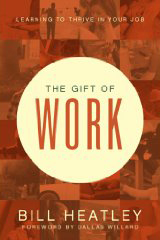
  • The Gift of Work -> Chapter 6: Training as a Disciple of Christ

    thought-leadersPrepare and tend the soil.

    The metaphor cuts across my tendency to complicate and over think my views on work and faith.

    gift-of-work1My best bet for contributing to a healthy and bountiful crop is to prepare and tend the soil. My best bet for contributing to a meaningful and productive workplace is to become a certain sort of person. Instead of attempting to control the production process (which by definition in this metaphor is out of my control), I should focus on becoming the sort of character who can participate well whatever the process. Becoming a certain kind of person is in my control.

    What sort of person? A learning person. An engaged person. An attentive person. A healthy person. A grounded person. A God-connected person. A maturing person.

    Instead of asking what sort of decisions does God want me to make, I’d be better off asking (more…)

  • Question of the Week

    Instead of solving the next problem presented to you, how might you help that person become a better problem solver him or herself?

    The Question of the Week is offered to increase awareness of one’s personal leadership practices and encourage experimentation with creative alternatives.
  • Listen In -> Tangible Accountability #3: Relationships That Build In Support

    What if accountability were a means of support instead of a means of blame?

    What if leadership meant ensuring the success of your team instead of punishing the failures of your team?

    This week Claudia and I discuss how accountability can be a powerful means to build in the support relationships that check in occasionally, provide needed resources, are available for questions, and are committed to the project’s success.

    Isolation can be a real danger when a lot is going on and people are busy with multiple priorities. Situations can change in ways that affect others or have implications to the schedule or budget. The sooner such changes are communicated, the sooner appropriate and timely adjustments can be made.

    That’s when we’d be better off if those relationships were already in place and built right into the system.

    Listen in.

    If you are joining the conversation mid-topic, you can find the entire series on Tangible Accountability here.
  • Question of the Week

    What leadership skills do you model when problems arise?

    The Question of the Week is offered to increase awareness of one’s personal leadership practices and encourage experimentation with creative alternatives.
  • The Gift of Work -> Chapter 5: Not a Trivial Pursuit

    thought-leadersWe have become a culture of “preventative ethics.”

    That’s my term for what Bill Heatley identifies as ethics that confines itself to avoiding either litigation or offending people. There’s a problem with defining or limiting anything to what it is not.

    gift-of-work1I hear the grieving of what has been lost in terms of moral vocabulary, social mores, and behavioral standards. Being the veritable pragmatist that I am, though, I want to move immediately to thinking through creative options for facing this current reality, however tragic, and creating, developing and experimenting with alternatives for maturing into a working community that is, in fact, characterized by love, goodness and justice.

    It might be more effective to have our working communities back into their ethics. If it’s not going to work to begin with the concept and move to the practice, then let’s talk together about our practices. Teams would discuss and agree upon what behaviors they would like their working relationships (more…)

  • Study Shows Personal Net Surfing Increases Work Productivity

    insightful-linkI love it when data emerges that validates my hunches.

    People who surf the internet while at work are more productive. Gotta love it.

    “People who do surf the Internet for fun at work – within a reasonable limit of less than 20% of their total time in the office – are more productive by about 9% than those who don’t.”

    The productivity arises from our need to zone out (take a break) every once in a while in order to restore our concentration. It’s simply not possible to focus all of the time.

    Seems obvious, but some employers are (now irrationally) concerned that they’re not getting their money’s worth out of employees who are not fully focused on work every moment they’re “on the clock.” I’ve long counseled that this attitude foments an adversarial posture with the very people on whom you depend for maximum engagement.

    With one set of policies (e.g. no personal internet use) you communicate that you don’t trust them. Then you turn around and ask them to give 110%, go the extra mile for a client or contribute to brainstorming restructuring ideas, and you wonder why they hold back.

    No matter how you feel about personal internet usage at work, the facts about its impact are emerging. Can you turn this information into a learning opportunity?

    Click here for the University of Melbourne article.

  • American Idol Savvy: Advantage to the Amateurs?

    IdolMaybe I’m a softy for the rags-to-riches or the going from complete unknown to pop superstar drama.

    To say it the other way around, there’s something about an amateur competition that provokes resentment when I discover what polished professionals some of the contestants are.

    Granted Adam Lambert and Alison Iraheta are amazing vocalists. But the fact that Adam has sung professionally for some time now, and that Alison has won a major singing competition previously takes something out of it for me.

    Let’s just say they don’t get any votes from me no matter how well they perform.

    Unfair? Or is it appropriate in an amateur competition that there be a bias toward the true amateurs?

  • Listen In -> Tangible Accountability #2: Structures That Build In Results

    Accountability is not the police force that comes in after the fact to point out everything we did wrong, accountability is the structures along the way that we put in place to make sure all that we intend in fact continues to take place.

    In motion, real time meetings, check-in points, deadlines, and specific plans that provide opportunities for issues to be addressed, problems to be anticipated, and changes to be coordinated.

    What are these accountability structures that get us where we’re going and help us adjust before it’s too late?

    Listen in.