Karl Edwards presents Working Matters

Category: Working Matters

  • Should I Be Firing Myself?

    Insightful LinkIn the best spirit of No Excuses Leadershipâ„¢, I’m delighted to find Lisa Haneberg over at Management Craft suggesting that leaders might recognize for themselves when it’s time to move on.

    My favorite Question of the Week for leaders to ask themselves is: “How might you be a part of the problem that won’t go away?” I like it so much because it points to the heart of leadership effectiveness, which is self-awareness. Knowing how you show up at work and the impact your presence, actions and words have on others.

    “Be WITH the team, or change teams,” Lisa exhorts. So many of us make the mistake of making our own vantage point our sole frame of reference for evaluating the big picture. But a vantage point is just that… one point among many. Is it because we have more power that we get to let ourselves off the hook and blame the team for missed goals, petty in-fighting, or poor customer service?

    I think not. The leader is always ultimately responsible for what happens on the ground. No excuses.

    If we haven’t talked recently about the challenges you are currently facing, let’s do so. Give a call or shoot me an email. Your contribution is too important to ignore.

    On your side,

    – Karl

  • Some Space From Work

    Santa Monica BeachI don’t even want to look at my work today.

    A good sign that I need some space. Fortunately, it’s Saturday and with the kids off from school, I won’t be able to pick up my work if I wanted to.

    There are other times, though, when I’m so full of new ideas and unfinished projects and return calls to make that I can barely see straight. It’s when I feel like there are no options that I have learned there is one option I must be sure to act on.

    Get some space.

    A long walk along the beach will usually do it. The salty breeze, the endless horizon, the simple colors of blue water, white foam and brown sand. The space creates room inside me for the dreams and responsibilities, feelings and tasks, relationships and deadlines to move around and reorder themselves.

    Not a conscious exercise but a hidden phenomenon taking place in the background while I am otherwise occupied ducking an errant frisbee or digging for sand crabs or counting sailboats.

    I then go back to work. And am ready to do so, because I go with refocused eyes and a refreshed heart.

    What do you do to get some space?

  • Listen In -> Strategic Planning #3: Learning From The Past

    Assess. Adjust. Assess. Adjust. Assess. Adjust.

    In this week’s podcast conversation, we find ourselves hungry to benefit from our past decisions. Instead of a black and white, right or wrong, success or failure, credit or blame mindset, we adopt a stance of attentiveness and action.

    Crucial to effective strategic planning is the capacity to learn from the past.

    We pay attention to what is and is not working and adjust continually. In smaller, more frequent increments, it is easier to learn, change course, recover from mistakes, seize new opportunities, etc.

    But only if the past is a source of rich learning. It’s the difference between knowing more and knowing better, capacity versus capability, facts or wisdom.

    Listen in.

    powered by ODEO

  • Reach Your Goals by Not Reaching Them

    Insightful LinkSometimes an insight doesn’t sink in until stated backwards or upside-down or in the negative.

    Check out Ian McKenzie’s 10 Rules to Ensure You Don’t Reach Your Goals. I think you’ll find them practical, simple and insightful.

    Most challenging to me was #3: “Spend time with people who are not reaching their goals. Stay away from anyone who has clear goals and a plan to reach them.” The implications to several current relationships will take some serious thought!

    If you haven’t registered for our free online Goals Journal, start keeping track of your most important goals today! View a sample Goals Journal here.

    On your side,

    – Karl

  • Does My Contribution Really Matter?

    A shaper of the future. Wow.

    Not me, surely. The forces and players around me are too big and too many and too complex for my contribution to make much of a difference.

    If you hear yourself in those words, then consider this: It is precisely because so much is going on all the time by so many that your contribution not only can make a difference, but is absolutely crucial.

    The future that emerges from the myriad of choices being made is not set in stone. Every tile added to the mosaic influences what sort of image ultimately emerges. We each need to believe that showing up fully and contributing whole-heartedly is like adding a tile to the mosaic.

    If you don’t contribute your tile, who will?

  • Controlling or Cruising?

    Toward which extreme would your planning approach tend? Controlling or cruising?

    Do you try to control more than may be possible, humanly speaking? Stick to tight schedules even if it means working nights and weekends. Keep everyone on task even if it means writing standard operating procedures for sharpening pencils. Coordinate activities across departments even if it means nagging people several times a day.

    Or have you given up on planning? Circumstances change too quickly on the ground for any plan to stand a chance of being implemented. Technology will change, a competitor will undercut your break even price, a key supplier will go out of business, an important team member will go on maternity leave at a crucial juncture. So you cruise. Go with the flow. Use your intuition. Shoot from the hip. Respond to issues as they arise.

    (If you haven’t listened to this week’s podcast, take ten minutes now as Claudia and I take on strategic planning as the second segment of our coaching regimen No Excuses Leadership.)

    As you’ve probably guessed, both sets of skills are crucial for successful strategic planning. They each address a stark reality leaders face. They each fail when adopted exclusively and universally. There is a vital proactive, aggressive, intentional component to planning. There is also a vital reactive, responsive, perceptive, discerning component.

    Where do you fall on the controlling versus cruising spectrum? What have you learned from veering too closely to either extreme?

  • Listen In -> Strategic Planning #2: Shaping the Future

    In these fast changing times, is planning worth the effort? Won’t the world be completely different before we get very far along toward our long range goals?

    In this week’s podcast conversation, Claudia and I look at strategic planning as a tension between control and change. No we don’t have the control leaders used to enjoy when the pace of change was slower. But neither are we at the whim of the forces around us.

    We’re excited because the opportunity to show up and make a difference is huge. Are you excited about your planning efforts?

    Listen in.

    powered by ODEOODEO

  • Flip

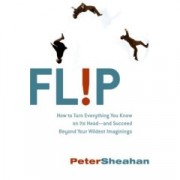
    FlipFlip: How to Turn Everything You Know on Its Head—and Succeed Beyond Your Wildest Imaginings

    Peter Sheahan, Wm. Morrow Publishers, New York, NY 2008.

    In the spirit of enjoying any piece that affirms my counter-intuitive tendencies, I believe I have come upon a treasure.

    “There is nothing more important in business today than an action orientation.” If that quote isn’t what you and I have been working on together in developing a “bias toward action,” I don’t know what is. Instead of making big changes, experiment and adjust while moving. If we are coaching together, I will be wanting you to read this book.

    At the other end of the spectrum, Sheahan asserts that control does not come from controlling, but from equipping and empowering others to act. He also shares how to personalize business relationships and find marketing niches where no one else is looking for them.

    More beneficial for its paradigm shifts than for any practical specifics, you’ll go away with a fresh and clearer set of lenses through which to evaluate your efforts.

  • Do Your Goals Haunt or Lure?

    Do your goals haunt or lure?

    It’s the difference between having your goals behind you or in front of you.

    Behind you, the best goals can do is accuse you. They can goad you with fear or haunt like some guilting ghoul. From behind you, your goals will send one message, “You are still not there yet. What is your problem?”

    In front of you, goals can serve as an alluring tempter or temptress. They will draw you toward an extremely attractive future. Out in front, your goals will send a message of motivation, “What you want is over here. Achieve and live it. It’s worth the effort.”

    And so back to the original question. Do your goals haunt or lure?

    I believe the distinction lies within two questions. 1) Have you owned each goal as your own? And, 2) Do you interpret missteps as damning failures or learning opportunities?

    For example: What goals were set in your last performance review? Who initiated them, you or your supervisor? If your supervisor, have you made them your own yet? If not, then I’ll bet you’ll feel like the goals are haunting you all year. “Are you there yet?” “Your raise depends on this.” “Don’t mess up now.”

    On the other hand, if you’ve owned the goals as your own, then your motivation comes from within instead of outside of yourself. You want; therefore you work. The achievement is associated with a positive desire (hence “lure”) instead of a negative judgment (aka fear.)

    Regarding the inevitable missteps along the way, if every one feels like a failure to you, then your road to goal achievement is primarily an experience of obstacles and setbacks. Your spirit gets progressively beaten down instead of nourished and energized as it would if you felt you were learning and improving along the way.

    And so we need to deliberately choose to view our errors as gifts. Gifts we open with gratitude and from which we choose to benefit. Benefit by learning: becoming wiser, more skilled and more committed to playing at the top of our professional game.

    For today it is enough to simply pause and reflect on the initial question: Do your goals haunt or lure?

    On your side,

    – Karl

  • Who is Your Mentor?

    A Leg UpTo whom do you look when you need a leg up, a wise word, honest feedback, a generous dose of encouragement, or a safe sounding board?

    Not in the formal sense of a named “mentor/mentee” relationship structure, though those are wonderful. But when you find yourself looking around for someone who’s “been there before,” who do you find yourself turning to?

    Who, before offering any advice, is simply on your side? Who believes in you and has an oddly generous interest in leveraging their experiences, relationships, and resources for your benefit?

    I’ve had such people in my life in the past. Maybe I am wistful for someone similar now. It seems to me, though, that such figures are too few and far between.

    Whenever I find myself feeling others should be doing something they’re not, I have to ask myself what I’m doing. Who do I come alongside and give the gift of encouragement, acceptance, availability and any resources that might enhance or enable their success?

    And so the original question gets reversed: How do you come alongside and empower others?