Karl Edwards presents Working Matters

Tag: performance

  • Even Olympians Respond To Pressure Differently

    The Olympics is a fascinating study in performing under pressure.

    Here we have the most highly trained athletes in the world doing in one moment of time what they have done thousands of time before.

    No problem, right?!

    But the Olympic moment is a different sort of moment.

    The entire world is watching. The performance will be meticulously judged and graded. Their only chance for a medal depends on this one, single performance.

    Pressure.

    Even highly trained Olympians vary in how they respond to pressure.

    Some experience the pressure negatively.

    They have to calm their nerves. They need to intentionally focus. They can become uptight, self-conscious, and over-think their performance. And they can make mistakes as a result.

    Some athletes experience the pressure positively.

    Their energy level rises. They rise to the moment as if it were a great adventure. All the attention, all the eyes watching are gifts of encouragement. And they often perform better than ever before.

    Aly Raisman (pictured) was a key example in her gold medal floor exercise. While almost every other gymnast who preceded her had one error lead to another as their spirits deflated, Aly chose to lead out with the most complicated series she knew. A run that she had been eliminating up until that moment due to a disastrous landing in practice.

    But when her gold medal opportunity was on the line, she embraced it, went for it, put everything into it, and performed it flawlessly.

    What about you? Do you experience pressure negatively or positively? Is pressure a gift or a curse?

    If you experience pressure negatively, what positive interpretations can you come up with that would be equally (if not more) valid than your current negative ones?

    How might the pressure be a gift? How might the pressure be an opportunity? How might the pressure be a tool?

    Watch the athletes closely as the games come to their conclusion. Compare their responses to the pressure. Compare their abilities to perform. See if you observe any correlation.

    On your side,

    – Karl Edwards

  • Listen In -> Employees… What Are They Good For? #4: The Problem of Poor Employee Performance

    I’d venture that for 90% of employee performance problems, supervisors focus their solution efforts on the problem employee.

    Helping the employee change. Demanding that the employee change. Talking to the employee. Writing up the employee. Training the employee. Disciplining the employee.

    What if, though, the employee was not the problem?

    What if problems elsewhere in the company were creating a situation in which no employee would look good?

    What if their negative attitude was a self-protective response to your harsh, arbitrary and/or imperious leadership style?

    What if their uncooperativeness was a response to the competitive bonus program in your compensation structure?

    In this week’s podcast discussion, Claudia and I take a closer look at the problem of poor employee performance.

    When acceptable performance becomes a problem, are we jumping too quickly to blame and punishment?

    Could there be aspects of your corporate structure, culture, or your own leadership methods that might be setting the stage for poor performance?

    Listen in.

    Just now joining the conversation? Catch up on the entire series here.
  • Listen In -> Lies and Myths We Believe About Work #4: Hard Work Will Be Rewarded

    Hard work is not always noticed much less rewarded. If we are quietly going about our hard work thinking that our supervisors both are aware of it and ready to reward it appropriately, we are mistaken.

    In this week’s show, Claudia and I discuss the myth that hard work will be rewarded.

    This myth is most commonly believed by the most cooperative and hard-working among us. We don’t want to make waves, draw attention to ourselves or be accused of unfair politicking.

    We feel the noble route is to demonstrate exceptional performance and then let the rewards flow from the system functioning as it was intended. Our performance reviews will—of course—result in appropriate compensation increases and position advancement.

    But systems don’t work as they are designed, and however noble and cooperative such an approach may be, it will ultimately backfire on us. Is your hard work noticed? Appropriately rewarded?

    Listen in.

    Just now joining the conversation? Catch up on the entire series here.
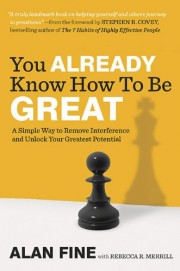
  • You Already Know How to Be Great by Alan Fine with Rebecca Merrill

    I do?

    The assumption Alan Fine’s title makes, You Already Know How to be Great, catches me off guard. And again I ask, “I do?” Because right now there’s a big disconnect between what I’m being told I know and what is actually true of my experience.

    Then comes the subtitle, “A Simple Way to Remove Interference and Unlock Your Greatest Potential.” Ah, so there is something blocking the way that needs removing, and there’s something locked away that needs releasing. Now I’m interested.

    Thus we find our way into a wonderful new resource by Alan Fine and Rebecca Merrill.

    Those of you who know me know I have little patience for coaches and “experts” who claim to have the formula for success. The line of thinking goes something like this, “If only you were different than you are, then you would be successful. We can help you become this entirely other person than you actually are.”

    Even if no consultant is so crass to verbalize it that way, that is the message nonetheless. “You are not enough, and you need our help to become someone else.”

    Enter Fine and Merrill who assert that you are indeed enough. In fact, the way forward has nothing to do with learning to be other than you are, but to be more (more…)

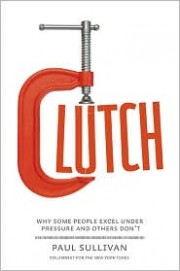
  • Clutch: Why Some People Excel Under Pressure and Others Don’t

    I heard Paul Sullivan speak yesterday at the Milken Institute in Santa Monica. The subject, of course was his book, Clutch: Why Some People Excel Under Pressure and Others Don’t.

    While much of the audience wanted to cling to a romantic definition of “clutch” that was significantly different than Sullivan’s, I thought he did a great job of carving out a specific angle that both set the stage for his research into extraordinary performers as well as make “clutch” performance attainable for anyone.

    Specifically, he is examining how some people can continue to do what they are capable of doing on an ordinary basis under pressure. The key being, “do what they are capable of doing on an ordinary basis.” This is not a book on heroics, luck or extraordinary achievements.

    I’ve already purchased my copy and am considering using Clutch for my next “Thought Leaders Unpacked” series so that we can think through Sullivans observations together.

    He works his way through five characteristics of “clutch” performers.

    1. Focus
    2. Discipline
    3. Adaptability
    4. Being Present
    5. Fear and Desire

    He also offers three reason why others do not perform well under pressure.

    1. Failure to take responsibility
    2. Overthinking decisions
    3. Overconfidence

    Keep your eyes and ears open for my decision about the next book we study together in “Thought Leaders Unpacked.” Clutch looks like an interesting, practical, and encouraging option.

    If you are in Los Angeles and not attending the Milken Institute’s free forums, you are missing out on a great resource. They invite extremely interesting people to introduce their latest books in the context of an open forum. There is time for Q & A and always a book signing.
    Thought Leaders Unpacked” is a regular column on this blog where we read a key book together, and I post my reflections on one chapter each week. My reflections are my own and are intended to generate conversation, catalyze additional thinking and encourage mutual learning.
  • Loving Monday: Which is More Work?

    loving_mondayWhich is more work: giving yourself fully to the task at hand or holding back?


    It’s a open question. It’s also a loaded question.

    My suspicion is that holding back takes more effort than working hard.

    Holding back requires constant reflection. “How much is just enough?” “Am I putting in more than I’m being paid for?” “Is anyone watching?” “What time is it now?”

    Giving your all requires no extra effort and involves no mind games. You simply go for it.

    You’re free and focused to a degree unavailable to the person holding back.

    Think about your own approach to work and working hard. Which days go by the quickest? On which days do you experience the greatest sense of achievement?

    Why begrudge going the proverbial “extra mile” with someone when I imagine we’d have already gone the extra mile and come back by the time we sweated through whether we were being taken advantage of or exceeded the requirements of our job description or won’t be appropriately appreciated.

    You can hold back if you choose. It may be appropriate. It may be fair. It may be justified. But it will certainly be a lot more work.

    Loving Monday is a weekly column designed to encourage us to step into our weeks with an intention to show up authentically, engage fully, and choose to make it a good week for ourselves. Explore past columns here.
  • Question of the Week #8

    What disincentives to taking the initiative would a visitor observe in our company?

    The Question of the Week is offered to increase awareness of one’s personal leadership practices and encourage experimentation with creative alternatives.
  • Listen In -> Performance Management with Jeff Hunt #2: Managing

    Has it been an entire year since you’ve talked with anyone on your team about their job performance?

    Does it feel a bit awkward to bring up that negative encounter nine months ago?

    Did you miss an opportunity to provide needed resources simply because you didn’t know about the need at the time?

    We are in week 2 of our conversation with Jeff Hunt of Goalspan about performance management, and our topic this week is “managing.”

    After establishing expectations for results having planned, our next step is to establish an on-going conversation about how we work together. Instead of performance management being a single annual event, we are going to make it a process.

    Don’t miss Jeff’s insights into the three components of managing job performance:

    1. Coaching and feedback – Establishing the ongoing conversation.
    2. Supporting learning and development – Providing the resources and training.
    3. Proactively addressing issues as they arise instead of waiting 10 months to the next evaluation.

    What is your process? Do you engage early and often? Do your performance evaluations increase or decrease employee morale, motivation and engagement?

    Listen in.

  • Thought Leaders Unpacked -> Integrity #1: The Three Essentials

    thought-leadersCompetence. Alliances. Character. The “three essentials.”
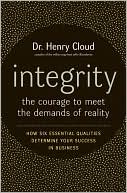
    While affirming the crucial importance of the first two characteristics of successful people, Henry Cloud introduces his book, Integrity: The Courage to Meet the Demands of Reality, with the spotlight on character.

    Integrity, by Henry CloudThe significance of this insight to these times of economic turmoil is huge. I would suggest that it was competent, well-connected professionals who lacked the third essential, character, who got us into this mess. People who could carry out their functions and leverage the systems with spectacular agility, but who did not know for what or for whom (other than themselves) or to what end they worked so hard.

    The timing for such a book as this could not be more significant. The value of such a discussion (more…)

  • Question of the Week

    How do you identify how well you performed today?

    The Question of the Week is offered to increase awareness of one’s personal leadership practices and encourage experimentation with creative alternatives.