When you think about your team, do you see an organizational chart and job descriptions or individuals names, faces and the unique contribution each person makes to their position?
Tag: leadership
-
Tim Ferris and The Entrepreneur’s Rollercoaster

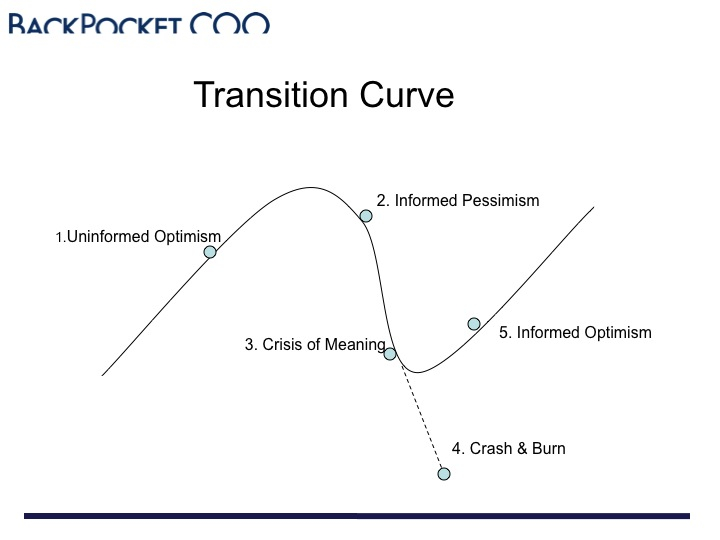
For my fellow entrepreneurs who also swing between self-worship and self-accusation, I came across this helpful diagram over on Tim Ferris’ blog.
It comes from the work of Cameron Herold. In this post he describes four stages of an entrepreneur’s “rollercoaster.”
- Uninformed Optimism
- Informed Pessimism
- Crisis of Meaning
- Informed Optimism
It’s a valuable read. Check it out and let me know where you currently fall in your rollercoaster experience. What might be a practical next step for you?
-
Question of the Week
How often is your anger an intentional leadership decision made for the benefit of the team, and how often is it a uncontrolled personal reaction benefiting only you?
The Question of the Week is offered to increase awareness of one’s personal leadership practices and encourage experimentation with creative alternatives.
-
Question of the Week
What would the members of your team say is your greatest leadership asset? …liability?
The Question of the Week is offered to increase awareness of one’s personal leadership practices and encourage experimentation with creative alternatives.
-
Question of the Week
While making a decision may cost you if it doesn’t work out, not making a decision will cost your more. How do you quantify the costs of your indecision?
The Question of the Week is offered to increase awareness of one’s personal leadership practices and encourage experimentation with creative alternatives.
-
Question of the Week
How would it affect your leadership style if you considered yourself primarily accountable to your staff instead of to your supervisors?
The Question of the Week is offered to increase awareness of one’s personal leadership practices and encourage experimentation with creative alternatives.
-
Question of the Week
Who on the team can you go to for honest, constructive feedback about your working style or communication effectiveness? What would be involved in developing such a relationship?
The Question of the Week is offered to increase awareness of one’s personal leadership practices and encourage experimentation with creative alternatives.
-
Blind Without New Perspectives
 Leaders often assert that they are “big picture” people and can’t be bothered with details.
But perspective does not work that way.
Beside the fact that any time a leader says he or she can’t be bothered with something, it is a significant clue that they are out of their element and making an excuse.
We are learning that there are more perspectives than merely the traditional forest versus the trees, or whether I’m standing in my shoes or yours.
What about the perspective of an unfolding future? Whether standing still or in motion ourselves, life, relationships, technology, laws, personal health, our competitors, the economy are all changing around us. As the future unfolds, how and where do our choices fit in and become part of what takes form?
How, as a leader, do you pay attention to an unfolding future and consider its implications to your business?
What about the perspective of human development and maturity? However sound our organizational charts and however well-defined our job descriptions, the individuals who embody those lists are continually developing, learning and expanding their capacities.
How, as a leader, do these individual developmental trajectories inform your planning, business development, and/or strategic thinking?
What other perspectives should we be considering?
-
Should I Be Firing Myself?
 In the best spirit of No Excuses Leadershipâ„¢, I’m delighted to find Lisa Haneberg over at Management Craft suggesting that leaders might recognize for themselves when it’s time to move on.
My favorite Question of the Week for leaders to ask themselves is: “How might you be a part of the problem that won’t go away?” I like it so much because it points to the heart of leadership effectiveness, which is self-awareness. Knowing how you show up at work and the impact your presence, actions and words have on others.
“Be WITH the team, or change teams,” Lisa exhorts. So many of us make the mistake of making our own vantage point our sole frame of reference for evaluating the big picture. But a vantage point is just that… one point among many. Is it because we have more power that we get to let ourselves off the hook and blame the team for missed goals, petty in-fighting, or poor customer service?
I think not. The leader is always ultimately responsible for what happens on the ground. No excuses.
If we haven’t talked recently about the challenges you are currently facing, let’s do so. Give a call or shoot me an email. Your contribution is too important to ignore.
On your side,
– Karl
-
Controlling or Cruising?
Toward which extreme would your planning approach tend? Controlling or cruising?
Do you try to control more than may be possible, humanly speaking? Stick to tight schedules even if it means working nights and weekends. Keep everyone on task even if it means writing standard operating procedures for sharpening pencils. Coordinate activities across departments even if it means nagging people several times a day.
Or have you given up on planning? Circumstances change too quickly on the ground for any plan to stand a chance of being implemented. Technology will change, a competitor will undercut your break even price, a key supplier will go out of business, an important team member will go on maternity leave at a crucial juncture. So you cruise. Go with the flow. Use your intuition. Shoot from the hip. Respond to issues as they arise.
(If you haven’t listened to this week’s podcast, take ten minutes now as Claudia and I take on strategic planning as the second segment of our coaching regimen No Excuses Leadership.)
As you’ve probably guessed, both sets of skills are crucial for successful strategic planning. They each address a stark reality leaders face. They each fail when adopted exclusively and universally. There is a vital proactive, aggressive, intentional component to planning. There is also a vital reactive, responsive, perceptive, discerning component.
Where do you fall on the controlling versus cruising spectrum? What have you learned from veering too closely to either extreme?