Karl Edwards presents Working Matters

Tag: communication

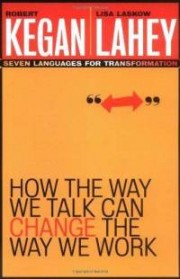
  • Karl’s Library: How The Way We Talk Can Change the Way We Work by Kegan and Lahey

    Set aside what you’re currently reading about leadership.

    If you want to transform your impact as a leader, you need to pick up a copy of How the Way We Talk Can Change the Way We Work by Robert Kegan and Lisa Laskow Lahey.

    Have you ever considered than an annoying employee complaint might also be a valuable personal value needing expression?

    Have you ever withheld an idea for improvement so your supervisor wouldn’t feel criticized?

    Kegan and Lahey provide an entirely new perspective on leadership by paying attention to how we talk to each other.

    They point to seven changes we can make in how we communicate that will reframe how we approach problems and result in lasting change.

    Seven Languages for Transformation

    1. From the language of complaint to the language of commitment
    2. From the language of blame to the language of personal responsibility
    3. From the language of New Year’s resolutions to the language of competing commitments
    4. From the language of big assumptions that hold us to the language of assumptions we hold
    5. From the language of prizes and praising to the language of ongoing regard
    6. From the language of rules and policies to the language of public agreement
    7. From the language of constructive criticism to the language of desconstructive criticism

    The shift we need to make as leaders is internal. When we see the conversation differently ourselves we will be able to have a different sort of conversation with others.

    You can continue to blame the rest of the team for their shortcomings. You may even be accurate in your assessment. But you will not see change.

    When you’re ready to try something new, try taking a look at how “the way you talk affects the way the team works.”

    You can get a copy of the book here.

    Karl’s Library is a weekly column highlighting my favorites from my professional development library. “Always learning” is one of the pillars of my personal mission statement. Explore past columns here.


     

    If you’re a Kindle fan like I am, it is available for the Kindle.

    Don’t have a Kindle? Get one! You’ll love it.

  • Listen In -> Clutter: Friend or Foe? #4: All Those Communication Options

    I got another angry email from Fred before I had a chance to respond to his first. Why doesn’t Nancy return my calls? Did I really need to receive so much information about Kendra’s breakup?

    Choosing to communicate via phone, text, email, or social network is not only a matter of personal preference, but must take into account the recipients preferences as well.

    Calling someone who never answers their phone is worse than futile. 

    Leaving a long phone message for a busy person is almost a form of cruelty.

    A new form of clutter clouds our focus with so many communication options available to us. Not only are there more means of communication than ever before, each person’s communication preferences vary.

    In this week’s podcast discussion, web developer Jorge Rosas and I discuss the problem of keeping track of this exploding world of communication options. What used to be a simple conversation can now be anything from a live video chat to an abbreviated text message.

    How do you keep track of who responds best to a text message and who responds best to a personal call? How do you know which messages need to be delivered in person and which messages can be published on a public social network?

    Listen in.

    Just now joining the conversation? Catch up on the entire series here.
  • Clippings from Don: Dumping the Dreaded Performance Review

    Everybody hates performance reviews. As much is not news to anyone.

    More interesting is the lack of creativity in designing meaningful and effective alternatives. 

    In this morning’s Wall Street Journal, Rachel Emma Silverman takes a look at the fading allure of this rigid, intimidating and counter-productive time-waster.

    Teams need to be able to communicate about their work. Everyone needs to be able to give constructive and timely feedback to those with whom they work.

    The problem with most performance evaluation processes is that they function exclusively as a top-down tool for ineffective leaders to communicate the negative feedback they didn’t have the courage or grace to communicate throughout the year.

    Two major problems result. The climate of judgment and intimidation makes even the most competent employee reticent to be honest about their (more…)

  • Listen In -> Awkward Communication #5: The Diplomat

    Some people are so nice that no difficult decisions ever get made.

    Instead of focusing on the issue at hand, these people are concerned that everyone involved is happy. Nice but ineffective. Safe but exasperating.

    There are important advantages to having strong diplomatic skills. One can communicate difficult news more effectively. One can keep dialogue going with impossible personalities. The list goes on.

    There comes a point, though, when the diplomat’s need for smooth waters and happy people supercedes actual effectiveness.

    For example, when it comes time to make an important decision that is going to upset some people, the diplomat will postpone the decision in hopes of creating an alternative with which everyone will beg happy. For time or opportunity sensitive decisions, such prevarication can be costly.

    Is there a way to weigh the costs and benefits of choosing to be the diplomat? Are you diplomatic out of a professional conviction that such a course is the most constructive or out of a need to avoid conflict, disagreements and bargaining?

    Listen in.

    Just now joining the conversation? Catch up on the entire series here.
  • Thought Leaders Unpacked -> The Answer to How is Yes #5: Sustaining the Touch of Intimacy

    thought-leadersIntimacy is an awkward word to use in the context of the workplace.

    We usually associate intimacy with romantic relationships, family relationships, and close friendships… in that order.

    Block highlights the importance of this human, relational, connected, interactive, interdependent reality of working with other people.

    As you know, I have long counted “Intimacy” as one of the five fundamental “Cries For Life” that, when working with people, we need to account for. So I was very excited to jump headlong into this subject.

    I came away from this chapter a bit hungry still.

    I thought Block did a better job warning of the dangers of virtual relationships, marketing based relationships, and digital isolation than he did of proposing strategies and ideas for building intimacy into one’s workplace relationships and culture.

    Having said that, I did come away thinking hard myself.

    The issue of showing up versus hiding at work arose for me. I can choose whether to bring myself fully to my work and the other team members or I can (more…)

  • Listen In -> Awkward Communication #4: The Nagger

    Is there anything more annoying than a supervisor that doesn’t trust you? They hover over your shoulders, check in repeatedly, and ask petty follow-up questions so often that there’s hardly time to act upon the previous interruption.

    We call this person the nagger.

    Maybe this person is you!

    The problem is different depending who on the team is the nagger.

    When you are the nagger, you would be well-advised to take another look at its “effectiveness” as a communication approach.

    When your boss or someone else on the team is the nagger, then you have to explore what drives their need to nag. Once you understand where they’re coming from, you’ll be better positioned to communicate why it doesn’t work with you.

    Listen in. (Before you go crazy!)

    Just now joining the conversation? Catch up on the entire series here.
  • Listen In -> Awkward Communication #3: The Intimidator

    Some people begin communications with threats, manipulations, or posturing.

    These bullies shut down communication before it gets started.

    Intimidation is a tool of the insecure to head off discussion, criticism, and/or reservations.

    If this is you, then you are inadvertently robbing yourself of the expertise, passion and experience of those on your team.

    If this is your boss, you need to find a way to keep the conversation going without getting defensive or giving up.

    Many intimidators don’t consider themselves intimidating, and are mystified by the silent acquiescence of those around them. Other intimidators interpret the silence as affirmation and agreement, furthering their impression that they are right.

    Is there anything you can do?

    Listen in.

    Just now joining the conversation? Catch up on the entire series here.
  • Listen In -> Awkward Communication #2: The Time-Bomb

    Where did that come from?!

    She just exploded, seemingly out of nowhere, in a flood of harsh expletives.

    You’ve been skipping the Tuesday planning meetings for weeks now. You’ve been under a lot of pressure, and you needed the extra time to stay on top of demands.

    All these weeks your boss never said a word… that is, until today. And now the words are loud, angry and hurtful.

    What went wrong?

    In this week’s podcast discussion, Claudia and I discuss these ticking time-bombs.

    Some people quietly let misunderstandings, disappointments and problems simmer and stew until they eventually explode in an eruption of venomous fury.

    Is this you? Your boss? There are alternatives!

    Listen in.

    Just now joining the conversation? Catch up on the entire series here.
  • Listen In -> Awkward Communication #1: Learning to Embrace Messy Realities

    Communication is a messy business.

    Anyone who tells you otherwise is lying or trying to sell something.

    Yes, in a perfect world all communication would be clear, direct, concise, sensitive, and persuasive. But we do not live in a perfect world.

    Instead of wishing vainly that our communications were ideal (or at least our boss’s were), what if we approached communicating as a messier, more awkward dynamic?

    Claudia and I begin a new series this week entitled, “Awkward Communication”, where we explore several common communication styles.

    Maybe you’ll see glimpses of yourself in these dynamics. You’ll definitely see aspects of your boss and co-workers.

    More importantly, we hope you hear insights into why people slip into these ineffective practices and take away some alternatives that will serve you better.

    Awkward Communication
    Week #1: Learning to Embrace Messy Realities
    Week #2: The Time-Bomb
    Week #3: The Intimidator
    Week #4: The Nagger
    Week #5: The Diplomat

    Listen in.

  • Clippings from Don: The Many Powers of Maybe

    Elizabeth Bernstein in Tuesday’s Wall Street Journal offers a pithy and insightful look at the growing practice of answering “yes-or-no” questions with a “maybe.”

    I‘ve long interpreted “maybe” as a polite “no.” My experience in my circles has been there are only two answers people give, “yes” and “maybe.” But evidently there are as many definitions and uses of the word as there are socially indirect communicators.

    After offering a variety of reasons why a person might respond to a question with an answer that is not an answer at all, Bernstein does a nice job of alerting us to awkward, insensitive and unhelpful impact our “maybe” has on the questioner.

    While interesting to read the reasons (excuses?) people opt for the non-response of “maybe,”  the insight is small consolation. That’s like asking an abused spouse to be more understanding of why her or his spouse is so violent.

    The person needing the counseling is the perpetrator not the victim.

    This is where Bernstein’s insights about the negative impact of a “maybe” response are worth their weight in gold to the discerning reader. If a few more of us find more direct ways to communicate our situations, then the word, “maybe” wouldn’t have to do so much more work than it really can.

    Take a look at the article here. How often do you find yourself using “maybe” as a response? How do you feel when you receive “maybe” as a response to your invitations?

    On your side,

    – Karl Edwards

    Voracious reader friend Don Silver always has an eye out for what interests me. Clippings from Don is a column where I pass on some of these articles, stories and resources to you.