For each of your high potential subordinates, what is a practical way you can extend trust before asking to be trusted?
Blog
-
When To Play Your Weaker Players: The Leader’s Conundrum
 Does anyone really play their weaker players when serious about winning the game?
It’s a nice sentiment. But if victory is at stake, rare (probably non-existent) is the coach who decides to extend an opportunity for challenge to anyone other than their best.
But how do your weaker players become stronger players when they get no game time?
Experience is a vital and irreplaceable form of training.
So do you risk the game on building a stronger future? Do you even have a future if you don’t build your weaker players?
But will you have a future if you don’t play to win now? What if the game ends early because you bet on the future and lost in the present?
I don’t know that there’s a definitive answer to these questions.
And that’s the point. The conundrum. The choice every leader faces. The risk every leader must take. Does take. Takes whether he or she knows it or not.
What are you doing to develop your weaker players? Is it worth it? How do you decide how much of the present game to risk on the future game?
How do you deal with this leader’s conundrum?
On your side,
– Karl
-
Listen In -> Performance Management with Jeff Hunt #2: Managing
 Has it been an entire year since you’ve talked with anyone on your team about their job performance?
Does it feel a bit awkward to bring up that negative encounter nine months ago?
Did you miss an opportunity to provide needed resources simply because you didn’t know about the need at the time?
We are in week 2 of our conversation with Jeff Hunt of Goalspan about performance management, and our topic this week is “managing.”
After establishing expectations for results having planned, our next step is to establish an on-going conversation about how we work together. Instead of performance management being a single annual event, we are going to make it a process.
Don’t miss Jeff’s insights into the three components of managing job performance:
- Coaching and feedback – Establishing the ongoing conversation.
- Supporting learning and development – Providing the resources and training.
- Proactively addressing issues as they arise instead of waiting 10 months to the next evaluation.
What is your process? Do you engage early and often? Do your performance evaluations increase or decrease employee morale, motivation and engagement?
Listen in.
-
Loving Monday: You Forgot What I Was Angry About?!
 Some of us never miss an opportunity to resent.
Given that it’s Monday, we’ve already lost a good portion of our weekend re-living the crime. “How could he be so cut-throat?” “She knew I wanted that assignment.” “Why doesn’t he pull his weight on this project?”
As real and as wrong as the underlying offenses probably are, some other dynamic is going on that authorizes us to stew within ourselves as the selected available option.
Given that it’s Monday, we would be better served if we don’t let our week begin with such a bitter taste in our mouths. It’s going to color everything we do. It might even poison our attitude in unrelated conversations and collaborations.
We need to come up with some alternatives.
We might just need to let the slight go. Put it behind us so that we can free up our hearts and minds to focus on the task at hand. Write if off for the sake of moving forward.
We might need to talk directly to the person involved. Instead of exploding all over them after we’ve reached our breaking point, we attempt a calm, fact-based conversation about the perceived offense.
We need to get creative. While we didn’t get ourselves into this situation, we are simply wasting time and energy waiting for the blind to see. We need to do something for ourselves. We need to set ourselves free to get back to work. Launch a new week. Enjoy loving what we do.
If you’re catching yourself seizing another opportunity to resent, take a step back. Take a look around. Find a better way forward.
-
Question of the Week
How might you value your employees as assets as well as expenses? In other words, how can you measure what you’re losing when you choose to cut staff even while you’re saving on the salary expense?
The Question of the Week is offered to increase awareness of one’s personal leadership practices and encourage experimentation with creative alternatives.
-
Thought Leaders Unpacked -> Integrity #8: What People In Touch Look Like
 Lots to chew on in this chapter.
Being willing to face reality and deal with the facts on the ground is an important skill. A skill I’d say I either already have or am very open to enhancing.
BUT… Cloud then goes and makes a distinction between being someone who actively searches out what reality is, and one who faces reality passively, as it presents itself.
 Talk about a punch to the gut! Suddenly I’m not so sure. Being open to face the facts and turning the house upside down in order to uncover the facts are two very different stances. I don’t think I can lay claim to the second. That hurts. Give me a second to nurse my bruised ego.
Ok, let’s keep going. I find Cloud’s question helpful, “Do I consider reality my friend?” If I don’t… if reality can harm me, diminish me, or discourage me, I am much less motivated to seek it out. If reality is my friend, however painful, I don’t have to protect myself from it. Instead of seeking out reality requiring heroic amounts of courage, it becomes intrinsically trustworthy and continuously welcome.
Insightful here is the built-in protection being a seeker of reality provides against blindness. The horrible thing about blindness is when we don’t know that we’re blind. Horrible in the personal sense that I find the possibility terrifying. Few things frighten me more than not being aware of what I am not aware of.
Only the passive person needs to be afraid, though. Once I become an active seeker out of reality, then I am doing everything I can to get in touch and stay in touch with the facts on the ground. The combination of the active approach and the welcoming stance means that I’m at minimal risk of simply missing out or inadvertently blocking out important information.
Where do you find yourself on the spectrum between actively seeking and passively receiving reality? What do you think about the assertion that reality is our friend?
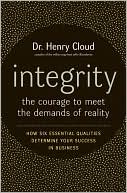
Each Friday I post my reflections from one chapter of Integrity: The Courage to Meet the Demands of Reality by Henry Cloud. If you are just joining the discussion now, welcome! Catch up on the entire series here.
-
My Guest Appearance on “Management Tips”
 Nick McCormick, author of Lead Well and Prosper, interviews me on his podcast, “Joe and Wanda on Management.”
I share my three “Hard Facts of Working with People.”
If you want your team to come alive and give 110% on the job, they need an opportunity to:
- Contribute and make a difference.
- Learn and develop.
- Connect and belong.
Listen in and join the conversation.
-
Listen In -> Performance Management with Jeff Hunt #1: Planning
Are you dreading all the paperwork and lost time involved in annual performance reviews?Are you dreading being judged by a supervisor that doesn’t know enough about what you’re doing to have a meaningful opinion?
Are your annual reviews exercises in self-protection… the supervisor protecting the company from the employee’s entitlement mentality and the employee protecting him or herself from the company’s need to control costs and wages by being stingy with positive feedback?
Get ready to have your assumptions blown to bits by Jeff Hunt, the founder and CEO of Goalspan, who joins us for a new series on Performance Management.
In this first interview, Jeff unfolds a strategy for transforming the dreaded employee performance evaluation into a on-going conversation and intentional management process.
That process begins with planning.
Listen in.
-
Question of the Week
In what ways might you inadvertently be holding your employees responsible for your insensitive communication style? In other words, are they reacting negatively because of their immaturity or yours?
The Question of the Week is offered to increase awareness of one’s personal leadership practices and encourage experimentation with creative alternatives.
-
Can Leadership Be Moral?
 The economic crisis in this country is not simply a result of financial assumptions gone awry.
Decisions were made that had no connection to the benefit of anything or anyone other than the achievement of short term financial results. No connection whatsoever.
 Companies were purchased for their intangible brand value, their assets sold, loaded up with debt, long term employees fired, and resold at a premium re-presented as restructured for success. In reality they were stripped bare and abandoned before the operational implications of high debt and high turnover set in.
All that to say you should read Mike King‘s recent article entitled, “Do You Demonstrate Moral Leadership?” It’s both insightful and practical.
Is your team in conversation about your standards?
If we’re going to reap the benefits of democratic capitalism, then we need to get more voices in the conversation than just the greediest, most driven and most ruthless of us.
What do you think?