 “I predict future happiness for Americans if they can prevent the government from wasting the labors of the people under the pretense of taking care of them.”
Thomas Jefferson
“I predict future happiness for Americans if they can prevent the government from wasting the labors of the people under the pretense of taking care of them.”
Thomas Jefferson
 The problem can seem so straightforward. A runaway complainer. A mounting cost overrun. A slipping schedule.
What if the problem, though, were merely a symptom of something deeper needing attention?

What if addressing the problem on the table was actually preventing you from looking deeper, asking more probing questions, exploring what values and practices were creating the breeding grounds for the issue at stake?
In this week’s show, Claudia and I discuss just this dynamic. Good leaders in bad times don’t settle for relieving symptoms. They dig deeper than the presenting issue and solve for underlying causes and confront systemic dysfunction.
Listen in.
 The circle. From the outside it looks impenetrable and exclusive. From the inside it feels open and inviting.
Those on the outside cannot figure out how to get in. Those on the inside wonder why they are keeping their distance?
Each feeling that the other isn’t taking action to close the gap and viewing themselves as already doing all they can.
In the workplace, “the circle” can be one of the biggest challenges to adding staff to the team. It’s one thing to give a new employee a desk, a phone and a job description. It’s quite another thing to incorporate them into the working community.
Even the most welcoming of departments will have their own language, their own jokes, their own unspoken rules, expectations and ways of going about their various jobs. These idiosyncrasies of this particular community can take quite a bit of time to pick up. In the mean time, one can feel a stranger in the midst of close friends.
The key to change is being able to get into each others’ shoes. To see and feel from the opposite perspective. Look out from their vantage point and understand their experience.
No matter how open you feel your work community is, if you were aware that a newcomer experiences the rhythms that you most treasure as barriers, you can take steps to intentionally draw them in and show them the ropes. And if you are new to the community and feeling excluded, being aware that their unspoken “rules” and code languages are the precious culture of work that these people have come to love and value can help you exchange the feelings of being left out for feelings of attraction to a new way of being community.
In the other person’s shoes, we see what is not evident from our own perspective. We may find that we all, in fact, want to work together and the circle need not be the barrier that it has been.
Are you on the inside or the outside of the circle? How might your perspective be reframed by taking the other person’s point of view?
On your side,
– Karl
“Appeasement is throwing someone else to the crocodiles in the hopes of being eaten last.”
Winston Churchill
After a blistering five weeks of criticizing business and political leadership for the arrogant, blind, brainless, fear-based, power-obsessed, insecure excuse for leadership they have provided in response to our economic crisis, we turn our attention in this next series to proposing a constructive alternative.

Hence our title, Good Leaders in Bad Times. It’s difficult to discern quality leadership in good times, because almost anything everyone does seems to work out okay when the economy is cycling upward.
But when the economy slows down, declines, or collapses, we discover who is all smoke and mirrors, and who is substance.
Here in week one, Claudia and I suggest that effective leadership in bad times begins with a good look in the mirror.
How might you be a part of the problem? Have you considered the question before?
Good leaders in bad times know that what others do and how others show up flows out from who they are and how they show up. In other words, if there is going to be change, it must begin with you.
Listen in and tell us what you think.
Then come back each week for what promises to be a thought-provoking and challenging series!
Good Leaders in Bad Times
Week 1: The Solution Begins in the Mirror
Week 2: The Issues Behind the Problems
Week 3: Training People to be Better Than You
Week 4: Reporting To Your Team
Week 5: Creating a Culture That Get Results
Listen in.
Any life truly lived is a risky business, and if one puts up too many fences against the risks one ends by shutting out life itself.
Kenneth S. Davis
I’m not sure if listening to politicians ponitificate is more exhausting or maddening.
Instead of engaging the expertise of workers on the job and leaders in business, political leaders battle with each other from abstract, partisan philosophies, making decisions with sweeping implications for which they have no means of anticipating and no intention of evaluating.
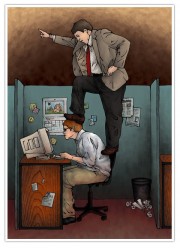 I’m almost to the point where I think we’d be better off never reelecting an incumbent rather than always reelecting the incumbent.
Government policy has a huge impact on business, shaping its boundaries, influencing its priorities, and tinkering with its architecture.
It often feels like we swing wildly between too much and too little government involvement in economy, business and the business of life.
We end our series on Leadership Bullshit in a Tough Economy with a look at the mumbo-jumbo that is posing as leadership among our political leaders.
Listen in.
How do you identify how well you performed today?
 What’s your favorite part of your job?
What specifically are you looking forward to this week? What gets your juices flowing? What do you brag to your friends about? What makes the time fly by?
One way I like to start the week is to remind myself why I am doing what I do.
 Work is a messy place for most of us. A mix of the rewarding and the maddening. Sometimes it feels like the maddening aspects are taking over.
If we can catch ourselves feeling discouraged, overwhelmed, unhappy, or stressed before too much time goes by, we have a better chance to take evasive action.
We can begin the week by reminding ourselves of what we love about our work. Why we took the job. What we’re trying to get out of it.
Even if our rationale wasn’t anything particularly noble, personally motivating or sexy, remembering that we took the job in order to pay the bills (if that was your rationale), can help us maintain a positive perspective in the face of even the most difficult days on the job.
As you jump into this week, take a moment to note at least one thing that you either love about what you do or that you know makes this job worth keeping and bringing your best game to.
On your side,
– Karl
 What do marriage counseling and dog training have in common? Everyone has a psychology.
No. It’s not that human and canine psychology have anything in common. No. It’s not that there are ways to train a spouse just as there are ways to train a dog.
 It’s that if you want to be understood by either a dog or a person, you have to understand what makes the other party tick.
In this week’s chapter of What the Dog Saw, Gladwell explores the world of The Dog Whisperer, Cesar Millan. While the stories of Millan’s various encounters with dogs and their owners were entertaining, it was the story of Millan and his wife’s marriage counseling where the insights began emerging for me.
How easy it is to function solely out of our own frame of reference. We strive to communicate our desires, requests and demands of those with whom we live and work as clearly, plainly and directly as we can.
What about the frame of reference out of which we’re being heard, though? What about the needs, desires and stories of those listening? An assignment that on an ordinary day at work might be received with a respectful nod of assent, on a stressful day—where the employee in question is already juggling more projects than they can handle and just got off the phone with a belligerent and unreasonable client—might be met with the furious and self-protective rebuff/attack of a wounded animal backed into a corner.
If we want to make things happen that involve other people, we do not have absolute control over the process. To the extent that we understand from where the others involved are coming and what their needs and desires are, we can adjust our communication strategy accordingly and exert far more influence over the outcome than otherwise expected.
How do you learn and gauge how you are being understood by others? What was your main take-away from this chapter?