
Wearing competence like a bad toupee.
Karl Edwards
Karl Edwards
 How many times have I imagined myself speaking in front of stadium crowds? If I had a nickel for every time I planned all I would be able to do when my business was big enough to have a full-time team of employees, I’d be rich.
The time I’ve spent worrying about my great products being stolen instead of putting them out on the public table could have built twice as many.
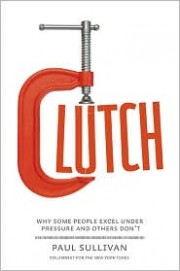
I find myself, again, personally challenged by Paul Sullivan’s insights into what does NOT result in “clutch” performance.
Chapter 8 describes the perils of “overthinking.”
To continue with myself as an example, when working on any given task my mind tends to jump ahead and begin anticipating a plethora of future issues, successes and/or problems that may arise.
My attention and efforts then subtly shift to pre-addressing those issues. Yes, before they even become issues!
It sounds funny and oddly obvious to say aloud, but that’s not how I am experiencing it at the time.
Sullivan’s point is that such efforts are ultimately distracting, unproductive and sabotaging to the attention, focus and presence we need to be applying to the (more…)
 “When I hear music, I fear no danger. I am invulnerable. I see no foe. I am related to the earliest times, and to the latest.”
Henry David Thoreau
Karl Edwards

As if looking for work wasn’t stressful enough.
Interviews can be nerve-wracking affairs. No matter how mutual you try to make the exchange, there is no getting away from the fact that the hiring person has the job and you don’t.

As a result of this power differential, we can easily feel that we are the only one on trial, the only one being evaluated, the only one with much at stake.
Mike King is someone I keep my eye on. He has put together an almost overwhelming list of 100 interview tips. You can find it at: “100 Ways to Ace an Interview” on his web site Learn This.
Suggestion for benefiting from King’s list
Read quickly through the list paying special attention to your initial responses as you do so.
We want to be playing at the top of our game when interviewing. Playing at the top of one’s game, though, does not mean play-acting. It means showing up fully yourself and comfortably yourself.
Click here for Mike King’s “100 Ways to Ace an Interview.”
On your side,
– Karl Edwards
 Too many leaders are unable or unwilling to tell people the truth.
It is sad but true.
This inability to trust others with the truth covers myriad facets of work life. The truth about company finances, the truth about impending lay-offs, the truth about promotion prospects, the truth about changing deadlines, the truth about management planning… and the list goes on.
 Today I want to focus on the unfortunate reality that so many leaders cannot tell you the truth about you.
FACT: Everyone has strengths, skills, talents and abilities. Therefore there is always something to affirm, empower and reward about everyone on the team.
FACT: Everyone is imperfect, learning, makes mistakes, chokes, falters, and fails on occasion. Therefore there is always room for constructive confrontation.
If leaders could tell people the truth about themselves, they would never be at a loss for extending compliments, expanding responsibilities or extending rewards. At the same time, in the ordinary course of events, leaders would be pointing out (more…)
“It is not power that corrupts but fear. The fear of losing power corrupts those who wield it, and fear of the scourge of power corrupts those who are subject to it.”
Aung San Suu Kyi
Karl Edwards
 After your meeting is over does everyone simply go back to what they were doing before the meeting as if nothing had just taken place?

We are busy people, and new ideas, initiatives, changes and decisions that come out of a meeting often fail to get implemented.
One of the reasons we hate meetings is because nothing changes. All that time. All that energy. The many discussions. The haggling. The compromises.
And then…
Nothing happens.
The unspoken message is that the effort was a waste of time.
Find out what follow-up can do for your meeting.
Listen in.
“Being unready and ill-equipped is what you have to expect in life. It is the universal predicament. It is your lot as a human being to lack what it takes. Circumstances are seldom right. You never have the capacities, the strength, the wisdom, the virtue you ought to have. You must always do with less than you need in a situation vastly different from what you would have chosen as appropriate for your special endowments.”
Charlton Ogburn