Karl Edwards presents Working Matters

Category: Working Matters

  • Listen In -> Bad Resolution Recovery #1: Sweeping Changers

    Probably the main reason New Year’s resolutions go awry is that we take on too much at once. We shoot for sweeping change.

    Noble as these aspirations are, they often result in discouraging us. Anything less than full implementation gets experienced as failure. Resolutions become not fun real fast as we swing between inspirational goal and deflating reality.

    In this week’s podcast interview, Claudia and I discuss alternatives to this all-or-nothing approach to change. Consider incremental adjustments that take you one practical and achievable step at a time toward your admirable aspiration.

    Join the discussion. Listen in now.

    powered by ODEO

  • The No Asshole Rule

    Robert I. Sutton. Business Plus. New York, NY. 2007.

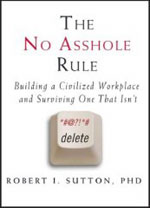
    No Asshole RuleWhy do some people get away with treating others with disdain? Why are they so often in positions of power and authority? What can we do about it?

    I’m having so much fun with this book, that I haven’t even finished it before telling you about it. This is one I wish I had written myself. It is surprisingly refreshing to have the assholes among us identified openly.

    My favorite part is that Sutton calculates the “Total Cost of Assholes.” The difficulty of quantifying the costs of lousy management has long been a loophole for these horrific leaders. When they slash bonuses, the bottom line seems to improve instantly to their “credit.” The loss of morale and the departure of key team members doesn’t show up as directly or as quickly in the accounting reports.

    Not merely an attack on the creeps in our ranks, this book is a practical response to those who would have the workplace be different. Make sure you’re not being as asshole yourself, and get new ideas for surviving those who are.

    Check it out. Helpful and fun at the same time.

  • Would You Prefer to Change or Adjust?

    As much as we might want it, lasting change often eludes us. Whether we’re leaders or team members, we hope to become something better. We hope to see differently and learn to work differently. But relating in new ways doesn’t come as easily as we would like.

    I’m not going to try to explain it. I’d be a different person myself if I could slip into the changes I’ve wanted through the years. The fact is that I still have many of the habits that I’ve had for most of my professional career.

    Getting frustrated doesn’t help. Kicking myself doesn’t help. I need an alternative. How about simply making an adjustment?

    Maybe change requires a more patient, less performance-oriented approach than many self-help books would have us believe. Growing up personally and professionally is a developmental process as much as a trained and practiced process.

    Maturity comes before proficiency. That means I take practical steps in small increments. I don’t aim for wholesale changes or sweeping transformations. Instead, through small every day decisions, I gradually mature into:

    • increased self-awareness
    • internal integrity
    • outward consistency
    • relational connectedness

    It’s worth the effort, because the results are real:

    • enhanced performance
    • increased professional confidence
    • consistent creative energy
    • sustained drive

    Okay, those are a lot of big words and abstract concepts. They come down to this: adjust where you can and go from there. Don’t worry so much that you’re not where you think you should be (or others think you should be). Just keep trying something new every once in a while and see how it goes.

    We don’t want to be the proverbial guy who keeps hitting his head on the same low-hanging door lintel. Nor do we avoid hitting our heads by never getting up at all. We simply learn to duck. We learn to adjust.

    What strategies have helped you adjust–either professional, personally or both?
  • Tired of Watching From the Sidelines?

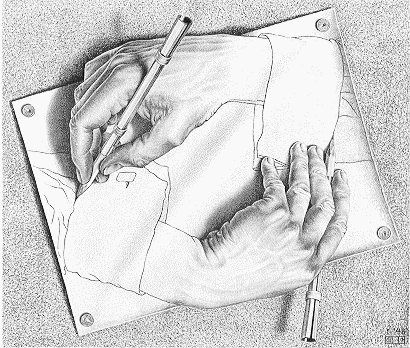
    Hands DrawingThe extent to which we show up is the extent to which we can contribute.

    If we wait at the edge of the room for someone to invite us to the proverbial table, we have only ourselves to blame when no one seems to notice all our talent standing there unused.

    We don’t ask if there is a seat for us. We take a seat… our seat. We wear ourselves comfortably and without second thoughts. And in the process of participating, we become co-authors of the unfolding story.

    If you’re tired of the picture others seem to have of you, then draw one yourself. Don’t leave either the artwork or the interpretation to others without finding a way to participate yourself.

    I think you’d be surprised by how much you will accomplish my merely choosing to show up yourself.

  • Instead of “Resolution” try “Adjustment”

    When it comes to New Year’s resolutions, we tend to think in all-or-nothing categories. Success or failure. Treasured annual tradition or wasted exercise in self-flagellation.

    What Claudia and I are trying to do in our current podcast series, is help us find ways to keep the benefits of the tradition but lose the baggage associated with its impracticalities.

    It is a good practice to periodically pause and take a look at oneself. Think through what’s working well and where adjustments would be appropriate. The new year provides a convenient calendar point around which to schedule such a review.

    Instead of throwing the proverbial baby out with the bath water, join us in this process of customizing the resolution making and keeping process to fit your working style.

    Click the audio player in the right column to listen now. Or subscribe to the audio feed to receive each recording as soon as it is posted.

  • Listen In -> Recovering From Bad New Year’s Resolutions

    Now that January is about over, is the same true for your New Year’s resolutions? All those bold decisions, ambitious plans, and good intentions from 4 weeks ago… If they’re scattered around your feet as just so much discarded failure or discouragement, then this is the podcast series for you!

    Claudia Rempel is back in the studio with her flair for getting to the core of issues. Instead of getting caught in a pattern of make-a-resolution -> break-a-resolution each year, we discuss ways to redeem this tradition and turn it into a useful change tool.

    In this series we will look at four types of resolution makers:

    1. The Sweeping Changers
    2. The Don’t Bother Cynics
    3. The Half-Hearted Intenders
    4. The Rigid Disciplinarians

    Each approach has a downside that sabotages our desire for change. But each approach has an upside that we don’t want to lose track of either. Join the discussion as we have some fun getting inside why change is so hard for us.

    Listen in.

    powered by ODEO

  • Idea Link: To-Learn Lists

    You know how I’m always pushing the value of lifelong learning. I came across a fun (even useful) idea that I thought you’d enjoy checking out.

    Scott Young suggests having a “To-Learn” list. More intentional and less haphazard than casual reading, so you’re more likely to make progress in more areas. But still simple and doable, so you’re less likely to put it off as you might a degree program or developing a long-term plan.

    Check it out. Give it a try. Don’t be surprised if it turns up in one of my coaching assignments.

  • People or Positions?

    Team PlanesWhen you look at someone on your team, do you see a person or their position?

    Are the unique characteristics of each employee the secret treasures that enhance or the troubling booby-traps that derail the effective performance of any given job description?

    Whether you get excited or annoyed when someone doesn’t fill their role as you defined it is an important clue to whether you believe the value comes from who is on the team, or from how you organize the team.

    It is not a simple either/or. Both are obviously significant. But in this age of professional empowerment, I’d err on the side of over-valuing my team members and letting their individual make-ups inform my organizational structure rather than the other way around.

    What do you think?

  • Navigating Leadership Fog

    Foggy NightShivering in the night fog, I find myself at the crossroads of decision and…

    I can’t bring myself to say the other word. Too many internal messages suggesting only the weak use it… or admit to it.

    Is the word, “fear?” Is it, “failure?” Or possibly, “doubt?”

    As many leaders do, I could choose to disconnect with myself. Plow ahead. Ignore this noise. Pretend what I want into existence.

    Or I could risk challenging the negative slant associated with this leadership unmentionable. I might choose to view it as a source of information. A potential clue to my way forward.

    Maybe curiosity is a more effective way through the fog than bluster. Could it be I’m looking for a better question more than a better answer?

    How do you navigate the fog?

  • Out-of-Contact Doesn’t Have To Mean Out-of-Touch

    If your working rhythm thrives on extended periods of concentration and focus, you need to turn off the phone, close your email browser, quit all your messaging programs and close the door. No question about it. No question, that is, from your perspective.

    Continuing our discussion of this week’s podcast interview with software developer Jorge Rosas, from the perspective of others (clients, team members, supervisors) a complete communication cut-off can be quite disconcerting, if not problem-causing.

    What we want is for others to feel that we are accessible without having instant accessibility be the only form contact can take.

    All communication technologies include a means to notify others of how and when you will respond to their contact. I have found that as long as others hear:

    1. That their message is important to you, and
    2. A time frame for when you will get back to them, they will be satisfied.

    Now your communication “absence” serves both your working needs and others’ contact needs.

    Please don’t sacrifice your own effectiveness in order to stay in touch with others. Those are not mutually exclusive outcomes.

    How do you get things done while remaining accessible 24/7?