 “Nothing will ever be attempted if all possible objections must first be overcome.”
Samuel Johnson
“Nothing will ever be attempted if all possible objections must first be overcome.”
Samuel Johnson
 I am the world’s foremost expert on being me.
I am a novice at being someone else. Anyone else. Even someone else from whom I might have a lot to learn.
Yet so many consultants, coaches and career counselors are advising us that we need to be someone other than ourselves.
 “If you want the job.” “If you’re serious about the promotion.” “If you want to negotiate well.”
I find myself over-thinking interview and sales situations. I am managing both a conversation with the person I am with as well as a conversation with myself about how I am going about the conversation with the other person.
How can I possible be fully present with someone when I am preoccupied with talking to myself?
I’m not! is the answer I pretty consistently receive from those willing to tell me.
Key for me has been realizing that I am an incredible expert on being myself. The task doesn’t require any more thinking. I can give my full attention to the issue on the table and the people I am with.
When I let go of the need to impress, to appear unrealistically competent, or to artificially mirror the qualifications of an attractive job description, I am free to come alive in the skin within which I am most comfortable—my own.
I make a very attractive “me.” Even if I’m not a fit or match for every client, job or interview, I will come across infinitely better as myself than any image of competence I might be tempted to put on.
It’s simply much easier to be oneself.
On your side,
– Karl Edwards
 Work, organization and communication all come together when we collaborate with others.
Do our technology tools facilitate our efforts or complicate them? Propel us forward or hold us back? Enhance our effectiveness or stymie it?
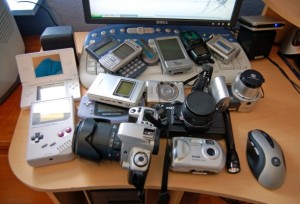
It’s easy to get the thinking process backwards when it comes to what technology will help us best collaborate with others.
In this week’s discussion, Jorge and I turn the thinking around and and suggest that different expected outcomes require different methods of collaboration.
It therefore becomes counter-productive to begin with choosing a technology solution.
Confusing? Listen in.
 How do you approach thinking about the failure of large, complicated, systems like a nuclear reactor or a space shuttle disaster?
Assigning blame is one goal. Understanding what happened and why is a similar but different approach. Fixing the specific failure so that it doesn’t happen again is another related goal.
 Gladwell, are you getting used to this yet?, turns our usual frames of reference on their respective heads.
It turns out that I’m probably a “normal accident” waiting to happen. Forget complex nuclear power plants or space shuttles for a moment.
What about the complexities of a person’s life?!
Work, family, relationships, projects, chores, play, and the unexpected all taking place simultaneously, consecutively, purposefully, randomly, wonderfully, and yes, every great once in a while, tragically.
It should not come as a surprise that, through no one’s particular act of negligence or incompetence or poor judgment, there might eventually occur a horrible accident.
In our narcissistic, litigious culture we survive and thrive on finding someone other than ourselves to blame and hold responsible for anything that harms us. But that may not always be either the case or even possible.
What alternative interpretations of “normal accidents” can we use to help us not only cope, but come out healthier on the other side of that which most horribly rocks our worlds?
What do you cope when the hard-to-explain brings harm into your life? What was your main take-away from this chapter?
 You want the week to begin well. You get up and prepare with good intentions. “I choose a positive, constructive attitude as I launch this fresh, new Monday morning.”
But reality is not kind this week. Joe called in “sick”… again. Sarah won’t help a co-worker meet an important deadline. An important client wants to renegotiate your fee. Management unexpectedly slashed your budget mid-year.
 And what began as a positive, constructive approach to the week is rapidly devolving into an dark and ugly—however understandable—reaction to the disheartening choices of others.
Here’s the deal, though. Attitude is not the same as emotions. We may feel discouraged, frustrated, or angry. Understandable and appropriate in the given examples.
Attitude, though, is a choice. Attitude is a stance. Attitude is the stance I choose to take regardless of what I am feeling.
Like any difficult choice, we need to practice and practice and practice embodying the attitude we choose.
We don’t merely flip a switch in the midst of experiencing a serious setback (more…)
“For if there is a sin against life, it consists perhaps not so much in despairing of life as in hoping for another life and in eluding the implacable grandeur of this life.”
Albert Camus
Do you find yourself sending an email, leaving a voicemail and texting your message just to make sure you get through?
With such a wide repertoire of communication options available today, we should be communicating more effectively, not less.
And yet.
How do you choose which communication method or technology to use for your various purposes?
In this week’s show, Jorge and I discuss whether we’ve got the cart in front of the horse when we assume the best way to communicate is always by using the latest technology.
Listen in.
It’s an interesting thought. Attractive to some. Repulsive to others.
Getting dressed in the morning can be such a hassle. Every day. The exact same routine. Time that could be spent at work (or in bed) is wasted on getting dressed.
 I’m not talking merely of the chore of tracking down the missing sock, choosing which shoes to wear or which tie matches best.
I’m talking about what “look” you’re trying to create. What sort of part you are looking to play in today’s unfolding drama at the office.
Some of us are trying to look more professional than we feel. Maybe look older, maybe younger, smarter, more successful, more confident, etc. etc. Some of us are trying to fit in. Show that we belong and are of the status and caliber of everyone else.
That’s a lot of work each morning! Putting on an entire persona is no small task.
What if we went to work naked?
Go ahead and cover up your body, so we aren’t distracted. But don’t spend any time covering up who you are. Dispense with the showmanship, the masquerade, the pretending.
You will do a much better job coming across as you intend simply being yourself than you ever stand a chance of doing trying to be some imagined ideal of a leader, professional, or expert.
Think of all the time and emotional energy you will save not meticulously crafting this image each morning!
Being comfortably and unconsciously yourself frees your mind up to focus on the issues, people and problems that will confront you as soon at you get to work. As a result you will do a much better job of being present for and practically dealing with anything that comes your way.
You are the best thing you have to offer the team at work. Don’t cover it up!
Experience the freedom of going to work naked today!
On your side,
– Karl Edwards
“You cannot dream yourself into a character; you must hammer and forge yourself one.”
Henry David Thoreau
Every week I feel like I’m saying, “This is my favorite chapter.”
So this week I’ll say, “This is my favorite chapter… so far.” Are men my age allowed to say, “OMG!” Earthquake to my soul.
The difference between choking and panicking. The difference between thinking too much and thinking too little. The difference between thinking when you don’t need to and not thinking when you do need to.
The first sort of over-thinking interferes with your natural (or practiced) ability to do what you need to do, and tragically you don’t do what you ordinarily would be able to do. The second sort of under-thinking interferes with your ability to put your brain to work when you need it most, and tragically you never get the opportunity to do what your brain would have otherwise been able to help you choose.
Choking or panicking.
I almost never panic. I tend to remain calm in crisis, my thinking somehow becomes clearer, and my willingness to act decisively heightens. I’m not sure why that is. I’ll just be thankful.
Choking, though, is another story altogether. And here is where this chapter was so enlightening for me. When faced with an important interview, for example, I respond to the importance by trying harder. That response has always made (more…)