
“Don’t rock the boat,” fear lied.
Karl Edwards
 For those of you who believe in cracking the whip in order to make sure everyone is working as hard as they can every minute that they can, stop reading here. You won’t appreciate this week’s podcast episode.
In fact, those who keep all their other resources tied up and busy should probably read elsewhere also.
 The reason is simple. In this week’s podcast discussion Van Wray of Amperant Advisors and I take a look at the importance of building some slack into our plans.
You read it correctly. Slack. Intentionally.
Not all opportunities or problems can be anticipated.
What if an unexpected opportunity came along, and we couldn’t respond because all our resources were already committed?
What about the work stoppage at one of your key suppliers? Now you’re off plan before you’ve even begun.
Unless, that is, you’ve built slack into your strategic plans.
How does one plan for the unexpected? How can we plan around what we cannot control?
Listen in.
The sumo wrestler is not one of sport’s more attractive images.
But today it is the perfect image.
When considering meaningful sports analogies for strategic planning, we usually lean toward the agile and light of foot. Relay races, basketball teams, and even sedentary chess come to mind.
We lean toward these images because they illustrate the aggressive, fast-paced, and/or savvy thinking that we want to characterize our planning efforts.
For some issues, though, our goal may be to NOT go backwards.
Have you considered that?
In this week’s podcast discussion with special guest Van Wray of Amperant Advisors, we discuss the importance of being intentional about those areas where we don’t want to lose ground.
Intentional to the point of articulating it an explicit goal.
For what area of expertise, market penetration, financial position, etc. would it be an aggressive and vital goal NOT to go backwards?
Wondering how to identify what sumo wrestling goals should be a part of your strategic planning?
Listen in.
 It is no secret that we get things backwards once in a while.
Most common is when we discover a solution in search of a problem.
Once in a while, an unanticipated solution reveals a “problem” that we didn’t know we had. The iPod and iTunes are good examples. It wasn’t until we had the option of listening to songs in any order we wanted and buying them in any combination we wanted that it occurred to us that the “album” package was severely limiting.
More commonly we have a brilliant inspiration for a new policy or procedure, gadget or widget, service or organization, but then discover that we are filling a gap no one else perceives or solving a problem no one else is experiencing.
Government agencies are famously addicted to designing rules, processes, paperwork, and systems that either serve no purpose at all (save justify someone’s departmental budget), or address an instance so peculiar and particular that the cost and burden to the 99.9% for whom that instance does not apply scandalously outweighs the benefit to the isolated few.
In between the visionary iPod and the short-sighted NLRB dictating in which states a business can and cannot do business while jobs increasingly move to other countries altogether, is where most of us operate… trying to do a good job, make a difference, and add value.
So three cheers for the creativity, initiative, and energy involved in proposing new ideas!
Where we want to catch ourselves… What we want to make sure we have considered… What we want to stay laser-focused on… is what problem, real or perceived, our idea is solving.
A solution without a problem risks being ignored as irrelevant, dismissed as extravagant, or opposed as burdensome.
How do you communicate your great ideas?
How well do you identify and explain the problem being addressed and the costs of not addressing it?
It may be discouraging to discover that you have come upon a solution in search of a problem. But it will be disastrous if you continue to sell, implement, and/or impose your solution without one.
On your side,
– Karl Edwards
 If you can’t trust yourself, who can you trust?
For many things like confidentiality, favorite foods, and things to fear, most of us have no problem trusting ourselves above all other voices.
But for other things, like working style, decision-making, creativity, and work quality, too many of us seem to believe that there exist standards, criteria and models of excellence to which we must aspire—and until we attain—we must in the mean time defer to those who do.
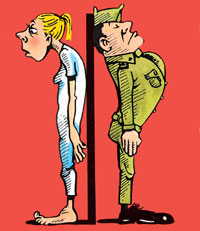 The main problem is that these ones who do… do not exist either.
In other words, we are comparing ourselves to standards and models who do not exist.
Worse than that, the people, bosses, gurus, etc. who are judging us as inadequate, are faking it themselves.
Faking it, though, is too strong a word. Some are faking it, to be sure. Others are simply going about their business being themselves. They are not pretending to be doing anything “right” or “best” or “successfully”. They are showing up, diving in, and leaving all that self-consciousness at the door.
So when I title this article “Trusting Yourself”, I am not talking about putting on bravado, arrogance, elitism, or making decisions in a vacuum in order to demonstrate your competence.
I am talking about an unforced and unrehearsed comfort in one’s skills, training, character and judgment. A calm confidence that who I am is enough.
Comfortable with all that I do and do not bring to the table, I offer my opinions boldly, I listen attentively, I participate actively, I interact respectfully.
My goal is to increasingly trust myself to be fully me. Do you trust yourself?
Or are you haunted by the myths, standards, and messages of success, effectiveness and capabilities suggested by others?
On your side,
– Karl Edwards
If you would like to discuss your situation in more detail, please don’t hesitate to contact me.
Stationery stores are packed with a myriad of clever and cute to-do lists for purchase. Some have check boxes to mark off as each task gets completed. Some have prioritizing systems to help you rank today’s duties in order of importance.
But have you ever seen a not to-do list?
Strategic plans are jam-packed with the meat and potatoes of what you will be doing over the next several years.
But have you ever seen a plan that delineated what you would stop doing this year?
In this week’s podcast discussion with special guest Van Wray of Amperant Advisors we confront the reality that all ideas are not good ideas.
In other words, the good ideas from yesterday may not be the good ideas we need for tomorrow. Which means there will come a time when we need to stop.
Stop certain programs. Stop certain lines of action. Stop offering certain products. Stop certain practices.
Hence the intentionality of thoughtfully developing a “Stop-list” and/or a “No-list.”
Have you thought about what you need to stop doing or what you need to say “No” to?
Listen in.
Office politics sucks.
One would think reasonably mature adults could work through most problems, misunderstandings, and challenges.
But we are not all as mature as we’d like to think we are.
 We see very clearly where others lack maturity, but are less clear-sighted about our own shortcomings.
We have lots of ideas how everyone else needs to change, but seldom see any need to explore viable alternatives for ourselves.
Our only point of control, though, lies with what we can change about ourselves. We cannot change other people.
We can accuse them. We can report them. We can instruct them. We can pray for them.
But we cannot change them.
If we are going to experience change, it will have to begin with us.
The choice is ours… To continue embattled, to become embittered, or to take a good hard look at “how we might be a part of the problem that won’t go away.”
What will you choose?
Call me if you’d like to discuss the details of your particular situation.