Karl Edwards presents Working Matters

Author: Karl Edwards

  • Listen In -> Confrontation for Those Who Don’t Like Confrontation #1: Making Confrontation Normal

    Granted confrontation will probably never be anyone’s favorite task.

    What, though, if confrontation were a mere ordinary, matter-of-fact, and mundane task? Just another workplace reality whenever diverse people and complex systems overlap. Ho hum.

    Could fear and anger be making confrontation more difficult and dangerous than it really need be?

    Join Claudia and I as we begin a new discussion series entitled, Confrontation for Those Who Don’t Like Confrontation.

    Maybe we simply need to change our vocabulary. Instead of “confrontation” we could call it, “talking about difficult issues,” “informing others of your boundaries,” or “clearing up misunderstandings.”

    Problems are to be expected in the workplace. Confrontation should be a normal and dispassionate form of communication that takes place more often than not. Confrontation should be a helpful and constructive activity not a scary or dangerous one. Confrontation should help us work through our problems earlier and more effectively rather than letting them fester and compound.

    Confrontation for Those Who Don’t Like Confrontation
    Week #1: Making Confrontation Normal
    Week #2: Confronting Inappropriate Behavior
    Week #3: Confronting Unacceptable Work
    Week #4: Confronting Not Pulling One’s Weight
    Week #5: Confronting Misunderstandings

    How do you feel about confrontation?

    Listen in.

  • Quote to Consider: Getting Yourself On Your Side

    quote-to-consider“Self-distrust is the cause of most of our failures. They are the weakest, however strong, who have no faith in themselves or their own powers.”

    Christian Bovee

  • Loving Monday: Which is More Work?

    loving_mondayWhich is more work: giving yourself fully to the task at hand or holding back?


    It’s a open question. It’s also a loaded question.

    My suspicion is that holding back takes more effort than working hard.

    Holding back requires constant reflection. “How much is just enough?” “Am I putting in more than I’m being paid for?” “Is anyone watching?” “What time is it now?”

    Giving your all requires no extra effort and involves no mind games. You simply go for it.

    You’re free and focused to a degree unavailable to the person holding back.

    Think about your own approach to work and working hard. Which days go by the quickest? On which days do you experience the greatest sense of achievement?

    Why begrudge going the proverbial “extra mile” with someone when I imagine we’d have already gone the extra mile and come back by the time we sweated through whether we were being taken advantage of or exceeded the requirements of our job description or won’t be appropriately appreciated.

    You can hold back if you choose. It may be appropriate. It may be fair. It may be justified. But it will certainly be a lot more work.

    Loving Monday is a weekly column designed to encourage us to step into our weeks with an intention to show up authentically, engage fully, and choose to make it a good week for ourselves. Explore past columns here.
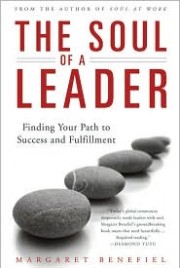
  • Thought Leaders Unpacked -> The Soul of a Leader by Margaret Benefiel

    thought-leadersIf you believe that you need to be self-sufficient, dominant, proficient, and heartless in order to be a good leader, I don’t know whether to welcome you or warn you about our next Thought Leaders Unpackedâ„¢ series.

    More than a challenge to the prevalent myths about leadership in our culture, Margaret Benefiel’s The Soul of a Leader is a guide to a healthier, deeper and more human understanding of leadership. Ironically, or maybe I should say, poetically, the evidence seems to suggest that such a human approach is also the more effective approach.

    From my perspective, it makes perfect sense that it takes a healthy human person to effectively lead other human persons. Strange that so much of the leadership cult and culture today is content with mechanizing and commoditizing what by nature—people—are unique and diverse in talents, interests, styles and motivations.

    What about you? Are you trying to squeeze yourself into the uncritically accepted mold of the self-sufficient, dominant, proficient, and heartless leader? Are you slowly dying inside in the process?

    What if by doing so you were robbing yourself and the world of the very gift you have to offer… you!? You in all your distinctness, passion, giftedness and power.

    Please join me as we explore this renewing and empowering book together. We will be working our way through one chapter at a time. I will post my reflections here each week. I invite you to contribute your reflections in the comment section. We can all learn more when we share more learning.

    Choosing the Path
    Following the Heart
    Finding Partners
    Daring to Dream

    Staying on Track
    Keeping Mission at the Fore
    Practicing Gratitude
    Battling for the Soul

    Persevering to the End
    Breaking the Cycle of Violence
    Persevering to the End
    Finding Spiritual Guidance

    Here is a link to the book on Amazon.com. Get your copy today and we’ll look at the first chapter next week.

    On your side,

    – Karl Edwards

  • Listen In -> Avoiding Success. Four Fears That Hold Us Back #5: Fear of Not Being Liked

    More painful for the new leader than probably anything else is being unpopular.

    Accepting a promotion would involve choosing to put myself in this awkward place vis-a-vis my team where my decisions might evoke negative reactions.

    The promotion is attractive because I anticipate being successful, making good decisions, and being enthusiastically appreciated for doing so.

    And yet, deep within, we know reality is not so simple. Reality is that we cannot please everyone.

    A wise question to ask oneself is how will one respond to the negative reactions, both those with substance and those without.

    More germane to this week’s discussion, though, is asking whether you are avoiding the responsibility of leadership in order to avoid the unpopularity that often goes along with it?

    Listen in.

    Just now joining the conversation? Catch up on the entire series here.
  • Shooting Oneself in the Foot… Again?

    Most of us can relate to the idiom about “shooting oneself in the foot.”

    We are painfully aware of those times when our efforts work against us instead of for us. Or we watch others in disbelief as they sabotage their own best plans and intentions.

    Ideally we would serve as our own best friend. We naturally feel regret, embarrassment, and confusion when we find ourselves to be our own worst enemy.

    Imagine being betrayed by the one who should be our most trusted advocate. How do we build trust with ourselves again? Or do we slowly spiral downward in a cycle of mistakes, eroding self-confidence and further mistakes?

    Instead of focusing on eliminating mistakes (an unrealistic and futile goal), what if we worked on becoming better advocates for ourselves?

    What if, instead of interpreting errors as failure events, we viewed them as learning processes?

    1. What if you viewed your mistakes as the beginning of something constructive instead of the end of something disastrous? What might you learn from the situation? What might you do differently going forward? What needs to improve in your own thinking, your team’s communication, or your organization’s processes? What benefit going forward can you construct from this unfortunate situation?

    Mistakes can become new beginnings.

    2. What if you viewed errors as learning in motion instead of static grades on a report card. It’s the difference between a motion picture and a photograph. If you take an uncomplimentary driver’s license photo, that’s the image (more…)

  • Loving Monday: Working Gratitude

    loving_mondayThat we have jobs is not to be taken for granted in this economy. Many of our friends, neighbors and family members do not.

    There is one sense where gratitude is an appropriate response to good fortune. Whether you direct your gratitude to the personal God of your faith tradition or somewhere else, we understand deep within that thanks are fitting… even necessary.

    In another sense we have come to experience that giving thanks is good for us. Gratitude helps us keep much that is difficult about our jobs or annoying about our co-workers in perspective. We find that feelings of overwhelm, discouragement and resentment are tempered when revisited from the point of view of the gift recipient.

    To live in a time where many people do not have work can heighten our sense of personal gratitude.

    We say, “Thank you,” not out of moral obligation, but out of careful stewardship of the human spirit… our own spirit… which cannot operate without refreshment.

    Functioning as a gift recipient is an entirely different frame of reference than functioning as an overlooked employee, a taken for granted team member, or a faceless cog in the machinery.

    Gratitude is good for the soul and invigorating to the spirit.

    For what might you give thanks as you begin this week?!

    Loving Monday is a weekly column designed to encourage us to step into our weeks with an intention to show up authentically, engage fully, and choose to make it a good week for ourselves. Explore past columns here.
  • Quote to Consider: Safety Comes With a Price

    quote-to-consider“If you let fear of consequence prevent you from following your deepest instinct, then your life will be safe, expedient and thin.”

    Katharine Butler Hathaway

  • Thought Leaders Unpacked -> What the Dog Saw #19: Troublemakers

    thought-leaders

    I love categories. They help me think. They help me break down large sweeping ideas, realities and generalities into manageable chunks.

    Generalities. The practice under consideration in this week’s chapter of What the Dog Saw. “How do we know we’ve made the right generalization?”

    What-the-Dog-SawFor someone like myself who uses categories religiously to help organize, sort and sift, Gladwell’s observations about the reliability of our generalizations is both fascinating and challenging.

    Fascinating because we ban ownership of entire breeds of dogs thinking that we’re protecting children, while allowing the sort of people who breed aggressive dogs to continue creating situations of great danger to children.

    Challenging because I don’t yet consider the “stability” versus “variability” of my category choices. Do I pay more attention to dog breed or dog owner?

    This issue comes down to finding meaningful and reliable criteria to make generalizations and develop categories that are as helpful to one’s thinking and communicating as I have always found them.

    Gladwell’s not suggesting we throw the proverbial baby out with the bath water. Categories and generalizations are crucial and amazing tools. Whether we’ve chosen the best tool for the job is another matter altogether.

    On what basis do you make your generalizations or define the categories you use to think, plan and communicate? What if another approach, change in vocabulary, or a completely different taxonomy were able to transform the way you approached complex problems at work?

    What was your main take-away from this chapter?

    We have come to the conclusion of this series of “Thought Leaders Unpackedâ„¢“. A special thank-you to Malcolm Gladwell for his witty, insightful and thought-provoking, What the Dog Saw. It’s been a great journey together. Thank you for your involvement.

    Each week I post my reflections from one chapter of What the Dog Saw by Malcolm Gladwell. If you are just joining the discussion now, welcome! Catch up on the entire series here.
  • Listen In -> Avoiding Success. Four Fears That Hold Us Back #4: Fear of Harm

    “They’re looking for a fall guy. I’m going to be given the responsibility of turning around the division without the necessary resources and support and then blamed for not fixing what they prefer would stay broken.”

    The third ordinary fear that we try to mask when avoiding success is the fear that we are being used or taken advantage of.

    Exploitation is a management reality. It happens. We use our executives. We take the credit when they perform and point the finger when they fail. I’m not excusing the practice. But it takes place. To deny it is both foolish and dangerous.

    We can choose to step into that reality and treat it as one of many challenges to be faced, or we can avoid that reality and protect ourselves from being harmed.

    The problem with going through our careers protecting ourselves from harm, is that we also protect ourselves from opportunities. In this week’s show, Claudia and I look at how fear of being harmed becomes an excuse for some to avoid new professional challenges. What about for you?

    Listen in.

    Just now joining the conversation? Catch up on the entire series here.