Karl Edwards presents Working Matters

Tag: perspective

  • Loving Monday: Exploring New Territory

    loving_mondayTraveling in a strange place can feel either like an exciting adventure or a nerve-wracking nightmare.

    So much newness can arouse our curiosity, excite our senses and expose us to fresh perspectives. On the other hand, so much newness can disorient us, make us feel lost, and scare us into extreme cautiousness.

    Some of us love to travel to new places. Some of us prefer the routine of the familiar.

    At work we experience a similar tension between the need to explore the new and the need to respect the reliable.

    The great thing about Monday morning is that it comes around only once a week, but it keeps coming around.

    We don’t have to operate at either extreme of always exploring what is new and different or remaining fixed securely in the confines of what we know works.

    What if, once a week, we gave ourselves permission (or challenged ourselves, as the case may be) to seek out fresh perspectives and explore new ideas, methods and relationships?!

    The adventure (or nightmare) would only come around once a week, but it would keep coming around.

    Loving Monday is a weekly column designed to encourage us to step into our weeks with an intention to show up authentically, engage fully, and choose to make it a good week for ourselves. Explore past columns here.
  • Quote to Consider: Youth is But Half of Life

    quote-to-consider“Grow old with me! The best is yet to be, The last of life, for which the first was made: Our times are in his hands Who sayeth ‘a whole I plant, Youth shows but half; Trust God; see all nor be afraid.’”

    Robert Browning

  • Loving Monday: Rearranging the Furniture

    loving_mondayErgonomics has its place. And that’s all I’m going to say.

    Efficiency is important, and yet it is only one factor among many. Variety is another. Neither is the whole story.

    Today I’m going to suggest that you rearrange the furniture.

    I’m going to suggest that you break out of the stultifying sameness of your static set-up. Give your brain the fun and refreshing challenge of seeing things differently. Of not being able to count on the same-ol’ same-ol’. Of being forced to bring to the conscious level what has been in the background.

    Doing things differently simply because the furniture is on the other side of the room from where it used to be, necessitates new perspectives, takes us to different vantage points and can bring to awareness assumptions about how and why we do certain things the way we do.

    Minimally, you’ll give your brains a visual treat and an energizing exercise. More significantly, you are creating opportunities to stumble upon new and better ways of experiencing work even as you avoid literally stumbling upon your work.

    Let’s start this week off by rearranging the furniture.

    On your side,

    – Karl Edwards

  • Loving Monday: Fifteen Minutes for Perspective

    loving_mondayFifteen minutes.

    Give yourself the gift of fifteen minutes.

    Before the demands of the day start pulling your strings like a puppet on caffeine, take fifteen minutes to get some perspective on the week.

    What are the main events, milestones or meetings taking place this week? Who do you need to check in with on their work product or progress? What’s the one thing you choose to complete by the end of the day today?

    Fifteen minutes. Fifteen minutes of quiet. Fifteen minutes alone. Fifteen minutes to take a step back and get a panorama view of the week’s landscape before you begin navigating the intricacies of the trail underfoot.

    It’s a gift you cannot afford not to give yourself.

    Fifteen minutes for perspective.

    (Have you seen our Daily Focus Pads? A simple morning reflection tool to make sure you have one thing you know will get done by the end of the day. Click here.)
  • Thought Leaders Unpacked -> What the Dog Saw #13: Blowup

    thought-leadersHow do you approach thinking about the failure of large, complicated, systems like a nuclear reactor or a space shuttle disaster?



    Assigning blame is one goal. Understanding what happened and why is a similar but different approach. Fixing the specific failure so that it doesn’t happen again is another related goal.

    What-the-Dog-SawGladwell, are you getting used to this yet?, turns our usual frames of reference on their respective heads.

    It turns out that I’m probably a “normal accident” waiting to happen. Forget complex nuclear power plants or space shuttles for a moment.

    What about the complexities of a person’s life?!

    Work, family, relationships, projects, chores, play, and the unexpected all taking place simultaneously, consecutively, purposefully, randomly, wonderfully, and yes, every great once in a while, tragically.

    It should not come as a surprise that, through no one’s particular act of negligence or incompetence or poor judgment, there might eventually occur a horrible accident.

    In our narcissistic, litigious culture we survive and thrive on finding someone other than ourselves to blame and hold responsible for anything that harms us. But that may not always be either the case or even possible.

    What alternative interpretations of “normal accidents” can we use to help us not only cope, but come out healthier on the other side of that which most horribly rocks our worlds?

    What do you cope when the hard-to-explain brings harm into your life? What was your main take-away from this chapter?

    Each week I post my reflections from one chapter of What the Dog Saw by Malcolm Gladwell. If you are just joining the discussion now, welcome! Catch up on the entire series here.
  • Loving Monday: Verdict on a Rainy Day

    loving_mondayI hate the rain.

    Grey skies and rain-drenched highways evoke a spectrum of responses as we roll out of bed to begin another week of work.

    For some, including me, dreariness and traffic jams fill the imagination before we even get out the door.

    For others, thankfulness for the nourishing and cleansing water covering our desert metropolis fills our hearts, and we smile.

    It’s a matter of perspective. Same circumstance. Radically different experiences of it.

    Particularly powerful, though, is to realize that you get to choose what perspective you adopt each morning.

    Given that it’s Monday morning, and we’re trying to get our weeks off to a good start, I’d venture that anything we can do to read refreshment and gratitude into the precipitation would help set the brighter, more constructive tone we want for the busy week ahead.

    How aware are you of the perspective with which you interpret circumstances? Do you even realize that you are making a choice when you interpret circumstance as positive, negative or somewhere in between?

    Try an experiment with me. Next time something out of the ordinary happens: like a change in weather, a deadline change, an irritable client, an absent co-worker. Try noting your initial reaction. Then write down three other possible interpretations of the same set of circumstances.

    Now take another look at your original reaction. The choice is yours, and you are, in fact, making a choice. Will you stay with your original interpretation of the circumstance or will you choose to adjust it?

    The choice is yours. You have more power in how you experience of what happens around you than you think.

    I‘m still not particularly fond of rain, but I choose to be grateful for its gift of life and appreciate the clean skies that will result. My week is off to a much better start.

    What about yours?

  • Loving Monday: Are We Having Fun Yet?

    loving_mondayWhat’s your favorite part of your job?

    What specifically are you looking forward to this week? What gets your juices flowing? What do you brag to your friends about? What makes the time fly by?

    One way I like to start the week is to remind myself why I am doing what I do.

    Work is a messy place for most of us. A mix of the rewarding and the maddening. Sometimes it feels like the maddening aspects are taking over.

    If we can catch ourselves feeling discouraged, overwhelmed, unhappy, or stressed before too much time goes by, we have a better chance to take evasive action.

    We can begin the week by reminding ourselves of what we love about our work. Why we took the job. What we’re trying to get out of it.

    Even if our rationale wasn’t anything particularly noble, personally motivating or sexy, remembering that we took the job in order to pay the bills (if that was your rationale), can help us maintain a positive perspective in the face of even the most difficult days on the job.

    As you jump into this week, take a moment to note at least one thing that you either love about what you do or that you know makes this job worth keeping and bringing your best game to.

    On your side,

    – Karl

  • Question of the Week

    Might the magnitude of your investment in one solution be making it difficult to recognize that it is time for a different solution?

    The Question of the Week is offered to increase awareness of one’s personal leadership practices and encourage experimentation with creative alternatives.
  • Listen In -> Making Peace with Work #1: Reality Can Be Difficult

    We talk a lot here about finding work that we love.

    But reality intrudes and we more often than not find ourselves in complex, imperfect, difficult work situations. It’s not helpful to be encouraged to thrive when we’re doing all we can merely to survive.

    We begin a new audio discussion series this week titled, “Making Peace with Work.”

    Join us as we take a look at four difficult work realities and suggest healthier alternatives:

    Making Peace with Work

    Week #1: Reality Can Be Difficult

    Week #2: Replacing Busyness with Rhythm

    Week #3: Replacing Isolation with Collaboration

    Week #4: Replacing Excuses with Intention

    Week #5: Replacing Resentment with Engagement

    Listen in.

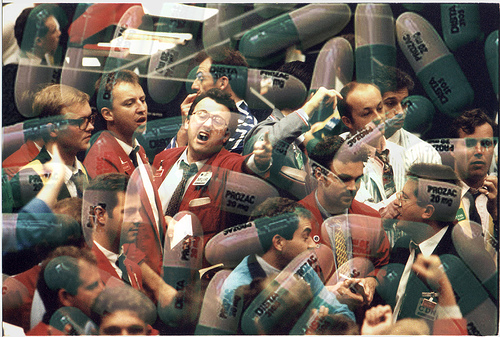
  • Don’t Let Their Meltdown Become Your Meltdown

    It’s certainly not fun to watch the stock market fall, taking your long term savings and possibly a dream or two with it.

    It’s certainly not comforting to watch entire companies close their doors, creating instant unemployment for not just a few skilled workers.

    And no one likes hearing about anyone losing their home, even in the maddening case when the initial mortgage commitment was irresponsible.

    My question for you is, “Are you letting their meltdown become your meltdown?”

    It’s easy to start worrying about our own job security, financial well-being, and credit issues. But there is a big difference between the sort of reality check some of us need to make us face the facts about our money practices and the sort of shared anxiety based, not on facts, but on the broader climate of uneasiness, fear and panic.

    One question you might want to ask yourself is, “Am I making this decision to make myself feel less anxious today, or is this the best possible choice to help me achieve my short and long term financial goals and commitments?”

    In times of economic stress, it is easy to slip into making decisions in order to make us feel better. This is where we risk allowing their meltdown to become our meltdown.

    What we are looking for is a sense of poise instead of panic. Perspective instead of overwhelm. Strategy instead of fear.

    Poise is both an interior and exterior posture that is steady, balanced and paying attention. Poise is not easily knocked over or thrown off course by the unexpected earthquakes and/or hurricanes of life. Poise involves maintaining one’s composure to better assess the situation, distinguish between fact and fear, and think more clearly.

    Perspective is a vantage point. Perspective involves being able to step back and look at issues from more than one angle. Perspective rejects isolation and consults with safe and experienced friends, associates and professionals.

    Strategy is wisdom committed to action. Strategy discerns urgent issues requiring immediate decisions. Strategy recognizes longer term possibilities and holds or adjusts course accordingly. Strategy does not recoil from difficult decisions, because its validation does not come from needing to feel better right away.

    Validation is the peace that is available from a posture of poise, a vantage point with perspective, and a thoughtful strategy of next steps.

    What are you doing to prevent their meltdown from becoming your meltdown?