Karl Edwards presents Working Matters

Tag: people

  • Listen In -> The Hard Facts of Working with People #2: People Need to Contribute and Make a Difference

    Many of us, if we were honest, would prefer not to have other people on the team. But we need more arms and legs than we have ourselves!

    So we hire beings to function as utilities, which by their nature are anything but utilities. That is, we hire human beings.

    Hard fact to face about these creatures known as human beings is that they need to contribute and make a difference.

    Take this fact into account as you shape their job descriptions, responsibilities, communication patterns, and performance evaluations, and you will discover the most amazing source of energy, ideas, production and effectiveness imaginable.

    Ignore this fact and you will spend a fortune on high turnover, stagnant careers, negative attitudes, and a bare bones work ethic.

    You can crack the whip all you like. Yell and scream. Threaten and punish. Nothing will elicit anything more than the absolute minimum in effort.

    It’s your choice. Face this hard fact of working with people or not.

    Listen in.

    Just now joining the conversation? Catch up on the entire series here.
  • Listen In -> The Hard Facts of Working with People #1: Replaying a Timely and Helpful Series

    “If I had a nickel for every time someone referred to working with people as “the soft side of business” I’d be a millionaire.”

    What I said several years ago when this podcast first aired still holds today.

    It is precisely because of this disastrous fallacy about working with people that we are replaying this important series during our vacation season at Bold Enterprises.

    Far from being the soft side of business, working with people is filled with hard realities that, unless faced, will undermine even the best laid plans.

    Just because the human element is difficult to quantify and doesn’t show up neat and tidy in the financial reports, doesn’t mean that it isn’t one of the central keys to success in your workplace.

    You invest in state of the art technology. You conduct thorough and ambitious strategic planning. You invest in the best in marketing and sales. You keep a lid on unnecessary costs.

    But too many of us are dismissing, ignoring or overlooking the highest impact investment of all… our people.

    The Hard Facts of Working with People
    Week #1: Facing the Facts about a Timely and Practical Reality
    Week #2: People Need to Contribute and Make a Difference
    Week #3: People Need to Learn and Develop
    Week #4: People Need to Connect and Belong

    Listen in.

    Just now joining the conversation? Catch up on the entire series here.
  • Listen In -> Paying Attention to Attentiveness #4: Attentive to People

    People change. It’s the first rule of working with others.

    People change from moment to moment depending on mood, attitude, and circumstance. People change over time as a part of growing up, maturing and developing.

    Professionally, when people develop their skills and grow in their interests and capabilities their jobs, roles and responsibilities need to change as well.

    If we assume that the people who work for us do not change and we are not paying attention, we risk losing these valuable assets.

    Do people have a way to grow and mature in their roles where you work? Is anyone paying attention to how people are behaving, engaging and/or changing both in the short term and the longer term?

    If not you could be in for more than a few rude surprises!

    Listen in.

    Just now joining the conversation? Catch up on the entire series here.
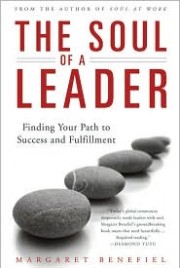
  • Thought Leaders Unpacked -> The Soul of a Leader #6: Battling for the Soul

    thought-leaders“When things aren’t going well, the temptation to allow the soul to erode is strong.” (p. 101) Aptly put.

    Considering that all businesses rely on people to get their work done, it always amazes me that so many leaders do not do everything in their power to make sure their teams are playing at the top of their professional games. In fact, many do not even factor the human component into their thinking and planning.

    Soul erosion.

    I have long taught that there are three “hard facts” about working with people that any leader must come to terms with if they want their teams to succeed. One is that people need to contribute and make a difference. Second, people need to grow and develop. And third, people need to connect and belong.

    Ignore any one of these three “hard facts” and you are merely erecting your own obstacles.

    Margaret Benefiel is calling for this sort of honest assessment of one’s commitment to people. It’s not lip service. It’s looking at one’s practices, policies and behaviors, and assessing the effect they have on those in your professional care. If the effect is negative, harmful, or even dismissive, then you are—like it or not—fostering “soul erosion.”

    Fact. People add value when they get to show up as people. Diminish the human (more…)

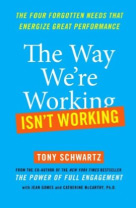
  • The Way We’re Working Isn’t Working

    American managers are in denial about the fact that their teams are comprised of human beings.

    Content with a data-defying strategy of squeezing as much work as possible out of their teams for as little compensation as possible, these self-congratulating fools close their eyes to the facts and resort to childish name-calling (e.g. “soft”) to anyone who dares suggest that human physiology and psychology are important factors in workplace productivity.

    What if there were facts, though, about how people work that could multiply your productivity with only incremental additional costs?

    I’m excited to come across a kindred spirit in Tony Schwartz in his new book, The Way We’re Working Isn’t Working.

    I’ve long advocated that people are an amazing, if complex, asset into which we should invest not a faceless, annoying expense that we should minimize.

    Schwartz provides invaluable insights into how the human beings function and provides the practical means to transform these insights into a more energetic, renewing, and yes, productive workplace.

    Specifically he looks at human physiology, emotions, our minds, and our spirituality. Far from hyping the latest feel-good fad, Schwartz methodically supports his case with data. If you look at the facts, certain things are true about what makes people thrive, commit, care, and work hard. On the downside, certain factors cause people to wear down, avoid risk, blame others and otherwise distance themselves from their work.

    Far from being “soft,” it is those leaders who have the courage, honesty and wisdom to face what I describe as “the hard facts about working with people” who have the mettle it takes to face the complex issues facing business going forward.

    Gone are the days where people can be reduced to inter-changeable commodities to be discarded at the first sign of trouble.

    Tony Schwartz is a must-read resource for any leader hoping to work effectively with people going forward.

    On your side,

    – Karl Edwards

  • Listen In -> Visionary Leadership with Marion Skeete #4: Respecting and Involving People

    Is the leader so ordained because she is better, smarter, more knowledgeable, better in any way than everyone else on the team or in the community?

    Does following a leader involve turning off our brains and compliantly doing what we are told?

    Is the leader the author of a vision that emerges from his or her own imagination? Or is the leader the servant of a vision that emerges from the unfolding story of the community?

    In week 4 of our series on Visionary Leadership with Marion Skeete our discussion turns to the voices that are and are not included in the conversation about where we are going and how we do things.

    Could it be arrogant and inappropriate for the leader to assume that anyone who cannot get on board with the leader’s vision is better off not being in the community or organization at all?

    If you feel like you’re on the outside of your organization looking in, then this show is for you.

    Listen in.

    Just now joining the conversation? Catch up on the entire series here.
  • My Guest Appearance on “Management Tips”

    wooden-nickel-management-tips-4Nick McCormick, author of Lead Well and Prosper, interviews me on his podcast, “Joe and Wanda on Management.”

    I share my three “Hard Facts of Working with People.”

    If you want your team to come alive and give 110% on the job, they need an opportunity to:

    1. Contribute and make a difference.
    2. Learn and develop.
    3. Connect and belong.

    Listen in and join the conversation.

  • Question of the Week

    Who might be an unexpected resource that you have overlooked until now?

    The Question of the Week is offered to increase awareness of one’s personal leadership practices and encourage experimentation with creative alternatives.
  • Loving Monday: Looking Forward to Whom?

    Whom are you looking forward to seeing this week?

    Who believes in you, appreciates you, or simply accepts you as you are?

    Who will make you laugh, help you out, or take you at your word?

    Finding people at work we look forward to seeing is a crucial component of loving Monday. The work itself may get complex, stressful and/or overwhelming. But if there is a relationship or two that can make you smile, go the extra mile with you, or you can’t go without seeing, then you’ll be surprised at where the energy will come from to get out of bed and get yourself moving in the morning.

    Coming back to people who are important to you can make Mondays a highlight.

    What stories from this past weekend did you come into this morning?