
Karl Edwards presents Working Matters

Tag: freedom

  • Free or Trapped?

    Ever think about how you ended up in the job or career path you are in?

    You might be participating in a family business. Maybe a friend recruited you. You needed a paycheck and grabbed something that pays the bills. You wanted the prestige that goes with your profession. You chose to climb the corporate ladder to get the responsibilities, pay, and status that goes with doing so. You are trying to finance a certain lifestyle. Someone once told you that you would be good at this sort of work.

    What is your story?

    In particular, and the focus of this morning’s reflection, how much choice did you have in the matter?

    Was it the only job that was available? Would any other choice have felt demeaning or less prestigious? Were you responding to family expectations? Were you competing with peers? Were you desperate for any paying work? Were you protecting your job security?

    Whether we feel free or trapped is a huge factor in shaping how we deal with situations at work. Especially all that is complicated and unpleasant in our jobs!

    If we feel free (i.e. we chose our situation and feel we have a choice about whether or not we will stay in our situation), we are much more likely to be able (more…)

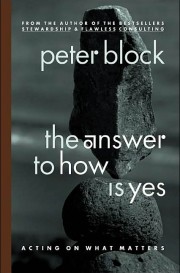
  • Thought Leaders Unpacked -> The Answer to How is Yes #3: Defenses Against Acting

    thought-leadersFreedom is a funny thing. While a vocational aspiration for many of us, the implication that when free we bear full responsibility for our lives is often too much to bear.

    Hence chapter three. Chapter three is where we get the opportunity to check our spoken aspirations against our actual behavior.

    I often have myself convinced that I want one thing, and then find that I am acting in such a way that sabotages or contradicts my own desires.

    Block does a nice job of pulling out several of these behaviors that work against our dreams.

    When swimming around in my own head, it is easy for me to convince myself about the sincerity and passion of my desires.

    When confronted with a behavior, like seeking the approval of those in power or collecting “enough” data to make an informed decision, I have a tool for reconnecting myself to reality.

    I have a tool to help me shift my focus away from those things that are outside of my control back to my own choices which are in my control.

    I have a tool help me notice when I am giving away my power or shifting responsibility off of myself. I don’t need to beat myself up for doing so, as much I need to celebrate catching myself in the act, so to speak, earlier than later.

    The good news of chapter three is that I don’t have to stay blind to the subtle means I employ to avoid what I want. The sooner I can spot a fear, an escape, a defense, an excuse, or a weakness, the sooner I can address it.

    The sooner I address my “defenses against action” the sooner I’m back to taking action and on the way to being, living and making the unique contribution that I have to offer the world.

    Which of Block’s defenses against action do you relate most closely with? How can you reframe an excuse you’ve been making to avoid responsibility into an opportunity to embrace responsibility?

    What was your main take-away from this chapter?

    Each week I post my reflections from one chapter of The Answer to How is Yes by Peter Block. My reflections are my own and are intended to generate conversation, catalyze additional thinking and encourage mutual learning.
    If you are just joining the discussion now, welcome! Catch up on the entire series here.
  • Loving Monday: Loving Freedom

    loving_mondayMany of us Americans are off of work today.


    The 4th of July falling on Sunday results in most workplaces granting a holiday on Monday.

    It seems fitting to acknowledge that our conversations about work, careers, and the choices that meaningful and rewarding experiences of each entail, are only possible in a free society.

    Freedom and security create the opportunity we have of hard-working, fun-loving teams of energetic, engaged and dedicated individuals designing workplace cultures that bring them alive during the day, provide for their families during the week and transform the world over time.

    Even when the worst of work life in America is experienced, there are means for getting help dealing with a bad boss, a stale career,  exploitative practices, and/or criminal excesses.

    And so we celebrate Independence Day with the conscious intention of both treasuring and seizing the opportunities our freedom has bought for us.

    Loving Monday is loving freedom. It’s great to have a day off of work, and it will be great to get back to work.

    Happy Birthday, America!

  • Quote to Consider: Destiny is a Choice

    quote-to-consider“The tissue of life to be we weave with colors all our own, And in the field of destiny we reap as we have sown.”
    John Greenleaf Whittier

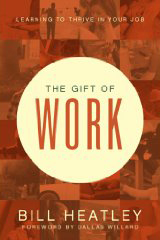
  • The Gift of Work -> Chapter 2: Kingdom Living

    thought-leadersTraining for kings.

    From the outside in… practicing habits of healthy living until proficient. From the inside out… becoming increasingly open to the involvement of God in the training process.

    Such are the spiritual disciplines: twin and simultaneous trajectories toward becoming the kind of person you were meant to be.

    gift-of-work1Reflecting on the workplace, it is my stewardship of the life God has given me that determines the character of my presence and contribution there. Hence the power of Heatley’s now obvious, but usually overlooked, linkage between our stewardship within God’s kingdom with the role of kings.

    How I show up matters.

    Whether or not I choose to engage fully—authentically, energetically and creatively—matters.

    The choices I make at work improve, restore, and (more…)

  • The Gift of Work -> Chapter 1: Changing Our Minds About Work

    thought-leadersI’m going to jump right into the issues raised by Bill Heatley’s The Gift of Work: Spiritual Disciplines for the Workplace without much content summary. So grab your copy and join the fun!

    gift-of-work1

    Faulty Frames of Reference

    Powerful from the get go is his challenge to our basic frame of reference about work as “a daily humiliation.” (p. 24) Such starting assumptions: work is but a necessary evil to pay the bills, TGIF, and working for “the man”—among others—is where we get our equation backwards. It’s as if we suspend our lives while at work in order to make the money we need to finance the lives we want to live while at home. We have to get ourselves dirty in the workplace (read “the world”) in order to serve God and others everywhere else.

    Instead of investing, engaging, reflecting and improving, we end up keeping work at arm’s length.

    A huge hurdle to becoming open to alternate frames of reference is learning how to identify our own starting assumptions. It can be like asking a blind person why they tripped on the cracked sidewalk. How can I figure out what I’m not seeing if I’m not seeing?

    More Ordinary Than You’d Think

    I love the way Heatley, almost matter-of-factly, asserts that work is (more…)

  • Loving Monday: Missing Important Routines

    I’m shutting down after an unusual day and just now realizing I missed my Monday morning routine… writing about Loving Monday!

    How’s that for irony?!

    Maybe the topic this week should be routines. Routines that facilitate regular, important activities versus routines that stifle, quench creativity and merely fill space.

    The distinction comes when deciding when to “violate” a routine in some manner. Or, in this case, deciding how to interpret being distracted into inadvertently missing a routine.

    Negligence or freedom? It could be either.

    Key to being able to welcome the unexpected, confront crisis, and respond to what cannot be anticipated is being able to operate out of freedom. Freedom to choose routine. Freedom to vary routine. Freedom to abandon routine.

    Are your routines blessings that facilitate consistent attention to what you value most? Or are your routines chains that bind your time and energies from attending to what you want?

    Two very different sorts of work weeks result. It’s the difference between loving Monday or dreading it.

    Would you share a routine of yours you value highly.

  • Freedom Is The Key To Engaging Responsibility

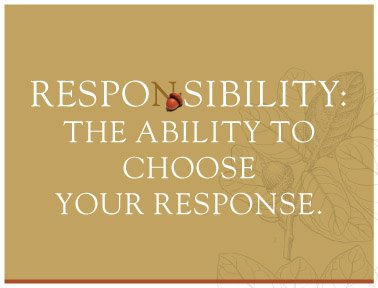
    ResponsibilityResponsibility is a reflection of freedom, not control.

    Any obliging of oneself is responsible to the extent that it is an act of freedom. If coerced, forced or manipulated, the responsibility shifts to the controlling party.

    Leaders mistakenly believe that they can delegate responsibility without granting the freedom to choose. “Do this and do it in this way.”

    Some even wonder why their assignment is not greeted with more enthusiasm and appreciation. Bewildered by the ingratitude and (more…)