
Karl Edwards presents Working Matters

Tag: clutch

  • Thought Leaders Unpacked -> Clutch #1: Focus (Part 2)

    thought-leadersIt’s always an ordinary serve.

    It’s a great angle on a great image. If all that preparation (see last week’s post) does anything for us, it sets us free to be present in the game. Our minds are freed up to pay attention to what is going on around us and adjust along the way instead of thinking about technique or rethinking the game plan.
    Tennis is the perfect metaphor for me. Relaxed during the pre-game rally, I generally fall apart once the game starts. I’m busy doing my thing and doing it just fine until I start thinking about it.

    My attention has somehow moved from what is going on with the ball to how I need to win the point.

    Hence my deep draw to the phrase, “It’s always an ordinary serve.”

    The wording itself suggests the obvious fact that all serves in one sense are merely serves. It is I who change any given serve to something else.

    I carry this tendency into my sales. When talking with a client about their challenges, I am relaxed, present, attentive, and extremely helpful. When talking with a client about my services, I am tense, apologetic, eager to impress and determined to prove myself.

    I come across completely differently in essentially the same conversation depending on whether the focus in the client or myself.

    Lesson to self: Relax and be  yourself. You’re good at what you do. If fact, you’re great at what you do. Trust that. The experience of being with you will sell itself. It’s always an ordinary serve.

    What is your version of, “It’s always an ordinary serve?” At what do you excel until you start thinking about it too much? Why do you think that is? What was your main take-away from this chapter?

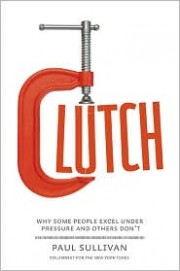
    Each week I post my reflections from one chapter of Clutch: Why Some People Excel Under Pressure and Others Don’t by Paul Sullivan. My reflections are my own and are intended to generate conversation, catalyze additional thinking and encourage mutual learning.
    If you are just joining the discussion now, welcome! Catch up on the entire series here.
  • Clutch: Why Some People Excel Under Pressure and Others Don’t

    I heard Paul Sullivan speak yesterday at the Milken Institute in Santa Monica. The subject, of course was his book, Clutch: Why Some People Excel Under Pressure and Others Don’t.

    While much of the audience wanted to cling to a romantic definition of “clutch” that was significantly different than Sullivan’s, I thought he did a great job of carving out a specific angle that both set the stage for his research into extraordinary performers as well as make “clutch” performance attainable for anyone.

    Specifically, he is examining how some people can continue to do what they are capable of doing on an ordinary basis under pressure. The key being, “do what they are capable of doing on an ordinary basis.” This is not a book on heroics, luck or extraordinary achievements.

    I’ve already purchased my copy and am considering using Clutch for my next “Thought Leaders Unpacked” series so that we can think through Sullivans observations together.

    He works his way through five characteristics of “clutch” performers.

    1. Focus
    2. Discipline
    3. Adaptability
    4. Being Present
    5. Fear and Desire

    He also offers three reason why others do not perform well under pressure.

    1. Failure to take responsibility
    2. Overthinking decisions
    3. Overconfidence

    Keep your eyes and ears open for my decision about the next book we study together in “Thought Leaders Unpacked.” Clutch looks like an interesting, practical, and encouraging option.

    If you are in Los Angeles and not attending the Milken Institute’s free forums, you are missing out on a great resource. They invite extremely interesting people to introduce their latest books in the context of an open forum. There is time for Q & A and always a book signing.
    Thought Leaders Unpacked” is a regular column on this blog where we read a key book together, and I post my reflections on one chapter each week. My reflections are my own and are intended to generate conversation, catalyze additional thinking and encourage mutual learning.