How might you be a part of the problem that won’t go away?
How might you be a part of the problem that won’t go away?
 It’s no secret that I often struggle to remember what day of the week it is. I don’t know what I’d do if we didn’t have the regular, if somewhat rigid, cycle of seven days to structure the week.
Yes, I said rigid. And yes, that was a hint of resentment you heard in my voice.
But I’m learning (the hard way, of course) that however senseless and arbitrary the seven-day pattern, living within the confines of this “prison” is more liberating than living somehow independent of it.
The supposed freedom I hanker after keeps turning out to be a different sort of prison. That is the prison of having all choices available to me all of the time.
Imagine if every priority had a voice and they were all shouting for attention all of the time. Any time you managed to choose one item to work on, the others immediately demanded that you again justify your exclusive efforts. As a result, you never really enjoy focused effort, but rather find yourself explaining and reexplaining to a pantheon of warring and unending urgencies.
It’s analogous to driving rules. That you can count on the other driver stopping at the red light frees you to maintain your driving speed through your green light. The limitations make more possible not less.
What frustrating limitations, unfair rules, arbitrary structures, or rigid patterns are making you crazy? How might you look at them differently and discover ways in which they might make more possible instead of less.
Today is Monday. The beginning of the work week. However arbitrary, a myriad of decision have already been made for me, freeing me to return to work, pick up where I left off last week, and know that my co-workers will be at my side.
Again, I find myself… loving Monday.
While an unacceptable behavior, insubordination might suggest what positive trait worth nurturing?
 We’re making a mistake. I’m making a mistake. A big fat ol’ gnarly mistake.
Our mistake is to think our professional story is about us. My mistake is to think that my professional story is about me.
My skills, my resume, my experience, my competence, my insights, my ideas, my appearance, my efforts. If only I were more aggressive. If only I were better connected. If only I were more organized. If only 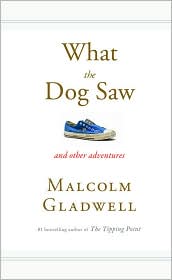 I were less like me and more like so-and-so (insert name of who you are measuring yourself against here), I’d be more successful.
Success, though, is not about me. Success is about you. “You” being the others in the equation, in your market, your circles, your family.
Or so we glean in Gladwell’s first chapter of What the Dog Saw. What the other person is trying to accomplish. Where they are trying to go. What they need. What they feel. What they want.
Success, so to speak, is in understanding the other person’s story and being able to articulate how you, your product or your services enhance and belong within that story.
The power of Ron Popeil’s story lies in his making his products understandable to people. The products were the star of his sales efforts not him. When people saw Popeil’s kitchen gadgets, they saw themselves.
At first read, I must admit I wasn’t inspired by this first story of Gladwell’s book. “This is sure a lot of verbiage dedicated to the eccentric hawking techniques of a niche salesperson.”
But the more I reflect, I am taken by Popeil’s freedom to get out of the way as he introduced people to his products. As with any successful matchmaking, the matchmaker cannot remain in the middle of the relationship if the relationship is to succeed.
What sort of matchmaker are you? Matching your services to customers needs. Matching your parenting to your children’s development needs. Is the subject what you do or what your customers are trying to do? Your authority being respected or your child’s well-being being enhanced?
What do you think? What was your main take-away from this chapter?
 “(America is the country where) the young are always ready to give to those who are older than themselves the full benefits of their inexperience.”
Oscar Wilde
I just picked up a copy of Malcolm Gladwell’s new book, What the Dog Saw and Other Adventures. I grabbed it the minute I saw it. The very second, in fact. Those around me wisely waited while I examined every copy for flaws. Cradling my perfect baby, I made a beeline to the cashier.
It wasn’t until I got it home that I realized it’s not a new work at all. It’s a collection of his New Yorker articles. The best in his view.
After I recovered from this brief moment of disappointment (not a big fan of the recompiling for a second round at the till marketing strategy)(I’d probably be singing a different tune if I ever experienced a first round at the till), I realized that the only part of the New Yorker I’ve ever read are the cartoons. So I’m sitting here with all “new” material.
I love this guy’s work. The preface alone has me fully engaged. Understanding what’s going on in someone else’s head.
There are three main themes/sections:
Of course I can’t read something so fun by myself. This is the stuff of incredulity and hilarity, insights and further reflection.
So read with me. We’ll take it a chapter at a time. We’ll meet here and share impressions, reactions and our own takes.
I’ve got Amazon links scattered throughout this post. Grab your copy now. We’re going to begin right away.
I recently discovered a new staircase that took my breath away.
Literally.
Several hundred steps rising from the floor of the Los Angeles Basin to a 360 degree view of the entire city 511 feet in the air.
 Whether you experience the climb as inspiring or intimidating probably depends on how you view heavy breathing and aching muscles. Or how much you enjoy seeing the mountains that surround the city or identifying city landmarks from miles away.
I may have just discovered a form of exercise quirky enough to bring me back for more.
For my fellow Angelenos, I refer to the new Baldwin Hills Scenic Overlook recently opened just off Jefferson Boulevard in Culver City. Pleasant walking trails once you reach the top complete with nature center. (Yes, there is also auto access.)
I‘m writing, though, because it felt so good to start the day with an intense climb. Any exercise would probably have a similar effect, but given the fact that I don’t do “any” exercise, this is an exciting discovery for me.
Vigorous enough to give my heart a work-out. Inspiring enough to get me to the top.
There are so many “shoulds” out there about health, life, relationships, work, etc., etc. As accurate as the “should” might be, we must face the fact that not all of us are motivated by all “shoulds.”
We need to find those good things that we can “want” as well. When it comes to exercise, my final list is strikingly short.
I think I found me a new one! Back to the stairs and then back to work.
In what ways are you and I connected?
Are we in conversation here at the Working Matters blog talking with each other about our jobs and careers?
How about on LinkedIn? On Twitter? On Facebook? On FriendFeed? On iTunes?
Click on your favorite link and let’s get connected!
On your side,
– Karl
“A man who lies to himself, and believes his own lies, becomes unable to recognize truth, either in himself or in anyone else, and he ends up losing respect for himself and for others. When he has no respect for anyone, he can no longer love, and in him, he yields to his impulses,  indulges in the lowest form of pleasure, and behaves in the end like an animal in satisfying his vices. And it all comes from lying—to others and to yourself.”
Fyodor Dostoevsky
The Brothers Karamazov
 It’s easier to make a small adjustment rather than a major change.
Instead of viewing change as an all-or-nothing proposition, (which usually prevents us from taking any action at all,) try viewing change as a process in which we check in with ourselves and make smaller incremental adjustments.
In this week’s show, Claudia and I look at process. Join us as we talk about being alert to what’s working and what’s not working for you, and then learning and adjusting on the go.
What if the way forward involved only taking a next step?
Listen in.