Karl Edwards presents Working Matters

Tag: decision-making

  • Listen In -> Posture of Strategic Readiness with Van Wray #5: The Anticipated Decisions

    Of the universities to which your child is granted admittance, he or she will have to decide one to attend. It’s an important decision, and it cannot be avoided.

    Except that your child is currently twelve years old.

    It is not yet time to make that particular decision.

    Yet it would be a mistake to ignore or avoid the investigative and preparatory work involved in helping your child make the best decision possible when the time comes.

    In this week’s podcast discussion with Van Wray of Amperant Advisors, we look at how to best approach these certain but distant decision points in our businesses.

    Certain decision are coming.

    We know they are on the way, but we don’t have enough information to make the decision yet. We cannot afford, though, to ignore, forget about, or minimize their importance in the mean time. What do we do?

    Listen in.

    Just now joining the conversation? Catch up on the entire series here.
  • Karl Shares Six Words… #58


    Feigning decisiveness she dodges the question.


    Karl Edwards

  • Listen In -> Playing Favorites #3: Favoring Certain Technologies

    Every technology has its loyal fans. I’ve never worked on any computer but a Mac.

    I believe my bias is based in fact. I want my employees doing their jobs not learning how to use their tools.

    But what if I were spending a premium on computers because they were cool?

    Some of us feel locked into our technology choices because of the magnitude of the initial investment. We let better solutions and technologies that come along pass us by because we can’t deal with the awkward reality that the world changed before we got our money’s worth.

    In this week’s show, Claudia and I explore how we play favorites when it comes to the technologies we choose.

    When does our loyalty to a brand exceed its merits in comparison to another?

    Are we making the best leadership decisions on these huge investments if we’re playing favorites without even knowing it?

    Listen in.

    Just now joining the conversation? Catch up on the entire series here.
  • Quote to Consider: Choosing Boldly

    quote-to-consider“When you cannot make up your mind between two evenly balanced courses of action, choose the bolder.”

    W. J. Slim

  • Decisions Not So Black and White

    Decisions.

    It’s common and not an entirely bad thing to want to make the “right” decision instead of the “wrong” decision.

    We all want our decisions to be validated in the crucible of reality.

    But it is fallacious to assume either that there are only two alternatives (the right one or the wrong one), or that the reason that some decisions don’t work out has to do with a fatal flaw in the original decision.

    Let’s take the two problems one at a time.

    First, that there is a “right” decision to be made and all other decisions are flatly “wrong”.

    This either-or, blank-and-white thinking is naive at best if not outright dangerous.

    Instead of a fork in the road, imagine a chess board. There are many possible moves to make. There are multiple strategies one might select and/or switch between. There is also another player involved who is making decisions with varying degrees of precision, shrewdness and finesse of their own.

    Imagine then an (as yet not invented) eight-person chess game with an octagonal gigantic chess board. Multiple decision-makers and multiple dynamics (more…)

  • Listen In -> Why We Hate Meetings #3: Not Focused toward Outcomes

    Some issues come up in meetings week after week. The discussion picks up where it left off and no resolution or decision ever gets made.

    And again you want to kill yourself (or at least the leader). Because again you are not busy doing the many important tasks waiting for you at your desk in order to be at this meeting. This meeting that is rehashing and rethinking and repeating what has been discussed on many previous occasions.

    Open discussions are a good thing. Hearing all sides to a complex issue is a good thing. Playing out various scenarios is, yes, a good thing.

    But when these thinking exercises have served their purpose, there needs to be movement toward a decision, toward a plan, or toward an clearly identified outcome.

    We waste our own and everyone else’s time when we discuss for discussion’s sake. We must discuss for the sake of making the best possible decision. We must think together for the sake of achieving the optimum plan of action.

    We hate meetings when they are missing a clear trajectory toward particular decisions and concrete action.

    Find out what a simple set of expected outcomes can do for your meeting.

    Listen in.

    We have a tool that can help. Check out our Meeting Planner, a simple, professional workbook for planning meetings that focus discussions, increase team buy-in, and get things done. (Click here for more information.)
    Just now joining the conversation? Catch up on the entire series here.
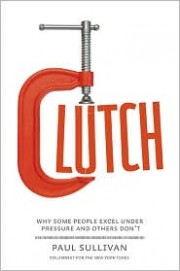
  • Thought Leaders Unpacked -> Clutch #3: Adapting

    thought-leaders“Fight the fight, don’t fight the plan.”

    Even while the subject of this chapter is “adapting,” it is interesting to me that we return to “focus” as the underlying capability that makes even adapting possible.

    Focusing on the outcome allows the decision-maker to adjust plans along the way without getting bogged down by a fallacious loyalty to the original plans.

    In other words, the issue is not implementing the plans as currently laid out, but achieving the outcome those plans were intended to achieve.

    As I have written elsewhere, the leader needs both proactive decision-making skills and reactive skills. The poised tennis player is as ready for whatever might come at them as they are prepared to execute their own game plan.

    In “clutch” situations (where ordinary skills need to be applied in extraordinary circumstances), pressure, immediacy, danger, the unexpected, and complexity conspire to muddle and/or overwhelm our senses.

    If we are not prepared or willing to pay attention to those complicating, unfolding realities, then our ability to make appropriate and relevant decisions will suffer.

    If we have the luxury of time, then we can take a step back and evaluate the data and adjust accordingly. If time is not available, we need to be able to make (more…)

  • Question of the Week #16

    How will postponing the decision you are trying to make really improve the decision you end up making?

    The Question of the Week is offered to increase awareness of one’s personal leadership practices and encourage experimentation with creative alternatives.
  • Quote to Consider: Too Many Hurdles?

    quote-to-consider“Nothing will ever be attempted if all possible objections must first be overcome.”

    Samuel Johnson

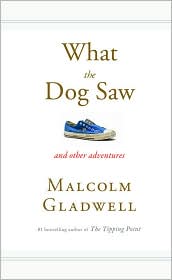
  • Thought Leaders Unpacked -> What the Dog Saw #12: The Art of Failure

    thought-leadersEvery week I feel like I’m saying, “This is my favorite chapter.”

    So this week I’ll say, “This is my favorite chapter… so far.” Are men my age allowed to say, “OMG!” Earthquake to my soul.

    What-the-Dog-Saw

    The difference between choking and panicking. The difference between thinking too much and thinking too little. The difference between thinking when you don’t need to and not thinking when you do need to.

    The first sort of over-thinking interferes with your natural (or practiced) ability to do what you need to do, and tragically you don’t do what you ordinarily would be able to do. The second sort of under-thinking interferes with your ability to put your brain to work when you need it most, and tragically you never get the opportunity to do what your brain would have otherwise been able to help you choose.

    Choking or panicking.

    I almost never panic. I tend to remain calm in crisis, my thinking somehow becomes clearer, and my willingness to act decisively heightens. I’m not sure why that is. I’ll just be thankful.

    Choking, though, is another story altogether. And here is where this chapter was so enlightening for me. When faced with an important interview, for example, I respond to the importance by trying harder. That response has always made (more…)