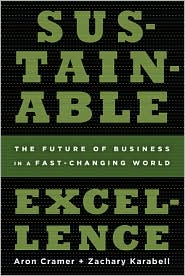
 The Milken Institute Forum last night was excellent. Aron Cramer and Zachary Karabell were there discussing their new book, Sustainable Excellence: The Future of Business in a Fast-Changing World.
 Theirs was not a morality play. That is, they did not discuss sustainability as a moral precept on behalf the planet’s survival, humanity’s future and the kumbaya warmth of being good and doing better. So many activists rely on a liberal pseudo-religious elitism that manipulates conformity to one’s agenda based on threatening to label people something they would find horrible like, “ignorant,” “narrow-minded,” or “greedy.”
Cramer and Karabell discussed sustainability from a business perspective.
It makes business sense to integrate issues of sustainability into the heart of one’s business strategy. Good stewardship of one’s business goes hand in hand with good stewardship of our resources.
While both authors were morally committed to sustainability, they did a good job of describing their research into a phenomenon of the last several years wherein leadership, creativity, and innovation in sustainability is coming from the business world, not the non-profit activist organizations or governments. They also described how they believe business is best positioned to both design and act upon meaningful change in an effective and timely manner.
I look forward to this read. I have long believed that only the business context has the necessary combination of systemic financial motivations, human and capital resources, and decision-making flexibility to provide the sort of creative leadership necessary to give shape and form to the emerging future.
Where and to whom do you look for meaningful change?
On your side,
– Karl Edwards
 Training for kings.