How are others affected when you come under pressure?
How are others affected when you come under pressure?
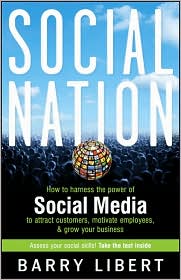 One of the “worlds” that is changing faster than it is staying the same is social media.
It can feel daunting trying to catch up with what is happening in social media before it has morphed into something else again.
And how many of the experts on the topic are little more than early and lucky entrants? All their “how-to’s” are no longer applicable because we are no longer early in the process nor is everyone lucky.
Then comes Barry Libert, who in his collaborative work, Social Nation, gives us a great overview of best practices, primary perspectives, and strategic keys.
Seven Principles for Building Your Social Nation
If you are new to social networking, then you will love this book. Libert lays out a wonderful frame of reference for thinking about the skills, processes and purposes of social networking as a component of one’s business strategy.
Those already interacting heavily on the web might find much of the content (more…)
 “A man should not strive to eliminate his complexes but to get into accord with them, for they are legitimately what directs his conduct in the world.”
Sigmund Freud
“Many people have the ambition to succeed; they may even have a special aptitude for their job. And yet they do not move ahead. Why? Perhaps they think that since they can master the job, there is no need to master themselves.”
John Stevenson
 It’s always an ordinary serve.
It’s a great angle on a great image. If all that preparation (see last week’s post) does anything for us, it sets us free to be present in the game. Our minds are freed up to pay attention to what is going on around us and adjust along the way instead of thinking about technique or rethinking the game plan.
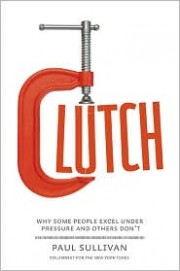
Tennis is the perfect metaphor for me. Relaxed during the pre-game rally, I generally fall apart once the game starts. I’m busy doing my thing and doing it just fine until I start thinking about it.
My attention has somehow moved from what is going on with the ball to how I need to win the point.
Hence my deep draw to the phrase, “It’s always an ordinary serve.”
The wording itself suggests the obvious fact that all serves in one sense are merely serves. It is I who change any given serve to something else.
I carry this tendency into my sales. When talking with a client about their challenges, I am relaxed, present, attentive, and extremely helpful. When talking with a client about my services, I am tense, apologetic, eager to impress and determined to prove myself.
I come across completely differently in essentially the same conversation depending on whether the focus in the client or myself.
Lesson to self: Relax and be  yourself. You’re good at what you do. If fact, you’re great at what you do. Trust that. The experience of being with you will sell itself. It’s always an ordinary serve.
What is your version of, “It’s always an ordinary serve?” At what do you excel until you start thinking about it too much? Why do you think that is? What was your main take-away from this chapter?
“Some fellows pay a compliment like they expected a receipt.”
Kin Hubbard
How would it affect your leadership style if you considered yourself accountable to your staff instead of your supervisors?
 Up to whose expectations am I trying to live?
The too-easy answer for a person with a Christian spirituality like myself is God’s.
That’s the “right” answer. The textbook answer. In light of the goodness and power and perfection of God, how could any other set of expectations be considered?
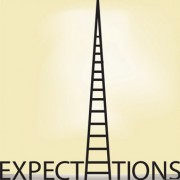 The problem with the “right” answer is that truncates our thinking about the issue before it even begins. We know that God never expects humans to be less than human. So free and responsible thinkers we must continue to be.
The “good boy/good girl” answer is to cooperate with those under whose authority we work. Our job is to meet the expectations of our boss. This option seems reasonable at first blush… that is until we experience our first supervisor whose expectations are not so reasonable.
The problem with the “good boy/good girl” answer is that, again, we find ourselves checking our brains, our skills and our experience at the door in deference, in this case, to the brain, skills and experience sitting higher on the organizational chart.
This is a child’s response to expectations. “You’ll do it because I said so.” The rationale is simply a passive submission to authority. No (more…)
 We all believe certain lies. Even lies we know to be lies. Even lies that undermine our well-being. We believe them in spite of ourselves.
Don’t ask me why. It would probably take years of therapy to uncover why we might internalize as true something so blatantly false.
 One set of lies has to do with the negative names we call ourselves. “I’m a loser.” “I don’t have what it takes.” These non-specific, unverifiable conclusions we draw about ourselves hover as accusing judgments, sabotaging our ability to see much less consider options in which we may thrive.
Another set of lies has to do with imaginary rules that then become obstacles to us. “You have to earn your stripes first.” “That’s now how it works.” “Who do you think you are?” Before you even begin a conversation, act on an idea, or move toward a dream, you talk yourself out of it because you somehow are not qualified or are not approaching it “correctly” and therefore doomed.
Whether or not you choose to explore with your therapist why you believe these lies, I want to suggest that you’ve achieved a major feat of self-empowerment merely by identifying them.
Merely by calling them out for what they are—lies—we disarm much of their power over us.
For example, it will serve me better to identify that I am afraid of being criticized for my decisions than to bluster and pretend to be more confident that I am. In the first case, I can go ahead and make the best decision possible. In the second case, I end up making lousy decisions because all my attention is diverted to appearing more confident than I am.
Calling out a lie might go something like this, “That’s a lie! I don’t know why I act as if it were true, but doing so is keeping me from doing what I feel is best. I’m going to take a step toward what I want anyway.”
Oversimplified to be sure, but what’s the point here? Instead of unconsciously behaving as if the lie were a truth and pretending to know better (an energy consuming process of self-deception), we choose to consciously call out the lie and our mysterious buy-in to it (an energy freeing process of honest self-awareness) so that our behavior can be a deliberate, intentional, and personal choice. Now that’s empowerment!
What lies do you find yourself believing in spite of yourself? Experiment with identifying those lies and calling them out. I believe you will discover you have a bit more internal space to make better decisions, make more timely decisions, and make more satisfying decisions.
On your side,
– Karl Edwards