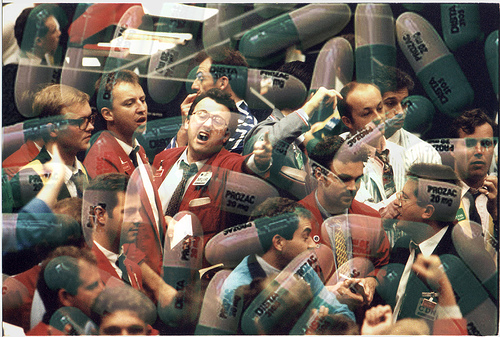
Karl Edwards presents Working Matters

Tag: pressure

  • Loving Monday: One Monkey at a Time

    loving_mondayWe all know the feeling.

    The feeling of the monkey on our back.

    It’s not a good feeling. That one annoying chore yet to be completed. The difficult phone call yet to be made. That perpetually postponed decision still to be made.

    I just got rid of one of the monkeys on my back.

    It feels great.

    I didn’t get rid of them all. Just one. And still I feel lighter. Buoyant might be overstating it, but there’s a smile on my face nonetheless.

    One monkey. Try it.

    Try taking care of just one monkey that’s been hanging on your back. Get rid of it. Do your part and give it to someone else.

    You’ll start your week lighter. You’ll start your week with a satisfying win.

    Got monkeys on your back? We all do.

    The key is taking on one monkey at a time.

    Just one.

    Which one will you choose?

    On your side,

    – Karl Edwards

    Loving Monday is a weekly column designed to encourage us to step into our weeks with an intention to show up authentically, engage fully, and choose to make it a good week for ourselves. Explore past columns here.
  • Even Olympians Respond To Pressure Differently

    The Olympics is a fascinating study in performing under pressure.

    Here we have the most highly trained athletes in the world doing in one moment of time what they have done thousands of time before.

    No problem, right?!

    But the Olympic moment is a different sort of moment.

    The entire world is watching. The performance will be meticulously judged and graded. Their only chance for a medal depends on this one, single performance.

    Pressure.

    Even highly trained Olympians vary in how they respond to pressure.

    Some experience the pressure negatively.

    They have to calm their nerves. They need to intentionally focus. They can become uptight, self-conscious, and over-think their performance. And they can make mistakes as a result.

    Some athletes experience the pressure positively.

    Their energy level rises. They rise to the moment as if it were a great adventure. All the attention, all the eyes watching are gifts of encouragement. And they often perform better than ever before.

    Aly Raisman (pictured) was a key example in her gold medal floor exercise. While almost every other gymnast who preceded her had one error lead to another as their spirits deflated, Aly chose to lead out with the most complicated series she knew. A run that she had been eliminating up until that moment due to a disastrous landing in practice.

    But when her gold medal opportunity was on the line, she embraced it, went for it, put everything into it, and performed it flawlessly.

    What about you? Do you experience pressure negatively or positively? Is pressure a gift or a curse?

    If you experience pressure negatively, what positive interpretations can you come up with that would be equally (if not more) valid than your current negative ones?

    How might the pressure be a gift? How might the pressure be an opportunity? How might the pressure be a tool?

    Watch the athletes closely as the games come to their conclusion. Compare their responses to the pressure. Compare their abilities to perform. See if you observe any correlation.

    On your side,

    – Karl Edwards

  • Question of the Week #24

    How are others affected when you come under pressure?

    The Question of the Week is offered to increase awareness of one’s personal leadership practices and encourage experimentation with creative alternatives.
  • Loving Monday: Holiday Distraction Coming

    loving_mondayAs much as we love our jobs we seldom begrudge a long holiday weekend.

    A shortened work week opens up a couple of possible scenarios for the week ahead.

    One is that we are absent in mind and spirit even while our bodies are present. We’re not off until Thursday, but the anticipation and the preparations fill our minds until we have to admit we have very little space left for the work-related tasks.

    The other scenario is that we are trying to squeeze a full week’s worth of effort into three days. The output requirements haven’t changed but the time frame within which to work has.

    In one case we are finding ourselves quite unproductive. In the other case, we are attempting to be hyper-productive. In both cases, we are distracted by the coming holiday weekend.

    Instead of continuing on as if this were a normal three days like any other, we become distracted by the schedule change. Both are forms of distraction. Neither are lethal, but you aren’t functioning at your best either.

    In one case the distraction removes all pressure. You’ve simply begun your holiday weekend already here on Monday. In the other case the distraction imposes enormous pressure. You somehow need to do everything in practically half the time. In both cases you are underperforming as a result.

    What would probably serve you better is a happy medium of looking forward to the coming long weekend with the awareness that certain adjustments will be required given the loss of two days.

    You can’t think clearly or get much done when you’re either daydreaming about turkey and stuffing or stressed out by the volume of work ahead. Ironically, if you can calm down and focus on what adjustments need to be made this week, you’ll be able to identify your priorities and make the decisions necessary to make good use of the three days available without spoiling the welcome break of the holiday ahead.

    Hoping this Thanksgiving is a good distraction for you in every way possible.

    On your side,

    – Karl Edwards

    Loving Monday is a weekly column designed to encourage us to step into our weeks with an intention to show up authentically, engage fully, and choose to make it a good week for ourselves. Explore past columns here.
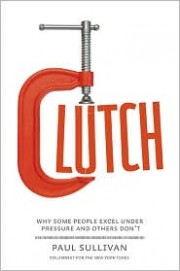
  • Clutch: Why Some People Excel Under Pressure and Others Don’t

    I heard Paul Sullivan speak yesterday at the Milken Institute in Santa Monica. The subject, of course was his book, Clutch: Why Some People Excel Under Pressure and Others Don’t.

    While much of the audience wanted to cling to a romantic definition of “clutch” that was significantly different than Sullivan’s, I thought he did a great job of carving out a specific angle that both set the stage for his research into extraordinary performers as well as make “clutch” performance attainable for anyone.

    Specifically, he is examining how some people can continue to do what they are capable of doing on an ordinary basis under pressure. The key being, “do what they are capable of doing on an ordinary basis.” This is not a book on heroics, luck or extraordinary achievements.

    I’ve already purchased my copy and am considering using Clutch for my next “Thought Leaders Unpacked” series so that we can think through Sullivans observations together.

    He works his way through five characteristics of “clutch” performers.

    1. Focus
    2. Discipline
    3. Adaptability
    4. Being Present
    5. Fear and Desire

    He also offers three reason why others do not perform well under pressure.

    1. Failure to take responsibility
    2. Overthinking decisions
    3. Overconfidence

    Keep your eyes and ears open for my decision about the next book we study together in “Thought Leaders Unpacked.” Clutch looks like an interesting, practical, and encouraging option.

    If you are in Los Angeles and not attending the Milken Institute’s free forums, you are missing out on a great resource. They invite extremely interesting people to introduce their latest books in the context of an open forum. There is time for Q & A and always a book signing.
    Thought Leaders Unpacked” is a regular column on this blog where we read a key book together, and I post my reflections on one chapter each week. My reflections are my own and are intended to generate conversation, catalyze additional thinking and encourage mutual learning.
  • Question of the Week

    How are the people around you affected for good and ill when you come under pressure?

    The Question of the Week is offered to increase awareness of one’s personal leadership practices and encourage experimentation with creative alternatives.
  • Don’t Let Their Meltdown Become Your Meltdown

    It’s certainly not fun to watch the stock market fall, taking your long term savings and possibly a dream or two with it.

    It’s certainly not comforting to watch entire companies close their doors, creating instant unemployment for not just a few skilled workers.

    And no one likes hearing about anyone losing their home, even in the maddening case when the initial mortgage commitment was irresponsible.

    My question for you is, “Are you letting their meltdown become your meltdown?”

    It’s easy to start worrying about our own job security, financial well-being, and credit issues. But there is a big difference between the sort of reality check some of us need to make us face the facts about our money practices and the sort of shared anxiety based, not on facts, but on the broader climate of uneasiness, fear and panic.

    One question you might want to ask yourself is, “Am I making this decision to make myself feel less anxious today, or is this the best possible choice to help me achieve my short and long term financial goals and commitments?”

    In times of economic stress, it is easy to slip into making decisions in order to make us feel better. This is where we risk allowing their meltdown to become our meltdown.

    What we are looking for is a sense of poise instead of panic. Perspective instead of overwhelm. Strategy instead of fear.

    Poise is both an interior and exterior posture that is steady, balanced and paying attention. Poise is not easily knocked over or thrown off course by the unexpected earthquakes and/or hurricanes of life. Poise involves maintaining one’s composure to better assess the situation, distinguish between fact and fear, and think more clearly.

    Perspective is a vantage point. Perspective involves being able to step back and look at issues from more than one angle. Perspective rejects isolation and consults with safe and experienced friends, associates and professionals.

    Strategy is wisdom committed to action. Strategy discerns urgent issues requiring immediate decisions. Strategy recognizes longer term possibilities and holds or adjusts course accordingly. Strategy does not recoil from difficult decisions, because its validation does not come from needing to feel better right away.

    Validation is the peace that is available from a posture of poise, a vantage point with perspective, and a thoughtful strategy of next steps.

    What are you doing to prevent their meltdown from becoming your meltdown?