 “The only measure of what you believe is what you do. If you want to know what people believe, don’t read what they write, don’t ask them what they believe, just observe what they do.”
Ashley Montagu
“The only measure of what you believe is what you do. If you want to know what people believe, don’t read what they write, don’t ask them what they believe, just observe what they do.”
Ashley Montagu
 Just because your boss doesn’t remember your name, doesn’t mean that your name shouldn’t still represent the best that is within you.
Just because your employer will lay you off the very moment their cash flow slows, doesn’t mean that you don’t give your best right up to that moment.
You do this not because you owe anything to your employer, but because you owe it to yourself.
I came across a great article this morning, A Year-End Commitment: Engage Yourself wherein Susan Cramm at the Harvard Business Review makes a great case for showing up fully engaged at work simply because that is what kind of person you are.
“Everybody thinks of changing humanity and nobody thinks of changing himself.”
Leo Tolstoy
 Lots to chew on in this chapter.
Being willing to face reality and deal with the facts on the ground is an important skill. A skill I’d say I either already have or am very open to enhancing.
BUT… Cloud then goes and makes a distinction between being someone who actively searches out what reality is, and one who faces reality passively, as it presents itself.
 Talk about a punch to the gut! Suddenly I’m not so sure. Being open to face the facts and turning the house upside down in order to uncover the facts are two very different stances. I don’t think I can lay claim to the second. That hurts. Give me a second to nurse my bruised ego.
Ok, let’s keep going. I find Cloud’s question helpful, “Do I consider reality my friend?” If I don’t… if reality can harm me, diminish me, or discourage me, I am much less motivated to seek it out. If reality is my friend, however painful, I don’t have to protect myself from it. Instead of seeking out reality requiring heroic amounts of courage, it becomes intrinsically trustworthy and continuously welcome.
Insightful here is the built-in protection being a seeker of reality provides against blindness. The horrible thing about blindness is when we don’t know that we’re blind. Horrible in the personal sense that I find the possibility terrifying. Few things frighten me more than not being aware of what I am not aware of.
Only the passive person needs to be afraid, though. Once I become an active seeker out of reality, then I am doing everything I can to get in touch and stay in touch with the facts on the ground. The combination of the active approach and the welcoming stance means that I’m at minimal risk of simply missing out or inadvertently blocking out important information.
Where do you find yourself on the spectrum between actively seeking and passively receiving reality? What do you think about the assertion that reality is our friend?
Right off the bat we encounter a make-or-break chapter.
“Please don’t make me face the fact that all those production resources out there walking around are distinct human persons.” “You can’t possibly expect me to take into account everyone’s feelings when making complex business decisions.”
I have long suspected that many leaders secretly resent the fact that they can’t do everything themselves and have to rely on others to make things happen.
But the reality these leaders must face is that their teams are, in fact, made up of human persons who function out of inner motivations, personal desires, and their own subjective perceptions. My term for this reality is, “The hard facts of working with people.” People are not the soft side of business in any way, shape, or form!
Here is my key take-away from this chapter: There is a measurable and substantial difference between getting people’s compliance and winning their hearts.
What sort of results are you hoping to obtain? We’re not talking about being liked. We’re talking about getting results. Making a difference. Making things happen. Meeting goals. Achieving great things.
Is learning empathy on your leadership development curriculum? One of your personal goals?
If we cannot relationally or emotionally connect with our team members, we cannot build the trust that sustained, focused, and passionate work efforts require. We undermine our own effectiveness. We sabotage our own results.
What was your main take-away from this chapter? What is your learning edge when it comes to building trust with others?
Running on all cylinders.
What a great image. Fully engaged. Functioning as intended. No component sitting idle or causing problems.
So many of our images of success are lifeless, driven, stressed, remote models of the meta-competent hero who is somehow better at everything than everyone else.
Running on all cylinders is attractive, alive, and energetic. It is not necessarily connected with being in charge, on top, winning over others, or achieving celebrity status
What would it be like to be playing at the top of my game? What if that involved being more comfortable in my own skin? Instead of putting on the professional persona of what “everyone” thinks the successful leader looks like, I simply function out of a healthier, sounder, more fully developed, balanced and grounded sense of who I genuinely am myself.
Very attractive.
My primary take-away from this chapter is having my own desire to improve and learn aroused. Instead of feeling that character and integrity are lofty ideals that are out of my reach, I come away drawn to change and intrigued by the potential for effective performance emerging from a deeper, sounder place within myself.
The challenge with any professional development process is to feel encouraged and energized by the potential for improvement instead of discouraged or defeated by the distance yet to travel.
Where are you on the spectrum from feeling motivated and encouraged to improve yourself at one end to defeated and discouraged at the other end? What was your main take-away from this chapter?
– Karl
Images don’t get any better than this. The wake a boat leaves as it plows through the water.
We also leave a wake as we plow through our day at work. It’s an interesting fact to consider.
With this simple analogy Cloud equips us with a non-judgmental tool for thinking about our impact on others. I don’t know about you, but when I sense the “blame game” in the vicinity, my defenses go up and I shift out of learning mode and into self-protection mode.
But that I leave a wake is just a fact. It raises the question that Cloud asks us to consider, which is “What sort of wake to I leave?” A question I am free to consider and learn from. Any learning or adjusting I do as a result of my reflection is my own. With this simple question I am empowered to coach myself.
My second main take-away from this chapter is that the demands of reality determine the requirements of the design. By defining character as my ability to meet the demands of reality, Cloud switches up the motivational equation for me.
I already want to be able to meet the demands of reality. No one has to convince me. There are no moral constructs someone else is asking me to adopt. I am by my own desire to fully engage with my own life predisposed to what might help prepare me for the journey ahead.
When I hear that the depth, breadth, and substance of my character are key to meeting the demands of reality, I want to invest in the development, strengthening and exercise of my character.
The pressures of a private consulting practice, a family experiencing a variety of transitions and a desire to develop a plethora of ideas for transforming the workplace in America, often leave me dizzy from spinning in so many directions. I want to engage of each of these fronts. I want to make the next set of choices required by each, and then the next set and the next.
The quality and effectiveness of engagement will arise from within… from what sort of character I have… or don’t. Yet.
What was your main take-away from Chapter 2?
Competence. Alliances. Character. The “three essentials.”
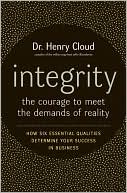
While affirming the crucial importance of the first two characteristics of successful people, Henry Cloud introduces his book, Integrity: The Courage to Meet the Demands of Reality, with the spotlight on character.
The significance of this insight to these times of economic turmoil is huge. I would suggest that it was competent, well-connected professionals who lacked the third essential, character, who got us into this mess. People who could carry out their functions and leverage the systems with spectacular agility, but who did not know for what or for whom (other than themselves) or to what end they worked so hard.
The timing for such a book as this could not be more significant. The value of such a discussion (more…)
Given that denial is one of my favorite coping mechanisms, it might seem odd that I would ever pick up a book about meeting “the demands of reality.”
But here I am. Again.
I feel like I’ve been wrestling with this book, Integrity: The Courage to Meet the Demands of Reality, since it first came out in 2006. It seems that when learning needs to go deeper than simply acquiring new competencies, that time (read years) and practice (read many mistakes) are involved.
Hence the rationale for working through this challenging piece together here on “Thought Leaders Unpacked.”
For many of us there is an unnoticed disconnect between our job performance and our self-understanding. When we think about work, we think about the tasks, responsibilities, goals, processes, and deadlines involved. We don’t have tools for considering how we ourselves might be a part of the problems we are trying to address.
When thinking about ways to help our employees work harder and smarter, we seldom include our own behavior in the mix of factors contributing to their shortcomings, challenges, or motivation levels.
A mirror and a map. Where can we find a mirror that will help us take a look at ourselves? What maps are available to help us navigate a more centered, realistic approach to developing our own character at work?
Join me in conversation each week as I post my reflections on one chapter of Integrity. There is no learning like learning from each other.
Integrity: The Courage to Meet the Demands of Reality
Forward this post to someone you think would benefit from our discussion. Every voice matters.