Karl Edwards presents Working Matters

Tag: coaching

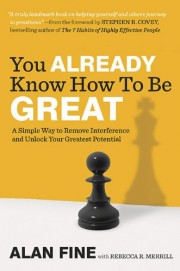
  • You Already Know How to Be Great by Alan Fine with Rebecca Merrill

    I do?

    The assumption Alan Fine’s title makes, You Already Know How to be Great, catches me off guard. And again I ask, “I do?” Because right now there’s a big disconnect between what I’m being told I know and what is actually true of my experience.

    Then comes the subtitle, “A Simple Way to Remove Interference and Unlock Your Greatest Potential.” Ah, so there is something blocking the way that needs removing, and there’s something locked away that needs releasing. Now I’m interested.

    Thus we find our way into a wonderful new resource by Alan Fine and Rebecca Merrill.

    Those of you who know me know I have little patience for coaches and “experts” who claim to have the formula for success. The line of thinking goes something like this, “If only you were different than you are, then you would be successful. We can help you become this entirely other person than you actually are.”

    Even if no consultant is so crass to verbalize it that way, that is the message nonetheless. “You are not enough, and you need our help to become someone else.”

    Enter Fine and Merrill who assert that you are indeed enough. In fact, the way forward has nothing to do with learning to be other than you are, but to be more (more…)

  • American Idol Savvy: Knowing Who You Are

    Idol“You don’t know who you are as an artist.” “You’ve lost your way.”


    Criticism, advice and other forms of feedback are received differently by those who “know who they are” and those who don’t.

    I’m not referring to those who blow off all feedback in order to prove that they are their own best judge. People who don’t listen to feedback are insecure fools merely masquerading as the confident and accomplished.

    Each Idol contestant receives a variety of feedback each week. Criticisms about what didn’t work. Suggestions for improvement. Challenges to stretch or try something new.

    Those who “don’t know who they are” put on the advice like trying on a new costume or mask. As a result their next performances don’t work either. You can tell the “costume” doesn’t fit, and that they clearly are not comfortable wearing it.

    Those who are more comfortable with who they are receive the advice and make it their own. In order to listen carefully these contestants don’t need to adopt indiscriminately.

    It’s the difference between squeezing into a mold, which assumes the mold is the standard and you are what doesn’t quite fit until you incorporate all the given advice, on the one hand. And enhancing your appearance with some make-up and fashion accessories, which assumes that you are the standard and the advice will help you become an even better you, on the other hand.

    How do you receive advice from your elders, mentors, supervisors and others who have words of wisdom they wish to give you? Do you tend toward the extremes: either rejecting all input or conforming to all input?

    How might you listen more carefully without needing to adopt indiscriminately?

  • American Idol Savvy: Coaching From The Sidelines

    IdolThey are known as the judges. Much of the time they evaluate as judges. More and more, though, Simon, Randy, Kara and Ellen are coaching the young singing contestants.

    Judge or coach. Or does it matter?

    Both roles provide good entertainment, which is what the show is about. (See our discussion last week.)

    But as coaching goes, they leave much to be desired. Their primary context for giving constructive feedback is once a week during the show itself. In other words, they are coaching from quite a distance.

    It’s the difference between a soccer coach taking a player aside in order to talk over his or her performance one-on-one, and yelling feedback from the sidelines during the game.

    It’s difficult to understand the long distance coaching in the midst of an intense game. The player’s focus needs to be on the game more than the coaching. The coaching tends to be extremely context-specific; that is, related to the particular moment, decision or action. Such advice can be difficult to integrate into one’s overall improvement strategy.

    Hence the confusion many contestants express about the seemingly contradictory advice they are receiving. They are thinking in terms of their overall strategy. (The big picture.) The judges are commenting on a specific performance. (A much smaller picture.) The two pictures relate intimately, but it can be confusing for a young contestant to sort how how.

    What about your coaching? How do you help people integrate context-specific feedback into their overall improvement strategy? Or do you?

    – Karl

  • Listen In -> Performance Management with Jeff Hunt #2: Managing

    Has it been an entire year since you’ve talked with anyone on your team about their job performance?

    Does it feel a bit awkward to bring up that negative encounter nine months ago?

    Did you miss an opportunity to provide needed resources simply because you didn’t know about the need at the time?

    We are in week 2 of our conversation with Jeff Hunt of Goalspan about performance management, and our topic this week is “managing.”

    After establishing expectations for results having planned, our next step is to establish an on-going conversation about how we work together. Instead of performance management being a single annual event, we are going to make it a process.

    Don’t miss Jeff’s insights into the three components of managing job performance:

    1. Coaching and feedback – Establishing the ongoing conversation.
    2. Supporting learning and development – Providing the resources and training.
    3. Proactively addressing issues as they arise instead of waiting 10 months to the next evaluation.

    What is your process? Do you engage early and often? Do your performance evaluations increase or decrease employee morale, motivation and engagement?

    Listen in.