Karl Edwards presents Working Matters

Author: Karl Edwards

  • Do Others’ Perceptions Matter?

    My clients know I feel strongly about accepting personal responsibility for how others perceive you.

    Check out the research that Liz Strauss shares on the impact perceptions can have on behavior.

    You not only create perceptions by how you choose to behave, but your behavior choices are affected by how you think others already perceive you!

    Are you inadvertently taking your cues from others? Think about it. It’s not a game or a trap. It’s an issue of self-awareness. Can you take a step back and have a look at what’s going on even while you are a participant?

    On your side,

    – Karl

  • Question of the Week

    How would it affect your leadership style if you considered yourself primarily accountable to your staff instead of to your supervisors?

    The Question of the Week is offered to increase awareness of one’s personal leadership practices and encourage experimentation with creative alternatives.
  • School Starts Today… What Else?

    School starts this week here in Los Angeles. Varied summer activities yield to resuming Fall routines.

    Whether or not we have school-age kids of our own, this massive shift in schedule is going on all around us.

    The opportunity lies in riding the wider shift in attitude to give a boost to our own plans. Is there a project you’ve been meaning to begin? Use the team’s return from summer vacations as a launching point.

    Has work effort been flagging? Then use the Fall to regroup and refocus. Has communication been rare? Use the season shift to gather everyone and discuss some important aspect of your work together. Is the office a mess? Schedule a “Back to School Work” day for everyone to get organized.

    If you designed your own “Back to School Work” initiative, what would be its focus?

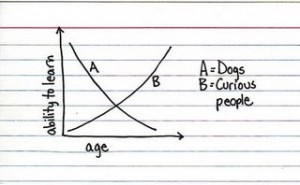
  • Lifelong Learning… Visually

    Always making a case for lifelong learning.

    Indexed

    The entire Indexed site is a must-visit.

  • Question of the Week

    Who on your team just might come alive on the job if they had the opportunity to learn a new skill or develop a professional interest?

    The Question of the Week is offered to increase awareness of one’s personal leadership practices and encourage experimentation with creative alternatives.
  • Listen In -> Uncertainty & Stress #5: Stay Connected to Your Relational Network

    If you were to lose your job, how surprised would your network of acquaintances be to hear from you?

    What if you were already in conversation with a wide circle of people on an on-going basis?

    In our series on Uncertainty and Stress, Claudia and I conclude with a look at the value of maintaining casual relationships.

    No special skills are necessary. No massive investment of time is required. Just you at your most natural, authentic and comfortable self, taking an occasional initiative to check in with those in your circles.

    Talk about something you can do to reduce your own stress levels!

    Listen in.

    powered by ODEO

    Catch up on the entire series on Uncertainty and Stress.

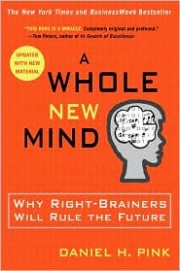
  • A Whole New Mind: Why Right-Brainers Will Rule The Future

    Daniel H. Pink, Riverhead Trade, New York, 2006.

    Whether you’re stronger as a right or left-brained person, I think you’ll find the skills Daniel Pink highlights both insightful and helpful.

    He introduces six “senses” associated with right-brain activity that he believes are key to leadership success in the future. Design, story, symphony, empathy, play, and meaning.

    Whether these skills come to you naturally or not is not the main value of this piece. The more important question is whether or not you are open to learning new ways and means of interacting with others, recognizing and confronting problems, seeing and moving toward the future.

    If so, then Pink’s categories will be a helpful starting point for setting some strategic personal development goals. If not, then be aware that he believes that right-brainers will rule the future!

    Click here for more detailed information.

  • Surviving Uncertainty and Stress

    Uncertainty and Stress

    What’s the most stressful part of hearing rumors of lay-offs? Possibly losing one’s job? Possibly losing a valuable team member? No. Neither actually. It’s the uncertainty.

    Think about it. Uncertainty.

    How will the weak economy affect you? Uncertainty. What will happen at your performance review? Uncertainty. The person who hired you is fired. Uncertainty. An unexpected opportunity presents itself. Uncertainty.

    Give me a defined problem any day. I can face a disaster. I can get help with a problem. I can develop a new skill. I can confront a bully. But please don’t leave me hanging.

    The key to surviving uncertainty is not to beg, bargain or complain, manipulate or manufacture certainty. Certainty is elusive at best and not possible in many instances.

    The key to surviving uncertainty is to identify which choices are in your control and which choices are not. By letting go of the things outside of your control (e.g. the economy, a supervisor’s idiosyncracies, the weaknesses over in the sales department, etc.), you can focus on the things you can control.

    Where do you have control? Ask yourself, “Where can my choices make a difference?”

    You can find new ways to add value and engage more fully with your current position. You can nurture your network of relationships, near and far, so that you have positive connections in a variety of contexts. You can find opportunities to learn new skills and expand current ones, especially skills that are transferable across a variety of fields.

    The negative stress associated with uncertainty will be replaced with a sense of purposefulness and personal power. Though those with more power in the organization may make decisions that complicate your life, you will know that you are doing all you can to be a value-adding team member, a well-connected community member, and an irrepressible transferable skill developer.

    Instead of worrying, you will be ready to make your next decision. Now, that feels good!

    On your side,

    – Karl Edwards

  • Problem-Solving… The Transferable Skill to Beat All Others

    If you want a transferable skill to acquire, expand or hone, problem-solving is your baby.

    What job doesn’t include problems?

    Problems are part and parcel of working life. And the capacity to welcome, confront and work through problems is a core competency you can and should brag about.

    • Welcome problems. Work is comprised of some tough realities. Being able to recognize and embrace these difficulties is part of what gives us energy and satisfaction. We’d be bored without them.
    • Confront problems. We don’t hide from, blame others, or wish away the troubles that arise around us. We go into solution mode. We initiate difficult conversations, go back to the drawing board, and make new choices.
    • Work through problems. We are not content with resolving superficial symptoms. We search for underlying causes, recurring patterns, and structural deficiencies. We are looking for changes that will last.

    An attitude of welcome, an approach of confrontation, and a commitment to see through lasting change.

    Problem-solving. A skill that will serve you well in any position, in any firm, in any field.

    What is your attitude toward, approach to and commitment regarding the problems you face at work?

  • Question of the Week

    What are three recurring problems for which your current “solutions”—for all that they are doing—are not resulting in change?

    The Question of the Week is offered to increase awareness of one’s personal leadership practices and encourage experimentation with creative alternatives.