Karl Edwards presents Working Matters

Tag: vision

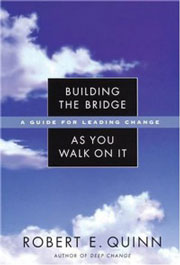
  • Karl’s Library: Building The Bridge As You Walk On It by Robert Quinn

    The perfect metaphor for describing the task of leadership today.

    With constant and rapid change being a decision-making reality, leaders no longer have the luxury of planning for futures that are either predictable or stable for any period of time.

    Robert Quinn was one of the first to address this issue in Building The Bridge As You Walk On It.

    Both visionary and practical Quinn helps us see how we can actively participate in building the future even as it emerges in many ways beyond our control.

    Eight practices characterize the leader who functions in what Quinn indentifies as the “Fundamental State of Leadership”:

    1. Reflective Action
    2. Authentic Engagement
    3. Appreciative Inquiry
    4. Grounded Vision
    5. Adaptive Confidence
    6. Detached Interdependence
    7. Responsible Freedom
    8. Tough Love 

    Each noun and its complementary adjective in the list are carefully chosen and combined.

    I use this book in my “No Excuses WORKout” coaching cohorts, and cannot say enough good things about it.

    Order your copy today.

    Karl’s Library is a weekly column highlighting my favorites from my professional development library. “Always learning” is one of the pillars of my personal mission statement. Explore past columns here.


    If you’re a Kindle fan like I am, it is available for the Kindle.

    Don’t have a Kindle? Get one! You’ll love it.

  • Quote to Consider: Eyes on the Goal

    quote-to-consider“Never look down to test the ground before taking your next step; only he who keeps his eye fixed on the far horizon will find his right road.”

    Dag Hammarskjold

  • Listen In -> Visionary Leadership with Marion Skeete #5: Cultivating a Language for Change

    How does a leader speak boldly without robbing others of their voices?

    Who gets a voice in the conversation of work, leadership, collaboration and the goals of the organization?

    We conclude our series with Marion Skeete of LegacyMakers International with a discussion about how difficult it is for most leaders to surrender their excitement about their own personal ideas in order to pay attention to and incorporate the ideas of the rest of the team.

    How does the leader stand with integrity in the tension between owning their responsibility to show up, engage and lead on the one hand, and showing deep respect for the participation, contribution, and dreams of the wider community on the other?

    Could the leader’s empowerment to lead be woven into how well they empower the community to embrace the stewardship of their own lives?

    How do you view the role of the leader?

    Listen in.

    Just now joining the conversation? Catch up on the entire series here.
  • Listen In -> Visionary Leadership with Marion Skeete #4: Respecting and Involving People

    Is the leader so ordained because she is better, smarter, more knowledgeable, better in any way than everyone else on the team or in the community?

    Does following a leader involve turning off our brains and compliantly doing what we are told?

    Is the leader the author of a vision that emerges from his or her own imagination? Or is the leader the servant of a vision that emerges from the unfolding story of the community?

    In week 4 of our series on Visionary Leadership with Marion Skeete our discussion turns to the voices that are and are not included in the conversation about where we are going and how we do things.

    Could it be arrogant and inappropriate for the leader to assume that anyone who cannot get on board with the leader’s vision is better off not being in the community or organization at all?

    If you feel like you’re on the outside of your organization looking in, then this show is for you.

    Listen in.

    Just now joining the conversation? Catch up on the entire series here.
  • Listen In -> Visionary Leadership with Marion Skeete #3: Inspiring and Catalyzing Change

    Are you as tired as I am of hearing leaders complain about resistance to change?!

    The leader is always right and the people are always wrong. It’s the leader’s job to effect change by bringing the people running gratefully out of their “wrong” and into the leader’s “right.”

    Anyone who voices any practical or conceptual problem with the leader’s vision is labeled, “resistant to change.” It’s as if the story was about the leader!

    Enter Marion Skeete of LegacyMakers International for week three of our discussion on Visionary Leadership.

    What if the story, in fact, belonged to the community?

    What if the unfolding future was comprised of the real life unfolding stories of the individuals, families, teams and organizations that leaders serve?

    What if the only conversations about the future that might really result in change were those conversations that included the people who were themselves maturing into those changes?

    Vision would not be something dreamed up by the leader in isolation and announced one day, but something already transpiring that the leader observes and articulates in such a way that helps the community interact, engage, and embrace.

    What if catalyzing change involved nurturing an already existing ember, rather than pouring fuel on a damp wood and striking a match?

    Listen in.

    Just now joining the conversation? Catch up on the entire series here.
  • The Visionary Leader: Captain or Mid-Wife?

    I find myself rethinking vision and leadership.

    Who do you know who seems to see what no one else sees? Not because no one else has eyes, but because no one else is looking.

    Visionary leadership is not about seeing something entirely new as much as it is about seeing what is already there unfolding in a way no one else yet expects. Just as our brains filter out most of the visual data in our field of vision so that we can pay attention to what is most important, so in our busy and complex lives many of us may not be able to see what is unfolding right in front of us.

    The visionary leader is more rarely the source of brand new ideas. She or he is rather the highly aware and deeply reflective one for whom all persons, events, stories, dynamics, and trends are precious and meaning-laden data.

    What distinguishes the visionary is the capacity to interpret this flood of information from a variety of vantage points. It is as if he or she is rearranging the tiles in a mosaic so that entirely different pictures emerge than the otherwise obvious one that everyone up until that point had been convinced was the only one.

    What we encounter in many hierarchical organizations are positional leaders who aspire to be perceived as visionaries. (A common cultural bias.) They consequently “do vision” out of their hierarchical frame of reference, which is to act as the primary idea generator, strategy definer, and program creator.

    The significance of distinguishing the personal skill from the organizational position lies in the very real possibility that the visionary leaders in your organization may not be the positional leaders. They may not even be on your radar screen. But they are there. Observant, reflective and influential.

    Think about it. Think through the people on your team. Think through people in other departments. What if someone in the accounting department could see in the numbers new possibilities for how you went about your work which you couldn’t see from your vantage point in operations? What if your receptionist understood your clients’ needs better from his or her perspective of helping than your marketing team could from their perspective of selling?

    And who has eyes and ears integrated enough with their heart and mind to watch these dynamics on a number of fronts and across a spectrum of personalities, roles, functions and processes? What kind of person does it take to see what ideas, directions and connections might be unfolding in enough time to participate in their emergence?

    Maybe “mid-wife” would serve as a better metaphor for visionary leader than “captain.” I wonder.

    What do you think?

    I think the emerging mosaic deepens and sharpens a bit more.

    This article flows out of recent conversations with Marion Skeete of LegacyMakers International. (These recordings are available on our web site and on iTunes.)
    As conversation always enriches and challenges, I find myself here needing to pause, reflect and adjust my conceptions of visionary leadership in light of my discussions with Marion.

    On your side

    – Karl Edwards
  • Listen In -> Visionary Leadership with Marion Skeete #2: Thinking Outside the Box

    How does a visionary leader communicate the “new thing” she or he sees when no one else sees it yet?

    And what if this new thing is something this leader is merely observing emerge from within the community she or he leads?

    In other words, how does one think outside of the box when much of the thinking is being done by others?

    In this week’s show, Marion Skeete of LegacyMakers International and I discuss how visionary leaders help “the story” of the community unfold and emerge.

    The story does not merely start over every time a power and control-based leader gets a new idea and starts shouting orders.

    Hence the importance of the empowering, listening visionary leader who can articulate where the story of the community needs to go next in terms of where the story of the community has been so far.

    Newness out of the old. A future integrated with the past. A maturing, developing, unfolding process of change.

    Listen in.

    Just now joining the conversation? Catch up on the entire series here.
  • Listen In -> Visionary Leadership with Marion Skeete #1: Rethinking the Role and Responsibility

    There’s a lot of talk about leadership but not many leaders are making much of a difference.

    Stuck within paradigms based on power and prestige, leaders are at best recycling the latest fad or at worst resorting to fear-based patterns of conquest and control.

    Enter our guest, Marion Skeete, for a new discussion series on Visionary Leadership.

    Marion Skeete is the founder and president of LegacyMakers International, a movement committed to empowering leaders to influence their community and culture.

    Join Marion and I as we rethink leadership in terms of helping people see a future that is both of their own creation and within reach.

    The maps that we have relied on to get us where we are today may not be sufficient for the journey ahead. Hence the value and importance of visionary leaders to help us articulate new ways of seeing, speaking about and maturing into a different and better future.

    We don’t need new commanders-in-chief who pretend to know where we, the people, need to go; but thoughtful, serving leaders who will empower us to step into the futures that we want to build for ourselves and our families.

    Visionary Leadership with Marion Skeete
    Week #1:  Rethinking the Role and Responsibility
    Week #2:  Thinking Outside the Box
    Week #3:  Inspiring and Catalyzing Change
    Week #4:  Respecting and Involving People
    Week #5:  Cultivating a Language for Change

    Listen in.

  • No Teasing Whore, This Angel

    Inhaling deep wafts of the morning mist, I push my way into the day—that now familiar mix of courage and impotence coloring each step.

    Foreign are the airs of confidence and self assurance that others seem to wear so effortlessly. But I press forward. Destiny’s beckoning promise continues to visit in the night, dancing gracefully along the horizon of my imagination. My appreciation for this encouraging angel erases every suggestion that she is but a teasing whore.

    I am different. I am different for a reason. I am different because I have something to do. I have something I must do.

    First published in Nuance Alley, April 2004.
  • Listen In -> Influencing Others #2: Clarity and Buy-in to the Mission

    The key to effective accountability is not threats or sanctions, but a clear vision of the future.

    Who you are, why you exist, where you are going and how you intend to get there as an organization.

    Of course, having a clear organizational mission is helpful only to the extent you have buy-in from the rest of the team. We need our teams to pour their hearts and souls into the effort, not merely rent us their hands and feet.

    In this week’s podcast conversation, Claudia and I discuss the power and importance of these two crucial aspects of your organization’s mission: clarity and buy-in.

    Listen in.

    powered by ODEO