Karl Edwards presents Working Matters

Tag: self-sabotage

  • Loving Monday: Wishing You Were More

    loving_monday

    Have  you ever thought that you should be more than you are? More experienced, more skilled, more relational, more organized, etc.?

    Our hiring practices can lead us to believe that there are ideal people out there somewhere. And we mistakenly conclude that we are not one of them.

    We compare diverse, complex individuals against our idealized preferences as laid out in a depersonalized list of job responsibilities, qualifications, and characteristics.

    (We’ll leave the disasters and complications that such a process creates for the hiring process for another article.)

    For today, though, I want to look at how we inadvertently buy into and compare ourselves with these idealized myths of the omni-competent professional.

    Well of course we always come up short against such an unfair and unrealistic comparison.

    Many of us react by thinking we should be other than we are… more than we are. We think we are lacking in some regard, deficient, or inadequate.

    The result of such thinking is disastrous.

    Once we believe that we are not enough or wish that we were more than we are, we begin behaving accordingly. We sabotage our own well-earned giftedness, (more…)


  • Listen In -> Lies and Myths We Believe About Work #1: How We Cooperate In Our Own Diminishment

    More frustrating than almost any other professional obstacle are the obstacles we create for ourselves. This week Claudia and I begin a new podcast discussion series looking at several common “truths” of working life and discuss how they are, in fact, LIES.

    Not only are they lies, but we end up sabotaging our own professional well-being by acting as if they were true.

    I wrote about these lies in a recent Loving Monday column. (Read “Empowered by Identifying the Lies” here.) So insidious and persistent is the extent to which we have bought into these lies that we thought it warranted a full discussion series.

    What is most troubling about these lies is that we participate in our own diminishment by believing them. We have no one to blame but ourselves.

    We obey an entire set of unspoken rules without anyone asking us to, without any job description delineating them, and without any policy demanding that we do.

    Lies and Myths We Believe About Work

    Week #1: How We Cooperate In Our Own Diminishment
    Week #2: You Don’t Have What It Takes
    Week #3: You Have to Prove Yourself First
    Week #4: Hard Work Will Be Rewarded
    Week #5: Making Waves is Making Trouble

    Which of these lies do you find most persuasive? Join the conversation.

    Listen in.

  • Listen In -> Avoiding Success. Four Fears That Hold Us Back #5: Fear of Not Being Liked

    More painful for the new leader than probably anything else is being unpopular.

    Accepting a promotion would involve choosing to put myself in this awkward place vis-a-vis my team where my decisions might evoke negative reactions.

    The promotion is attractive because I anticipate being successful, making good decisions, and being enthusiastically appreciated for doing so.

    And yet, deep within, we know reality is not so simple. Reality is that we cannot please everyone.

    A wise question to ask oneself is how will one respond to the negative reactions, both those with substance and those without.

    More germane to this week’s discussion, though, is asking whether you are avoiding the responsibility of leadership in order to avoid the unpopularity that often goes along with it?

    Listen in.

    Just now joining the conversation? Catch up on the entire series here.
  • Listen In -> Avoiding Success. Four Fears That Hold Us Back #4: Fear of Harm

    “They’re looking for a fall guy. I’m going to be given the responsibility of turning around the division without the necessary resources and support and then blamed for not fixing what they prefer would stay broken.”

    The third ordinary fear that we try to mask when avoiding success is the fear that we are being used or taken advantage of.

    Exploitation is a management reality. It happens. We use our executives. We take the credit when they perform and point the finger when they fail. I’m not excusing the practice. But it takes place. To deny it is both foolish and dangerous.

    We can choose to step into that reality and treat it as one of many challenges to be faced, or we can avoid that reality and protect ourselves from being harmed.

    The problem with going through our careers protecting ourselves from harm, is that we also protect ourselves from opportunities. In this week’s show, Claudia and I look at how fear of being harmed becomes an excuse for some to avoid new professional challenges. What about for you?

    Listen in.

    Just now joining the conversation? Catch up on the entire series here.
  • If The Future Hung on a Word

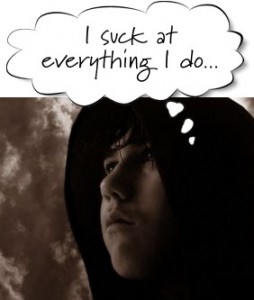
    self-talkWhat feelings does this picture stir?

    Reflect for a moment before reading on.

    Words matter.

    Even words to ourselves.

    Especially words to ourselves.

    We tend to underestimate the power of words. We casually throw out phrases like, “I’m a klutz” or “I’m bad with names” or “I’m just an average Joe or a plain Jane.” We aren’t totally serious in one sense, but in another we are expressing some inner dis-ease we are feeling.

    Before going into how such talk might not be serving us well, I want to affirm that the feelings, experiences, and beliefs about ourselves that underlie much of our negative self-talk are very real. I do not want to minimize or invalidate the reality of those feelings, experiences or beliefs in the least.

    We do ourselves two disservices, though, when we are not gracious with our self-talk. We buy into a lie, and we let ourselves off the hook.

    First, we buy into a lie—a false frame of reference that is (more…)

  • American Idol Savvy: Simon Dilutes His Brand

    IdolSimon Cowell is sabotaging his own distinct brand.

    Known for his direct but not always sensitive feedback, Simon is increasing his air time with additional antics that are coming at the expense of this powerful “brand.”

    His inability to resist throwing barbs while the other judges (particularly Paula) are talking, has the effect of diluting what we like best about Simon… his withering critiques of the contestants.

    (All right, his homo-ambiguous sparring with Ryan Seacrest is becoming an Idol staple. But this is the exception that proves the rule.)

    The proof comes when Simon wants to give positive feedback. It gets diluted, if not entirely lost. Watch for this.

    Disastrous for Simon, in my mind. There’s a lot of power in his positive responses precisely because they are so rare and (previously) so focused. Is he forfeiting his power to influence?

    What are your brand distinctives? Are they getting lost by trying to be too many things to too many people? Is it time to refocus, get back to basics, or cut out the side shows? What power are you forfeiting when you dilute your brand?

  • Question of the Week

    Who on the team steps in and covers for others’ unfinished work, poor quality, mistakes, and failures? How might you reward and/or cover for them?

    The Question of the Week is offered to increase awareness of one’s personal leadership practices and encourage experimentation with creative alternatives.
  • Listen In -> When Playing by the Rules Backfires #3: The Peacekeeper

    Some scenarios never change. Your boss who explodes at any hint of disagreement. Your co-worker who complains at the slightest inconvenience. Your client who goes over your head every time they want a schedule change.

    In this week’s podcast conversation, Claudia and I look at The Peacekeeper. In this version of playing by the rules, our protagonist (you?) goes out of his or her way to accommodate, pacify or otherwise head off the unpleasant behaviors of others.

    While on the surface admirable to keep things cool and running smoothly, the question for you is, at what cost?

    Are you inadvertently diminishing yourself, compromising your own job performance or sacrificing what you know is best in order to prevent someone else behaving like a child? How did that become your responsibility? Did anyone force you to take that role? Could it be that your noble-feeling peacekeeping could be backfiring on you?

    Listen in.

  • When Loyalty Turns Naive

    We’re discussing The Silent Achiever this week. We’re looking at the person who trusts the system to reward his or her performance according to company policy.

    I regularly emphasize self-awareness, because, more often than not, when we feel betrayed by the system it is our own naivety and/or blindness that got us into the position where others can exploit or harm us.

    Let me clarify that I am not blaming the victim here. I am trying to empower those for whom their heightened sense of loyalty and cooperation leads them to trust where trust is not due and who then find themselves overlooked or taken advantage of yet again.

    While systems are designed to be fair in principle, in practice there are a host of complications. Busy supervisors often aren’t aware of your efforts. Ambitious co-workers talk themselves up every chance they get. In these situations, your quiet loyalty has the opposite effect that you intend.

    What you need are ways to keep yourself in your supervisor’s range of vision. Stop by her or his office occasionally to share a bit of news about something you’re working on. Pass along interesting news clips related to your company. Have a weekly, “Thought you’d like to know…” that you use to keep him or her informed. Speak up in meetings, even if just to make a passing comment like, “Good point,” or ask a question.

    Instead of silently cursing the unfair system while congratulating ourselves for our quiet cooperativeness, let’s work on finding more visible expressions of our commitment and loyalty.

    What’s one new way you might show up more visibly? (Without, of course, morphing into the obnoxious co-worker whose form of self-promotion offends you so.)

    On your side,

    – Karl

  • Listen In -> When Playing by the Rules Backfires #2: The Silent Achiever

    You’re convinced the promotion will be yours. After all, you’ve been playing by the rules.

    In this week’s podcast conversation, Claudia and I discuss The Silent Achiever. This person trusts the company processes, procedures and structures. Not ones to brashly draw attention to themselves, they believe their performance will speak for itself.

    They are meeting their goals… exceeding expectations even. They put in extra hours, help others and never questions their boss’s demands.

    How could such exemplary performance possibly backfire? Why are so many silent achievers shocked and dismayed when the promotion keeps going to someone else?

    Listen in. Where do you too naively trust the system to be fair?